
nightguardian / laravel

Laravel SDK for NightGuardian: self-hosted error and health monitoring that never slows down or breaks your app.
Requires
- php: ^8.1
- ext-curl: *
- ext-json: *
- ext-zlib: *
- illuminate/cache: ^9.0|^10.0|^11.0|^12.0|^13.0
- illuminate/console: ^9.0|^10.0|^11.0|^12.0|^13.0
- illuminate/contracts: ^9.0|^10.0|^11.0|^12.0|^13.0
- illuminate/http: ^9.0|^10.0|^11.0|^12.0|^13.0
- illuminate/log: ^9.0|^10.0|^11.0|^12.0|^13.0
- illuminate/queue: ^9.0|^10.0|^11.0|^12.0|^13.0
- illuminate/routing: ^9.0|^10.0|^11.0|^12.0|^13.0
- illuminate/support: ^9.0|^10.0|^11.0|^12.0|^13.0
- illuminate/view: ^9.0|^10.0|^11.0|^12.0|^13.0
Requires (Dev)
- larastan/larastan: ^2.9|^3.0
- laravel/pint: ^1.13
- opis/json-schema: ^2.3
- orchestra/testbench: ^7.0|^8.0|^9.0|^10.0|^11.0
- pestphp/pest: ^1.23|^2.0|^3.0|^4.0
- pestphp/pest-plugin-laravel: ^1.4|^2.0|^3.0|^4.0
Suggests
None
Provides
None
Conflicts
None
Replaces
None
README

nightguardian.com.ar · Live demo
Official Laravel SDK for NightGuardian — self-hosted, open source error & health monitoring.
Español · Configuration · How it works · Compatibility
- Laravel 5.8 → 13. One package name, two release lines (1.x and 2.x); Composer picks the right one.
- Zero dependencies beyond Laravel itself (uses ext-curl). No Guzzle version conflicts.
- Never slows down or breaks your app. Sends after the response, 2 s timeout, circuit breaker, on-disk queue when the collector is unreachable. No queue worker or cron required.
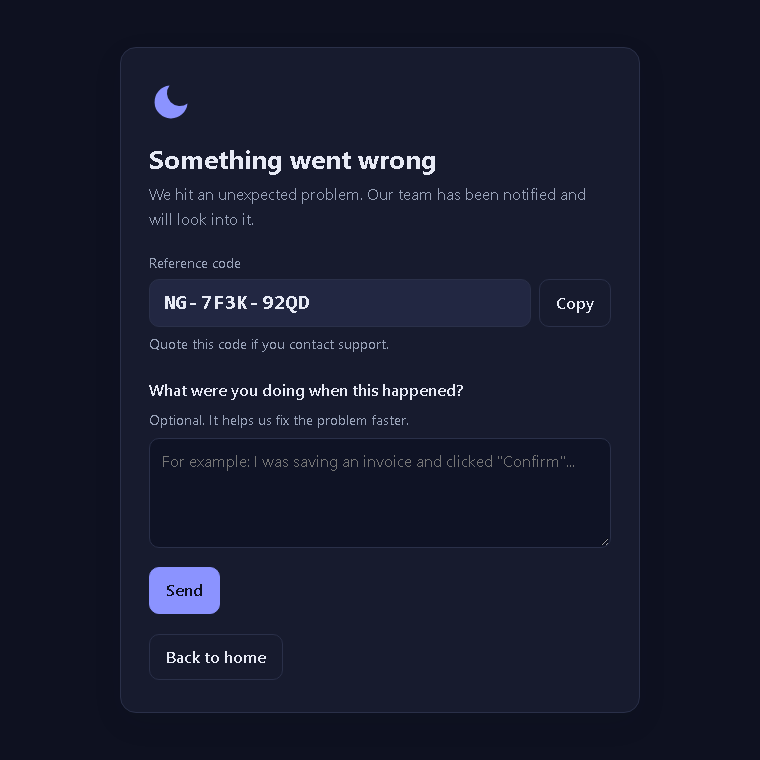
- Friendly error page with a reference code and an optional "what were you doing?" box.
- Private by default. Passwords, tokens, cookies and auth headers never leave your server.
Install
composer require nightguardian/laravel
NIGHTGUARDIAN_URL=https://nightguardian.example.com
NIGHTGUARDIAN_TOKEN=          # create it in your collector: Project → Tokens
php artisan nightguardian:test
Laravel's package auto-discovery registers everything. Publishing the config is optional:
php artisan vendor:publish --tag=nightguardian-config.
What gets captured
| Default | |
|---|---|
| Unhandled exceptions | ✅ |
Log::error() and above |
✅ (NIGHTGUARDIAN_LOG_LEVEL) |
| Failed queued jobs | ✅ |
| Failed scheduled tasks | ✅ |
| Slow requests (> 2 s) | ✅ (NIGHTGUARDIAN_SLOW_REQUEST_MS, 0 = off) |
| Slow queries (> 1 s) | ✅ (NIGHTGUARDIAN_SLOW_QUERY_MS, 0 = off) |
| Deploy markers | php artisan nightguardian:deploy in your deploy script |
Report manually:
use NightGuardian\Laravel\Facades\NightGuardian;

NightGuardian::report($exception, ['invoice' => $invoice->id]);
NightGuardian::message('Payment gateway answered late', 'warning', ['gateway' => 'mp']);
Commands
| Command | |
|---|---|
nightguardian:setup |
Writes the URL and token to .env, checks the connection |
nightguardian:test |
Sends a test event and shows the collector's answer |
nightguardian:status |
Config check, spool size, circuit breaker state |
nightguardian:flush |
Sends everything waiting in the spool now |
nightguardian:deploy |
Records a deploy (release, commit, branch) |
One app, many installations
A SaaS where every customer runs its own copy of the same app (one folder, one .env, one domain each) is the same code
reporting the same bugs from many places. Choose how the collector should see them:
| A. One shared token | B. One token per installation | |
|---|---|---|
| Collector | one project | one project per installation |
| The same bug in 30 installations | one issue (30× the events) | 30 issues, one in each project |
| Where does it happen? | the panel lists the affected hosts | the project is the installation |
| Alerts | once per new bug | once per installation |
| Access control | everybody sees everything | give each team or customer only its project |
| Retention, rate limit, tokens | shared | independent |
Pick A when you own and operate the app and want to fix bugs once: you care about what breaks and how widely. Pick B when installations are operated or paid for separately, customers may see their own project, or one noisy installation must never hide or rate-limit the others.
Every event carries a host tag automatically: the host of APP_URL (e.g. yapai.head-office.com.ar), also on jobs, the
scheduler and logs. It is what lets model A tell the installations apart. Set NIGHTGUARDIAN_HOST_TAG=false to turn it
off; a host tag you set yourself (in config/nightguardian.php → tags, or per event) is always respected. Make sure every
installation has its own APP_URL.
Connect an installation
php artisan nightguardian:setup --url=https://ng.example.com --token=ng_...
Without options it asks for the URL and the token (hidden). It checks the token starts with ng_ and the URL is https://
(plain http:// only warns), writes NIGHTGUARDIAN_URL and NIGHTGUARDIAN_TOKEN to the .env (the rest of the file,
its permissions and its owner are untouched), caches the configuration again if it was cached, and sends a test event
(skip it with --no-test). It never prints the token, can be run again safely and exits with an error code if anything fails.
Many installations on one server
Run it as the user that owns each .env so the files keep their owner. Model A (one shared token):
read -rsp "Project token: " TOKEN; echo
for app in /var/www/customer-*/; do
  echo "== $app"
  (cd "$app" && sudo -u www-data php8.3 artisan nightguardian:setup --url=https://ng.example.com --token="$TOKEN") || echo "FAILED: $app"
done
unset TOKEN
Model B (a token per installation, asked one by one):
for app in /var/www/customer-*/; do
  read -rsp "Token for $(basename "$app"): " TOKEN; echo
  (cd "$app" && sudo -u www-data php8.3 artisan nightguardian:setup --url=https://ng.example.com --token="$TOKEN") || echo "FAILED: $app"
done
unset TOKEN
The token is briefly visible in the process list while each command runs; on a shared server prefer typing it when the command asks for it.
Friendly error page
When an unexpected error ends in a 500 on an HTML request and APP_DEBUG=false, visitors see a small,
self-contained page (inline CSS, no external assets, light and dark mode, English and Spanish) with a
reference code like NG-7F3K-92QD and an optional "what were you doing?" box. The same code is attached to the
event in your panel, so a user can quote it to support and you find the exact error in seconds.
| Light | Dark |
|---|---|
 |
 |
- It only replaces the response for errors NightGuardian captured; ignored exceptions, client errors and everything
else keep your application's own pages. JSON requests are never changed, they only get an
X-NightGuardian-Referenceheader. - The comment arrives in the panel as feedback, linked to the original event. The thank-you page tells the truth: sent when the collector accepted it, recorded when it was queued on disk because the collector is unreachable.
- The feedback route has no session, cookies or CSRF token (the session may be what is broken). It is protected by a signed, 15-minute form token and a limit of 5 messages per minute per IP.
- Turn it off with
NIGHTGUARDIAN_ERROR_PAGE=falseor hide the box withNIGHTGUARDIAN_FEEDBACK=false. Customise the texts and the view withphp artisan vendor:publish --tag=nightguardian-views/--tag=nightguardian-lang.
Performance
NightGuardian never works before your response is ready: events are buffered in memory and sent when the request terminates, with a 1 s connect and 2 s total timeout. After a failure a circuit breaker stops further attempts for 60 s (doubling up to 15 min) and events wait in an on-disk spool, so a collector outage costs your requests ~0.
One caveat depends on how PHP runs:
- PHP-FPM (recommended): the response is flushed to the browser before the SDK sends anything
(
fastcgi_finish_request). Visitors never wait, even when the collector is down. mod_php(Apache without PHP-FPM, e.g. a default Laragon setup): PHP cannot release the connection early. The first time the collector is down, the browser may wait up to ~1 s longer (the connect timeout) before the request completes. The circuit breaker then opens and the following requests are not delayed. If that matters, lowerNIGHTGUARDIAN_CONNECT_TIMEOUTor switch to PHP-FPM.
Versions
| Laravel | PHP | SDK line |
|---|---|---|
| 9 – 13 | 8.1+ | ^2.0 |
| 5.8 – 8 | 7.1.3 – 8.1 | ^1.0 |
Contributing
PRs welcome! Read CONTRIBUTING.md. The wire protocol lives in the collector repo: protocol v1.
MIT © Pablo Zagni and contributors.