
jeffersongoncalves / laravel-oidc

OpenID Connect for Laravel via a custom Socialite driver. Multi-tenant ready.
Package info
github.com/jeffersongoncalves/laravel-oidc
pkg:composer/jeffersongoncalves/laravel-oidc
Requires
- php: ^8.2
- firebase/php-jwt: ^7.0
- guzzlehttp/guzzle: ^7.8|^8.2
- illuminate/contracts: ^11.0|^12.0|^13.0
- illuminate/support: ^11.0|^12.0|^13.0
- laravel/socialite: ^5.10
- spatie/laravel-package-tools: ^1.16
Requires (Dev)
- larastan/larastan: ^3.0
- laravel/pint: ^1.18
- orchestra/testbench: ^9.0|^10.0|^11.0
- pestphp/pest: ^3.7|^4.0
- pestphp/pest-plugin-laravel: ^3.0|^4.0
- phpstan/phpstan: ^2.0
Suggests
None
Provides
None
Conflicts
None
Replaces
None
This package is auto-updated.
Last update: 2026-10-07 16:34:00 UTC
README
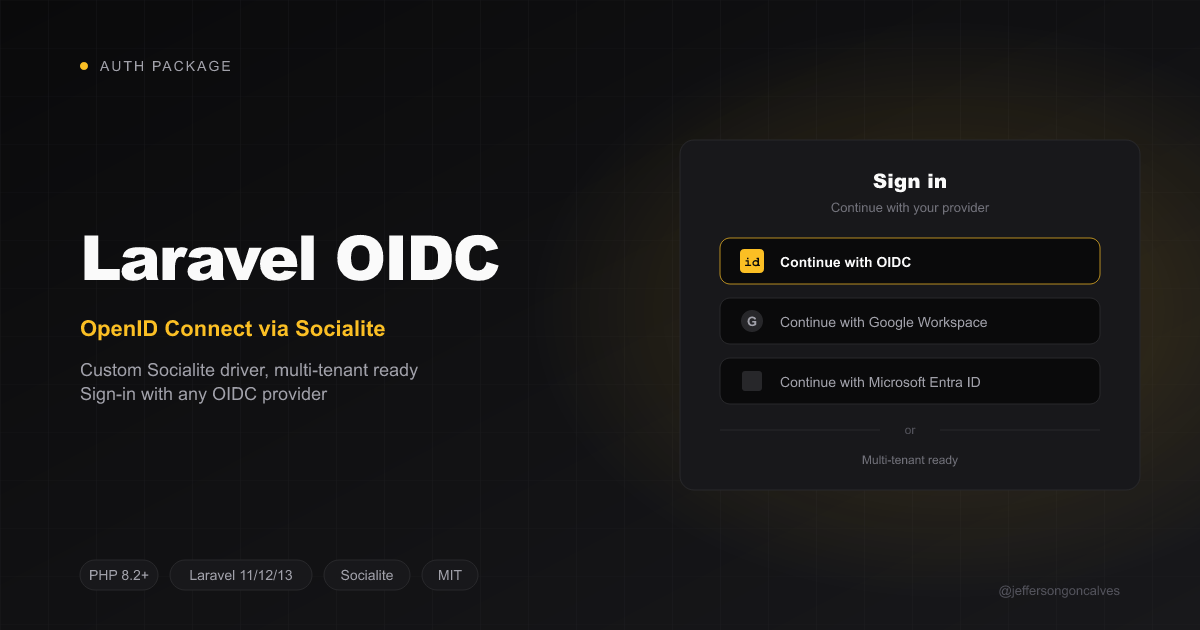
Laravel OIDC
Laravel OIDC adds first-class OpenID Connect support to Laravel by registering a custom
Laravel Socialite driver named oidc. Unlike vanilla
Socialite — which covers OAuth 2.0 but stops at the userinfo step — this package implements
the OIDC pieces Socialite leaves out: discovery (/.well-known/openid-configuration),
JWKS-based id_token validation, nonce-based replay protection, and PKCE.
It is designed for multi-tenant SaaS: configuration is supplied at runtime, so each tenant can connect its own Azure AD, Okta, Auth0, Google Workspace, Keycloak, or any other spec-compliant OpenID Provider.
Compatibility
| Package | Laravel | PHP |
|---|---|---|
| 1.x | 11.x, 12.x, 13.x | 8.2, 8.3, 8.4 |
Why?
Laravel Socialite ships drivers for fixed providers (GitHub, Google, etc.) and a small set of OAuth 2.0 helpers. It does not:
- Read the IdP's
.well-known/openid-configurationdiscovery document. - Validate the
id_tokenJWT against the IdP's JWKS. - Send and verify a
nonceto mitigate replay attacks. - Make per-request configuration easy in multi-tenant scenarios.
This package adds those pieces while staying inside the Socialite mental model: you still
call Socialite::driver('oidc')->redirect() and ->user().
Installation
composer require jeffersongoncalves/laravel-oidc
Optionally publish the config file:
php artisan vendor:publish --tag="oidc-config"
Configuration
The package works out of the box. For single-tenant apps, set the default IdP in .env:
OIDC_ISSUER_URL=https://login.microsoftonline.com/{tenant-id}/v2.0
OIDC_CLIENT_ID=your-app-client-id
OIDC_CLIENT_SECRET=your-app-secret
OIDC_REDIRECT_URI=https://your-app.test/sso/callback
For multi-tenant apps, leave the default block empty and supply an OidcConfig at runtime
(see below).
JWT verification
The package accepts only the algorithms listed in oidc.jwt.allowed_algorithms. If a trusted
identity provider publishes JWKS keys without an alg parameter, configure a default algorithm
that is also present in that allow-list:
'jwt' => [
    'allowed_algorithms' => ['RS256', 'RS384', 'RS512', 'ES256', 'ES384'],
    'default_algorithm' => 'RS256',
],
Leave default_algorithm set to null unless your identity provider requires it. The default
does not expand the allow-list, so a value that is not allowed is ignored.
Usage
Single-tenant (config from .env)
use Laravel\Socialite\Facades\Socialite;

Route::get('/sso/redirect', fn () => Socialite::driver('oidc')->redirect());

Route::get('/sso/callback', function () {
    $user = Socialite::driver('oidc')->user();

    // $user->id            // sub claim
    // $user->email
    // $user->name
    // $user->token         // access_token
    // $user->idToken       // raw id_token JWT
    // $user->idTokenClaims // decoded + validated claims
});
Multi-tenant (runtime config)
use Laravel\Socialite\Facades\Socialite;
use JeffersonGoncalves\LaravelOidc\Data\OidcConfig;

$config = new OidcConfig(
    issuerUrl: $tenant->issuer_url,
    clientId: $tenant->client_id,
    clientSecret: $tenant->client_secret,
    redirectUri: route('sso.callback'),
    scopes: ['openid', 'email', 'profile'],
);

return Socialite::driver('oidc')
    ->setConfig($config)
    ->redirect();
On callback:
$oidcUser = Socialite::driver('oidc')
    ->setConfig($config)
    ->user();
HasOidcConfig trait for tenant models
If you store IdP configuration on a model (a typical multi-tenant pattern), drop in the
trait. It expects columns issuer_url, client_id, client_secret (cast to encrypted),
redirect_uri, and an optional scopes JSON column.
use JeffersonGoncalves\LaravelOidc\Concerns\HasOidcConfig;

class SsoConnection extends Model
{
    use HasOidcConfig;
}

Socialite::driver('oidc')
    ->setConfig($ssoConnection->toOidcConfig())
    ->redirect();
Non-standard claim names
Some providers expose user data under non-standard claims (e.g. mail instead of email).
Map any of the five user fields (id, nickname, name, email, avatar) to the claim
that holds it — unmapped fields keep the standard OIDC claims (sub, preferred_username,
name, email, picture):
// config/oidc.php, "default" block
'user_field_mappings' => [
    'email' => 'mail',
],
Or at runtime:
$config = new OidcConfig(
    issuerUrl: $tenant->issuer_url,
    clientId: $tenant->client_id,
    clientSecret: $tenant->client_secret,
    redirectUri: route('sso.callback'),
    userFieldMappings: ['email' => 'mail'],
);
Models using HasOidcConfig can store the same map in an optional user_field_mappings
JSON column.
Linking users to OIDC identities (optional)
The package ships an optional OidcIdentity model that maps any authenticatable to its
OIDC identities (unique per issuer + subject), storing claims and tokens. Publish and
run the migration:
php artisan vendor:publish --tag="oidc-migrations"
php artisan migrate
Add the trait to your user model:
use JeffersonGoncalves\LaravelOidc\Concerns\HasOidcIdentities;

class User extends Authenticatable
{
    use HasOidcIdentities;
}

$user->oidcIdentities()->updateOrCreate(
    ['issuer' => $oidcUser->idTokenClaims['iss'], 'subject' => $oidcUser->getId()],
    ['email' => $oidcUser->getEmail(), 'claims' => $oidcUser->idTokenClaims],
);
The table name is configurable via oidc.identities_table. Tokens are hidden from
serialization.
Discovery without Socialite
use JeffersonGoncalves\LaravelOidc\Facades\Oidc;

$discovery = Oidc::discover('https://login.microsoftonline.com/{tenant-id}/v2.0');

$discovery->authorizationEndpoint;
$discovery->tokenEndpoint;
$discovery->userinfoEndpoint;
$discovery->jwksUri;
$discovery->issuer;
Supported Identity Providers
Any IdP that publishes a .well-known/openid-configuration discovery document and signs
id_tokens with one of the allowed algorithms (RS256, RS384, RS512, ES256, ES384)
will work. Examples:
| IdP | Issuer URL example |
|---|---|
| Azure AD / Entra ID | https://login.microsoftonline.com/{tenant-id}/v2.0 |
| Google Workspace | https://accounts.google.com |
| Okta | https://{your-org}.okta.com |
| Auth0 | https://{your-tenant}.auth0.com/ |
| Keycloak | https://{host}/realms/{realm} |
| Ping Identity | https://{environment}.pingone.com/{environment-id}/as |
Security
id_tokenvalidation. Everyid_tokenis decoded against the IdP's JWKS usingfirebase/php-jwt. Theiss,aud,exp, andiatclaims are checked, with a configurable clock-skew window.- Algorithm allow-list. Only the algorithms in
oidc.jwt.allowed_algorithmsare accepted. Symmetric algorithms (HS256& friends) are intentionally absent — accepting them with a JWKS would enable trivial key-confusion attacks. - Replay protection. A random
nonceis generated, stored in the session, and verified against thenonceclaim in the returnedid_token. - PKCE. Enabled by default with
S256. Disable per request withnew OidcConfig(..., usePkce: false). - Caching. The discovery document is cached for 1 hour and the JWKS for 6 hours by
default; both TTLs are configurable. Use
Oidc::clearCache($issuer)to invalidate after a key rotation.
Testing
composer test
Changelog
Please see CHANGELOG for more information on what has changed recently.
Contributing
Pull requests are welcome. Please make sure tests, PHPStan and Pint all pass before opening a PR:
composer test
composer analyse
composer format
Security Vulnerabilities
Please review our security policy on how to report security vulnerabilities.
Credits
License
The MIT License (MIT). Please see License File for more information.