
waynestate / helmet

Wayne State's baseline runtime: security headers, session hardening, trusted proxies, a health check and structured logs for web apps.
Requires
- php: ^8.3
- monolog/monolog: ^3.0
- paragonie/csp-builder: ^3.1
- promphp/prometheus_client_php: ^2.15
- psr/http-factory: ^1.0
- psr/http-message: ^2.0
- psr/http-server-middleware: ^1.0
- symfony/http-foundation: ^7.4
Requires (Dev)
- laravel/pint: ^1.32
- league/commonmark: ^2.10
- nyholm/psr7: ^1.8
- orchestra/testbench: ^10.0 || ^11.0
- phpstan/phpstan: ^2.1
- phpunit/phpunit: ^11.5
- waynestate/advisor: ^0.3
- waynestate/pinstripe: ^0.3
Suggests
- laravel/framework: For the Laravel adapter (step 2)
- waynestate/advisor: ADVISOR module: lets your coding agent read helmet_headers and helmet_php_support, read-only.
- waynestate/playbook: WSU's shared values (CAS, Entra, gateway); private, git.wayne.edu
Provides
None
Conflicts
None
Replaces
None
README
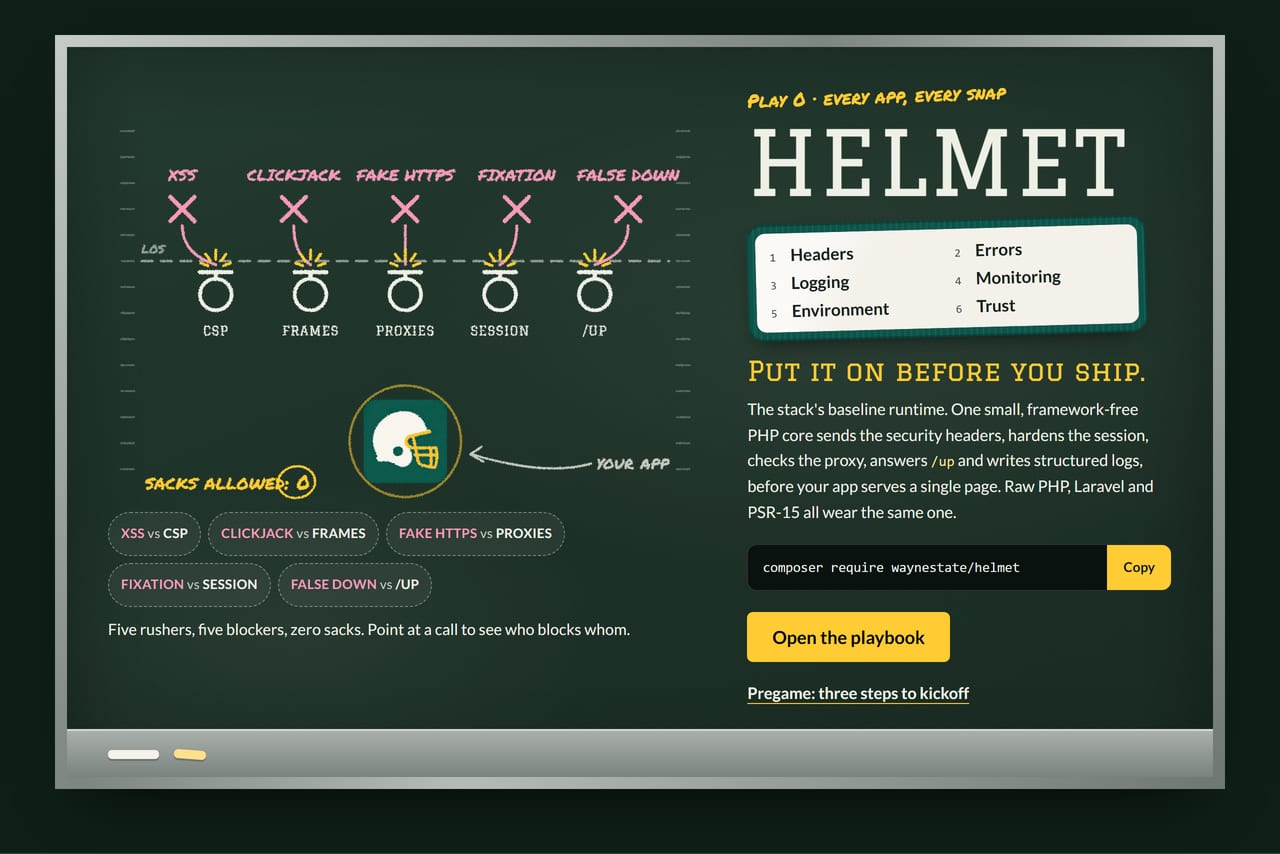
HELMET
GIF via Tenor


Put it on before you ship. Security headers, a hardened session and an honest proxy check, snapped on before the first page is served.
Checks: composer ci (the same command CI runs on git.wayne.edu).
Front page: site/index.html, the playbook, as static files (site/README.md).
On Citadel it is served by the raw-PHP deploy layer in deploy/: a Squire kit whose front controller serves site/ behind HELMET's security headers. For local development, keep serving site/ directly.
Documentation: helmet.apps.wayne.edu/docs/ carries the overview, the install and quick start, a guide per topic (headers, CSP, HSTS, session, proxies, the request-forgery guard, readiness, metrics, platforms), the API and environment variable reference, troubleshooting and upgrading.
HELMET is the Wayne State app stack's baseline runtime. One small
framework-free PHP core, Waynestate\Helmet, does the five things every app on
Citadel needs before it serves a single page: it sends the security headers,
hardens the session, decides whether the request really arrived over HTTPS,
answers the load balancer's /up ping, and writes structured logs.
Where the code lives
The canonical repository is git.wayne.edu/enterprise-apps/helmet (clone over SSH as git@git.wayne.edu:enterprise-apps/helmet.git, or HTTPS as https://git.wayne.edu/enterprise-apps/helmet.git). Open issues and merge requests there; tags are made there, by the maintainer, with an approver.
GitHub (waynestate/helmet) is a read-only push mirror of it. Nobody pushes to the mirror; Packagist reads from it.
git.wayne.edu is the head this helmet fits; the mirror is the mannequin.
It is the floor, not the ceiling. An app on raw PHP calls helmet_boot() once
at the top of its front controller and is done. An app on Laravel or a PSR-15
stack mounts the same core as middleware and gets the identical headers. The
rules live in one place, and every consumer path agrees.
Install
composer require waynestate/helmet
Composer picks the latest release, 1.4.1, and writes ^1.4 into composer.json. From 1.0 HELMET
follows semantic versioning; Upgrading has what changed since 0.4, starting with the one that
bites: an unknown quoted CSP source now throws at boot.
Walk the sideline: the front page's playbook, pregame and film room

Platform presets
A preset names a platform's trusted-proxy list, so an app does not hard-code
an address that belongs to the platform, not the app. The presets live in
Waynestate\Helmet\Platform\Presets:
| Preset | Trusted proxies |
|---|---|
citadel |
the Docker bridge gateway to the HA-Proxy front (see "Running off Citadel") |
docker |
none: a plain Docker network with no front proxy |
Raw PHP passes the preset name in the preset option:
$helmet = helmet_boot([
    'preset' => 'citadel',
]);
Laravel reads it from HELMET_PRESET (see the environment table below;
Playbook supplies it when the environment has none); an explicit
HELMET_PROXIES always wins over the preset.
Off the WSU platform, skip the preset and pass your own list of the addresses your front proxy connects from:
$helmet = helmet_boot([
    'trusted_proxies' => ['203.0.113.10'],
]);
An unknown preset name throws at boot, so a typo fails loudly instead of silently trusting nothing.
WSU values (Playbook)
The Laravel config reads HELMET_PRESET from the environment first and from
the private waynestate/playbook package (Playbook) second, when the
environment has no value. The raw PHP path takes the preset as an option to
helmet_boot() and reads no environment at all.
| Setting | What it is |
|---|---|
HELMET_PRESET |
A platform preset name (citadel or docker) that supplies the trusted proxies. |
Get Playbook with your own GitLab token, three ways.
Composer: add the repository to your app's composer.json, put the token in
auth.json (Composer's credential store, never in the repo), then require
the package:
{
    "repositories": [
        {
            "type": "vcs",
            "url": "https://git.wayne.edu/enterprise-apps/playbook.git"
        }
    ]
}
composer require waynestate/playbook
Or fetch the values file directly.
curl (Linux, macOS):
curl --fail -H "PRIVATE-TOKEN: $GITLAB_TOKEN" "https://git.wayne.edu/api/v4/projects/enterprise-apps%2Fplaybook/repository/files/playbook.env/raw?ref=main" -o .env.playbook
PowerShell (Windows):
Invoke-WebRequest -Headers @{ 'PRIVATE-TOKEN' = $env:GITLAB_TOKEN } -Uri "https://git.wayne.edu/api/v4/projects/enterprise-apps%2Fplaybook/repository/files/playbook.env/raw?ref=main" -OutFile .env.playbook
Clone:
git clone https://git.wayne.edu/enterprise-apps/playbook.git
A fetched .env.playbook is plain KEY=value lines: copy the ones you need
into your app's .env (or your Citadel environment).
The token is your own: read_api for curl, read_repository for clone and
Composer.
Playbook is private on git.wayne.edu. If you get a 404, ask the Enterprise Applications team for read access.
Running off Citadel
HELMET ships one package for every platform, so running off Citadel means changing configuration, not code. The only platform fact it needs is the address of whatever stands in front of the app container:
| Platform | What sits in front | HELMET_PROXIES |
Where logs go |
|---|---|---|---|
| Citadel | HA-Proxy | use the citadel preset (172.18.0.1) |
a file you set, such as /var/log/app/helmet.log (the preset sets proxies only) |
| OpenShift | the OpenShift router | the router's pod network CIDR, from your cluster admin | php://stderr |
| Coolify | Traefik or Caddy | the Docker network of the proxy | php://stderr |
| Raw Docker behind a compose proxy | your proxy service | the compose network's subnet | php://stderr |
One caveat about the citadel row: 172.18.0.1 is the Docker bridge
gateway, and the citadel preset is safe only when the front proxy
reaches the app over that bridge. A published app port that is
source-NATed to the gateway address would make a direct client look like
the proxy, so the platform must not publish the app's port.
An explicit HELMET_PROXIES overrides the preset on every platform. With
neither a preset nor a list, no address is trusted, so forwarded headers
such as X-Forwarded-Proto are ignored and the request is read as it arrived. Off Citadel, log to php://stderr and
let the container runtime collect the lines.
The helmet comes off the platform, not the app.
Usage
Raw PHP
At the top of the front controller, before anything is echoed:
use function Waynestate\Helmet\helmet_boot;

$helmet = helmet_boot([
    // The platform preset that supplies the trusted proxies. An explicit
    // 'trusted_proxies' list wins over the preset.
    'preset' => 'citadel',

    // Optional. A Monolog JSON logger, one line per record. "stream" may be a
    // stream or a file path. The presets supply trusted proxies only, so the
    // app picks its own log stream: on a platform like Citadel a file such as
    // /var/log/app/helmet.log, off the platform php://stderr. Every record
    // carries a request ID in extra.request_id, generated by HELMET; an
    // inbound header is never trusted for it. Set "request_id" to reuse an ID
    // you already have (8 to 64 letters, digits, dots, underscores or dashes).
    'log' => [
        'channel' => 'app',
        'stream'  => 'php://stderr',
        'level'   => 'info',
        // 'request_id' => 'req-20261029-abcd',
    ],
]);

// $helmet['nonce'] is the per-request CSP nonce. Put it in your <script> tags.
// $helmet['logger'] is a Psr\Log\LoggerInterface, or null when no log is set.
// $helmet['request_id'] is the ID stamped on this process's log records.
Every other helmet_boot() option is covered in its own section below:
csp and style_src_attr (Customizing the CSP), csp_report_uri and csp_report_only
(CSP reports), coop, corp, coep and permissions_policy (Cross-origin
isolation and feature policy), hsts_max_age, hsts_include_subdomains
and hsts_preload (Configuring HSTS), no_store (the no-store rows of
Raw PHP and Laravel agree), csrf
(The request-forgery guard), health_path (Health check without a front
controller), readiness (Readiness is a separate check), session (The session, secure mode) and error_handler
(A generic error page).
The log option configures that logger: channel names it, stream is a
stream or a file path, and level sets the minimum level. Set request_id
to reuse an ID you already have (8 to 64 letters, digits, dots, underscores
or dashes); otherwise HELMET generates one for the process.
Each record is one JSON line:
{"message":"login","context":{"user":"alice"},"level":200,"level_name":"INFO","channel":"app","datetime":"2026-10-29T12:00:00.000000+00:00","extra":{"request_id":"9f2c1ab04d5e6f70"}}
Security events
Five warnings carry HELMET's security events, and a logger that throws never
changes the answer: the 403 still goes out, the resolved client IP is still
the peer, the HTTPS decision stands, and the boot still finishes.
| Message | When | Context keys |
|---|---|---|
helmet.request_refused |
the request-forgery guard answers 403 |
event (request_refused), method (upper case), path (no query string), sec_fetch_site (same-origin, same-site, cross-site, none, other, or null when the header is absent), origin_present (bool) |
helmet.forwarded_for_rejected |
ClientIp::resolve() fails closed on an unparseable X-Forwarded-For entry: in helmet_metrics() and in the Laravel metrics endpoint |
event (forwarded_for_rejected), reason (unparseable_entry), peer (the trusted peer address) |
helmet.forwarded_proto_rejected |
the HTTPS check sees X-Forwarded-Proto from a peer that is not a trusted proxy, and ignores it: in helmet_boot(), SecurityHeadersMiddleware and the Laravel SecurityHeaders middleware |
event (forwarded_proto_rejected), reason (untrusted_peer), peer (the untrusted peer address) |
helmet.debug_enabled_in_production |
the Laravel adapter boots with app.debug true in the production environment |
event (debug_enabled_in_production) |
helmet.broad_trusted_proxy |
the app boots with a broad entry in its trusted-proxy list (an IPv4 range shorter than /16 or an IPv6 range shorter than /48) |
event (broad_trusted_proxy), entries (the broad entries, as configured) |
Never logged: the Origin value, cookies, Authorization, the X-Forwarded-For
or X-Forwarded-Proto header, or the bad entry. The helmet takes the hit and
reports it, without quoting the attacker.
The logger reaches each path this way: helmet_boot() hands its own logger to
the HTTPS check and the guard; PSR-15 users pass a LoggerInterface as the
last constructor argument $logger of SecurityHeadersMiddleware and of
RequestForgeryGuard (both default to null, which logs nothing);
helmet_metrics() passes its configured logger to ClientIp::resolve(); the
Laravel adapter writes every event through the app's own logger.
Use a platform preset (for example citadel, which trusts the Docker bridge
gateway), or list only the address the front proxy connects from, never a
whole private range. A broad range such as 10.0.0.0/8 also trusts other
containers on the same network, and any of them could then set
X-Forwarded-Proto. When the list does hold a broad entry, an IPv4 range
shorter than /16 or an IPv6 range shorter than /48, helmet_boot() writes
one helmet.broad_trusted_proxy warning through the configured logger; set
warn_broad_proxies to false to silence it. An explicitly empty
HELMET_PROXIES means trust nobody, even when a preset is set; only an unset
variable falls back to the preset.
The citadel preset trusts the container bridge gateway address, which is
only correct while the app's port is not published to the host network,
because a published port can make a direct client appear to come from the
gateway.
helmet_boot() sends the headers, strips X-Powered-By, and answers /up
with 200 ok before your code runs. It returns the nonce, the logger and
the request ID so the rest of the app can use them.
A generic error page
A raw PHP app has no framework to catch an uncaught exception, so PHP may print
the message, the file path and a stack trace to the visitor. Turn on the
opt-in error_handler and the visitor gets a short, fixed "Something went wrong"
page with status 500 and Cache-Control: no-store, while the full detail
(class, message, file, line and trace) goes to the log at error level:
helmet_boot([
    'error_handler' => ['enabled' => true],
]);
The page never contains anything from the exception, and a logger that
throws cannot change it. It is off by default, and Laravel keeps its own
exception handler. If you want to build the page yourself, call
(new \Waynestate\Helmet\Error\GenericErrorResponse())->build($exception, $logger)
for the status, headers and body as data. HELMET does not switch PHP's
display_errors off for you; the platform setting does that.
The same class builds the 4xx half of the rule. A raw PHP router answers a
client fault with helmet_client_error(), which sends the status, the fixed
page and Cache-Control: no-store, then exits:
use function Waynestate\Helmet\helmet_client_error;

if ($route === null) {
    helmet_client_error(404);
}
helmet_client_error_response($status) returns the same answer as data
(status, headers, body) when you want to send it yourself, and
(new \Waynestate\Helmet\Error\GenericErrorResponse())->clientError($status)
is the class underneath both. The page is fixed text: 400, 401, 403, 404,
405, 410 and 429 each carry their own title and sentence, and any other 4xx
keeps the status you passed and falls back to the Bad request text. Nothing
from the request or an exception reaches the body. Only 400 to 499 is
accepted: a 500 or a redirect status throws \InvalidArgumentException
before anything is sent. In Laravel, HELMET_ERROR_PAGES=true does the same
for every 4xx HTTP exception (see the Laravel environment variables below).
Debug output stays off in production
HELMET never switches debug output off or on for you, because the right place is the platform, not a library. Two settings decide whether a visitor can read a stack trace, and both belong to your deploy:
- PHP's
display_errors. Keep itOffin production. Squire's deploy kit already ships aphp.iniwithdisplay_errors = Offandlog_errors = On(deploy/.squire/php.iniin a Squire-based app), and Citadel uses the same values. Off the platform, set it inphp.inior the FPM pool. HELMET does not set or check it. - Laravel's
APP_DEBUG. Keep itfalsein production. The Laravel adapter cannot stop an app from turning it on, but it notices: when the app boots withapp.debugtrue in the production environment it writes one warning,helmet.debug_enabled_in_production, through the Log facade. Opt out withhelmet.warn_debug(envHELMET_WARN_DEBUG, defaulttrue). A logger that fails never breaks the boot.
The opt-in error handler above covers one more case: with it on, an uncaught
exception in a raw PHP app shows the fixed 500 page even if display_errors is
wrong. Warnings and notices still follow display_errors, so set it anyway.
Health check without a front controller
A raw PHP app with no front controller (or an Apache setup with no rewrite)
never reaches helmet_boot() for /up. Ship a two-line public/up.php
that calls HELMET directly:
<?php // public/up.php
use function Waynestate\Helmet\helmet_up;

require __DIR__ . '/../vendor/autoload.php';
helmet_up();
Squire's raw template ships this file. The probe only checks that the ball is in the air; it does not grade the play.
Readiness is a separate check
/up is liveness: "the process is running". Keep it free of dependency checks. If /up fails because the database is
down, the platform restarts a healthy app and makes the outage worse. Readiness is the other question, "send me
traffic?", and HELMET answers it on its own path, /ready, off unless you turn it on:
$helmet = helmet_boot([
    'preset' => 'citadel',
    'readiness' => [
        'enabled' => true,                       // default false
        'path' => '/ready',                      // the default; must differ from health_path
        'checks' => [
            'database' => static fn (): bool => db_ping(), // true or null passes, false fails
        ],
    ],
]);
The answer is JSON, no-store, 200 while no check failed and 503 once one did:
{"status":"ready","checks":{"headers":{"status":"pass","csp":"enforce","style_src_attr":"inline"},"trusted_proxies":{"status":"pass","count":1,"broad":0},"debug_output":{"status":"pass"},"database":{"status":"pass"}}}
HELMET adds three checks of its own config: the header set builds and carries a CSP (and in which mode), how many
trusted proxies there are and how many are broad (a count, never an address), and whether display_errors is on. The
last two warn and never fail. A check that throws fails, and its message goes to the log
(helmet.readiness_check_failed), never the body. Give your checks a short timeout so a hung database cannot hang the
probe. No secrets, no addresses, no policy text: the probe is reachable by anyone who can reach the app.
A raw app with no front controller can answer from public/ready.php with helmet_ready(); PSR-15 apps add the
ReadinessCheck middleware; Laravel apps call Route::helmetReady(). Never point the restart (liveness) probe at
/ready, and in Laravel do not put dependency checks in the DiagnosingHealth listener, because that event fires for
/up. Where each platform wants which path (Citadel, OpenShift, Coolify, Docker) is in the
readiness guide.
Raw PHP with a Vue (Vite) build
A raw PHP app that serves a built Vue/Vite SPA gives the bundler HELMET's
nonce in two steps. At build time, set Vite's html.cspNonce to a
placeholder:
// vite.config.js
import { defineConfig } from 'vite';

export default defineConfig({
    html: {
        cspNonce: 'CSP_NONCE_SLOT_FOR_HELMET',
    },
});
On every request, replace the placeholder with the nonce helmet_boot()
returned before you echo the page:
echo helmet_csp_nonce_swap(file_get_contents('dist/index.html'), $helmet['nonce']);
helmet_csp_nonce_swap() replaces every occurrence of the placeholder with
the nonce, HTML-escaped exactly the way helmet_csp_nonce_meta() escapes
it. A placeholder shorter than 16 characters throws, so it cannot collide
with page text, an empty nonce throws, and a page that carries no
placeholder is returned unchanged.
One more setting keeps the CSP honest: Vite inlines small assets as data:
URIs by default. The default policy already allows data: in font-src and
img-src, so inlined fonts and images pass; if you would rather not inline
at all, set build.assetsInlineLimit: 0.
And one rule Vue itself sets: precompile your templates. Single-file
components (.vue files) are compiled at build time, so they need nothing.
A string template: option or an in-DOM template needs Vue's full build,
whose runtime compiler calls eval, and HELMET's policy never allows
'unsafe-eval': the browser refuses it and nothing renders.
This recipe is proven in a real browser on every pipeline. tools/vue-vite
is a small Vue app built exactly this way, and tools/a11y/vue-check.mjs
serves its build in Chromium with HELMET's default headers and the swapped
nonce. It checks that the app mounts with no CSP violation, its stylesheets
and an inlined image load, a click updates the page, and a lazily imported
chunk renders with its stylesheet carrying the response nonce. It also
checks the two ways this goes wrong: the same build without the swap never
mounts, and a runtime-compiled template is refused. To run it yourself,
from the repository root:
php tools/a11y/corp-headers.php > build/helmet-headers.json
npm --prefix tools/a11y ci && npm --prefix tools/vue-vite ci && npm --prefix tools/vue-vite run build
node tools/a11y/vue-check.mjs --headers=build/helmet-headers.json
PSR-15 middleware
The same core, mounted in a middleware pipeline:
use Nyholm\Psr7\Factory\Psr17Factory;
use Waynestate\Helmet\Csrf\RequestForgeryGuard;
use Waynestate\Helmet\Headers\SecurityHeadersMiddleware;
use Waynestate\Helmet\Health\HealthCheck;
use Waynestate\Helmet\Platform\Presets;
use Waynestate\Helmet\Proxy\TrustedProxies;

$factory = new Psr17Factory();
$proxies = new TrustedProxies(Presets::proxies('citadel'));

$middleware = [
    new HealthCheck($factory, $factory, '/up'),
    new RequestForgeryGuard($proxies, $factory, $factory, except: ['/api/webhooks/*']),
    new SecurityHeadersMiddleware($proxies),
];
Order matters: SecurityHeadersMiddleware must be the outermost layer, so the error page your error middleware builds also carries the headers. In a Slim-style app, where the middleware added last runs first, add it after the error middleware; see the PSR-15 guide.
SecurityHeadersMiddleware sets the request attribute helmet.csp_nonce so a
downstream handler can read the same nonce the CSP header carries. Pass it a
PSR-3 logger as logger: and it logs helmet.forwarded_proto_rejected when a
peer that is not a trusted proxy sends X-Forwarded-Proto, exactly as
helmet_boot() does (see Security events). Without one it
logs nothing, as before.
RequestForgeryGuard is opt-in: mounting it turns the check on for that
pipeline. Its options are described in
The request-forgery guard.
By default the middleware rethrows, so the framework's error handler still
runs and produces the error page, and the middleware attaches the headers only
to responses that come back through it; pass rethrow: false (and a PSR-17
ResponseFactory) to make the middleware itself return a 500 carrying the
same headers. The raw PHP
path needs no such flag: helmet_boot() sends the headers before your code
runs, so they are already on the wire by the time an exception can happen.
Laravel
The Laravel adapter is a service provider, three always-on middlewares, an optional request-forgery guard, and a config file. It only wires and configures. Every rule (what the headers say, how a nonce is made, how a CSP is merged, and how a request-forgery check is applied) lives in the core, so Laravel and raw PHP cannot drift apart. The suite runs against Laravel 13 with Orchestra Testbench.
Install the adapter
Strap It On:
composer require waynestate/helmet
Package discovery registers Waynestate\Helmet\Laravel\HelmetServiceProvider,
so there is nothing to add to bootstrap/providers.php. The provider merges
the helmet config and joins the HTTP kernel's middleware:
ForwardedProtoNormalizeris prepended to the global stack, so it runs before Laravel'sTrustProxiesand your code. When a trusted proxy sends a comma-separatedX-Forwarded-Proto, it keeps only the last value, so Laravel's$request->isSecure()reads the same answer HELMET does.SecurityHeaderssends the headers in The headers and stripsX-Powered-By. By default it is global, so 404s and JSON routes carry them too.InjectRibbonadds the environment ribbon (below). It always stays in thewebgroup, because it edits HTML.RequestForgeryGuardis opt-in. Whenhelmet.csrf.enabledis true, it joins thewebgroup afterInjectRibbonand applies the check in The request-forgery guard.
They are added through the HTTP kernel, so they survive another package adding
to the same group. Set HELMET_SCOPE=web to keep SecurityHeaders in the
web group only; then routes outside web and unmatched 404s do not carry
its headers.
Publish the config
php artisan vendor:publish --tag=helmet-config
This copies config/helmet.php into your app. Do it: it is the best place to
change the CSP, because the policy is a PHP array there, not JSON squeezed into
.env. The config file is also the one place HELMET reads the environment
(env(), plus HELMET_PRESET through Setting, which also checks Playbook),
so php artisan config:cache keeps working.
Trust the proxy
HELMET decides on its own whether a request was really HTTPS, from
HELMET_PROXIES. Laravel has a separate trusted-proxy setting that drives
url(), secure cookies and $request->isSecure(). The provider follows the
same list: when the app has not set trustedproxy.proxies itself, it copies
helmet.proxies over, so HELMET_PROXIES drives both. An app that sets
trustedproxy.proxies keeps its own value, and an explicit
trustProxies(at: ...) call in bootstrap/app.php still wins, because
Laravel applies it before the config fallback.
The provider also narrows which forwarded headers Laravel believes from those
proxies: X-Forwarded-For and X-Forwarded-Proto, and nothing else.
Laravel's own default also trusts X-Forwarded-Host, X-Forwarded-Prefix
and X-Forwarded-Port, and a client can pre-seed any of them on a platform
whose proxy does not overwrite them, which poisons url(), redirects and
password-reset links. Port is out for the same reason: Citadel's HA-Proxy
never sends it at all, so a client-sent value would pass through untouched
and change the port Laravel reports and the URLs it generates. If your app
needs one of them, choose the set yourself with
trustProxies(at: ..., headers: ...) in bootstrap/app.php (or
TrustProxies::withHeaders()); HELMET then leaves your choice alone.
Citadel's HA-Proxy appends X-Forwarded-Proto instead of replacing it, so
a client can arrive with two values, https, http. Symfony reads the first
value of such a list (the client's), while HELMET reads the last (the one
the closest proxy appended). To keep Laravel in agreement, the provider
prepends a small middleware to the global chain that rewrites the header to
its last value when the request comes from a trusted proxy. A single value
is left alone, and requests from untrusted peers are ignored as before.
As in the raw PHP section, use a preset or list only the address your front
proxy connects from, never a whole private range. When the resolved list does
hold a broad entry, an IPv4 range shorter than /16 or an IPv6 range shorter
than /48, the provider writes one helmet.broad_trusted_proxy warning at
boot; set HELMET_WARN_BROAD_PROXIES=false to silence it once you have
reviewed the range.
Keep /up for liveness only. Readiness checks (database, cache) belong on a separate route: Route::helmetReady('/ready', ['database' => DatabaseReady::class]) in bootstrap/app.php withRouting(then: ...), where each check is an invokable class (so route:cache works). See Readiness is a separate check.
The /up health route is Laravel's own: keep health: '/up' in
withRouting(). The adapter registers no route.
Environment variables
| Variable | Config key | Default | What it does |
|---|---|---|---|
HELMET_SCOPE |
helmet.scope |
global |
global puts SecurityHeaders in the kernel's global middleware; web keeps it in the web group only. InjectRibbon always stays in web. |
HELMET_PRESET |
helmet.preset |
none | A platform preset name (citadel or docker) that supplies the trusted proxies. Read from the environment, else from Playbook (see WSU values (Playbook)). HELMET_PROXIES wins when both are set. An unknown name throws, even when HELMET_PROXIES is set. |
HELMET_PROXIES |
helmet.proxies |
none | Comma-separated IPs or CIDR ranges allowed to set X-Forwarded-Proto. Wins over HELMET_PRESET. Also copied to trustedproxy.proxies when the app has not set it. An explicitly empty value (HELMET_PROXIES=) trusts nobody, even when HELMET_PRESET is set; only an unset variable falls back to the preset. |
HELMET_WARN_BROAD_PROXIES |
helmet.warn_broad_proxies |
true |
Set false to silence the helmet.broad_trusted_proxy boot warning when the trusted-proxy list holds a broad entry (an IPv4 range shorter than /16 or an IPv6 range shorter than /48). |
HELMET_CSP |
helmet.csp |
the core default policy | A JSON policy array, merged over the default (see below). Empty or invalid JSON keeps the default. |
HELMET_HSTS_MAX_AGE |
helmet.hsts |
31536000 |
The HSTS max-age in seconds, sent on HTTPS only. It must not be negative. |
HELMET_HSTS_INCLUDE_SUBDOMAINS |
helmet.hsts_include_subdomains |
true |
Set false to omit the HSTS includeSubDomains directive. |
HELMET_HSTS_PRELOAD |
helmet.hsts_preload |
false |
Set true to append the preload directive to HSTS. Requires max-age of at least one year and includeSubDomains. Preload is hard to undo: once a browser has preloaded the domain it refuses plain-HTTP connections until the entry is removed. |
HELMET_CSP_TRUSTED_TYPES_ENABLED |
helmet.csp_trusted_types.enabled |
false |
Set true to append Trusted Types directives to the report-only CSP header. |
HELMET_CSP_TRUSTED_TYPES_POLICIES |
helmet.csp_trusted_types.policies |
["default"] |
Comma-separated Trusted Types policy names. |
HELMET_CSP_STYLE_SRC_ATTR |
helmet.csp_style_src_attr |
inline |
inline keeps style-src-attr 'unsafe-inline' for WayneUI's recipes, report adds a report-only probe with style-src-attr 'none', none blocks inline style attributes. See ADR-0001. |
HELMET_NO_STORE_ENABLED |
helmet.no_store.enabled |
false |
Set true to send Cache-Control: no-store on matching responses. |
HELMET_NO_STORE_PATHS |
helmet.no_store.paths |
none | Comma-separated path prefixes that carry no-store. Empty means every response. |
HELMET_RIBBON |
helmet.ribbon |
true |
Set false to switch the ribbon off everywhere. |
HELMET_POLICY_PATH |
helmet.policy_path |
none | Path to a CREED policy.json. When set, the ribbon shows a version warning for the running PHP (and, in Laravel, the framework) version. A missing or invalid file shows no warning and never breaks the page. |
HELMET_DEV_ORIGIN |
helmet.dev_origin |
none | The Vite dev server origin, used in local only when the dev server is running. Must be http or https on localhost, 127.0.0.1 or [::1]. Overrides the hot file. |
HELMET_CSP_REPORT_URI |
helmet.csp_report_uri |
none | The URL browsers POST CSP violation reports to. Adds report-uri and report-to to the policy and a Reporting-Endpoints header. An absolute URL must be https with a host; a single-slash path relative to the page's origin is valid too. |
HELMET_CSP_REPORT_ONLY |
helmet.csp_report_only |
false |
Set true to send the policy as Content-Security-Policy-Report-Only (observe violations without blocking them). |
HELMET_CSRF_ENABLED |
helmet.csrf.enabled |
false |
Set true to turn on the request-forgery guard for state-changing requests. |
HELMET_CSRF_ALLOW_SAME_SITE |
helmet.csrf.allow_same_site |
false |
Set true to let Sec-Fetch-Site: same-site pass. Off by default because sibling subdomains are still same-site. |
HELMET_CSRF_TRUSTED_ORIGINS |
helmet.csrf.trusted_origins |
none | Comma-separated origins allowed to make state-changing requests when the Origin fallback is used. |
HELMET_CSRF_EXCEPT |
helmet.csrf.except |
none | Comma-separated path patterns that skip the guard: an exact path, a prefix ending in *, or * for every path. |
HELMET_ERROR_PAGES |
helmet.error_pages |
false |
Set true to answer a 4xx HTTP exception with HELMET's fixed client-error page instead of Laravel's error view. Requests that expect JSON, validation errors, authentication redirects and every 5xx stay with Laravel; a 405 keeps its Allow header. |
HELMET_SESSION_SECURE |
helmet.session.secure |
auto |
The session cookie's Secure flag. auto leaves Laravel's session.secure unset, so the cookie is Secure on each request the trusted-proxy check calls HTTPS (the citadel preset is enough behind Citadel's proxy). always sets session.secure to true, so the cookie is Secure even on plain HTTP. An app that sets session.secure itself (SESSION_SECURE_COOKIE) keeps its value. Anything else throws when the config loads. |
Customizing the CSP in Laravel
helmet.csp takes the same shape as the raw PHP csp option and follows the
same rule: it is merged over the default, per directive. A directive you set
replaces the default's, a directive you leave out keeps it, and null removes
one. Open the published config/helmet.php and replace the
$csp = SecurityHeaders::defaultCspPolicy(); line:
$csp = [
    'img-src' => ["'self'", 'data:', 'https://images.example.edu'],
    'form-action' => null,
];
If you would rather use the environment, HELMET_CSP takes the same array as
JSON. In a .env file it needs double quotes and escaped inner quotes, which
is the reason to publish the config instead:
HELMET_CSP="{\"img-src\":[\"'self'\",\"data:\"],\"form-action\":null}"
Invalid JSON is ignored and the default policy stays, so a typo in the environment cannot loosen the CSP.
One gotcha when overriding: the policy adds the per-request nonce to
style-src and style-src-elem. A browser ignores 'unsafe-inline' once a
nonce is present, so setting style-src to ["'unsafe-inline'"] does not
restore inline styles; it removes them.
The nonce in Blade
The middleware puts the per-request nonce on the request as the attribute
helmet.csp_nonce, the same name the PSR-15 middleware uses. It also hands
the nonce to Laravel's Vite helper, so @vite needs nothing: the script and
style tags it print already carry the nonce the CSP header sends.
For an inline script, print the nonce from the Vite helper:
<script nonce="{{ Vite::cspNonce() }}">
    // allowed by the nonce, and free to load more scripts (strict-dynamic)
</script>
In a controller it is $request->attributes->get('helmet.csp_nonce'). A new
nonce is made for every request. Repetition is a fine Helmet song and a
terrible nonce.
Vite and Inertia
The middleware hands the per-request nonce to Laravel's Vite helper and
injects a csp-nonce meta tag into <head>. @vite needs nothing. The meta
tag lets Vite nonce the CSS and preload tags it adds after page load: the
dev runtime's, and in a production build the stylesheets of the chunks a
dynamic import() loads. A real browser proves it on every pipeline:
tools/a11y/laravel-page.php renders a small Vue app's page through Laravel
and HELMET's service provider, and tools/a11y/vue-check.mjs runs it in
Chromium with no CSP violation, a lazy chunk included (an Inertia root view
is a Blade view with the same @vite). When the request ends, HELMET resets the Vite nonce to a fresh random
one, so a long-lived worker (Octane, Swoole, FrankenPHP) does not carry one
request's nonce into the next.
A few rules keep the CSP honest:
- Nonce every inline script. The CSP has no
'unsafe-inline'for scripts. Every<script>without asrcneedsnonce="{{ Vite::cspNonce() }}". - No
'unsafe-eval'. The CSP never allows it. If your bundle needseval, fix the bundle. Vue's runtime template compiler is the usual culprit: keep templates in.vuefiles (compiled at build time), not in stringtemplate:options. - No scripts in Inertia's
<Head>. Inertia's<Head>renders into the document head after the page loads. A<script>there would not carry the nonce, and the browser would block it. Put scripts in your layout, where@viteand the nonce reach them. - No second nonce-producing package. If another package calls
Vite::useCspNonce()after HELMET, the@vitetags carry a different nonce than the CSP header, and the browser blocks the scripts. The middleware logs a warning when it detects this. - No shared caching of nonced HTML. The nonce changes every request. A cached page would carry a stale nonce, and the browser would block its scripts. Do not cache HTML at a layer that shares it across requests.
- Do not replace
style-srcwith'unsafe-inline'. The policy adds the per-request nonce tostyle-srcandstyle-src-elem, and a browser ignores'unsafe-inline'once a nonce is present. An override that relies on it loses every inline style silently. Keep the nonce, move the styles into files, or give the inline styles a nonce.
In raw PHP, print the meta tag in <head> with the nonce helmet_boot()
returned:
echo helmet_csp_nonce_meta($helmet['nonce']);
The Vite dev server is allowed in the local environment only, and only when
it is running (a hot file exists). The origin comes from HELMET_DEV_ORIGIN
when set, otherwise from the hot file. It must be http or https on
localhost, 127.0.0.1 or [::1], with an optional port. An invalid origin
is ignored and a warning is logged. In every other environment the dev server
origin is never added.
The ribbon
In local, development, dev, testing, test, staging, stage, qa,
uat, preprod, pre-prod and sandbox, InjectRibbon adds <div class="helmet-ribbon" data-environment="staging">staging</div>
right after the opening <body> tag of an HTML response, so nobody mistakes a
test site for the real one. It never appears in production or an
environment HELMET does not know, on JSON or other non-HTML responses, or on
HTML with no <body>. The package ships no
stylesheet; style .helmet-ribbon in your own CSS. Even with
HELMET_RIBBON=true, production never gets it, so there is no Aftertaste.
Version warnings. Point HELMET_POLICY_PATH at a CREED policy.json and
the ribbon gains a warning line for each component version that is in its
security-only phase or end of life. The raw PHP path checks the running PHP
version; the Laravel adapter also checks the framework's major version. With
no policy path there is no warning and no file read, and a missing, unreadable
or invalid file shows no warning and never breaks the page. Style
.helmet-ribbon-warning in your own CSS.
Raw PHP. helmet_ribbon() returns the same ribbon; print its html()
right after your <body> tag:
use function Waynestate\Helmet\helmet_ribbon;

echo helmet_ribbon(getenv('APP_ENV') ?: 'production', true, getenv('HELMET_POLICY_PATH') ?: null)->html();
The old Waynestate\Helmet\Ribbon\helmet_ribbon name still works for one release and raises a deprecation.
Both paths read one list of non-production names (Ribbon::ENVIRONMENTS),
matched in any case. Production, an empty name and any name HELMET does not
know get an empty string, so a typo in APP_ENV hides the ribbon instead of
showing it on the live site.
Raw PHP and Laravel agree
Both paths call SecurityHeaders::build(), so for the same request and
settings they send the same headers. A test pins that down: it compares what
the Laravel middleware sends, name and value, with build(). The settings map
like this:
| Setting | Raw PHP (helmet_boot()) |
Laravel |
|---|---|---|
| Trusted proxies | trusted_proxies |
HELMET_PROXIES / helmet.proxies |
| CSP overrides | csp |
HELMET_CSP / helmet.csp, same merge, null removes |
| HSTS max-age | hsts_max_age |
HELMET_HSTS_MAX_AGE / helmet.hsts |
| HSTS subdomains | hsts_include_subdomains |
HELMET_HSTS_INCLUDE_SUBDOMAINS / helmet.hsts_include_subdomains, default true |
| HSTS preload | hsts_preload |
HELMET_HSTS_PRELOAD / helmet.hsts_preload, default false |
| Trusted Types | csp_trusted_types |
HELMET_CSP_TRUSTED_TYPES_* / helmet.csp_trusted_types.*, default off |
| no-store | no_store |
HELMET_NO_STORE_* / helmet.no_store.*, default off |
| CSP report URI | csp_report_uri |
HELMET_CSP_REPORT_URI / helmet.csp_report_uri |
| CSP report-only | csp_report_only |
HELMET_CSP_REPORT_ONLY / helmet.csp_report_only, default false |
| COOP | coop |
HELMET_COOP / helmet.coop, default same-origin, null sends no header |
| CORP | corp |
HELMET_CORP / helmet.corp, default null (no header) |
| COEP | coep |
HELMET_COEP / helmet.coep, default null (no header) |
| Permissions-Policy | permissions_policy |
HELMET_PERMISSIONS_POLICY / helmet.permissions_policy, default deny list, [] sends no header |
| Nonce | $helmet['nonce'] |
request()->attributes->get('helmet.csp_nonce') |
| Health check | health_path, answered by helmet_boot() |
Laravel's health: '/up' |
| Readiness | readiness option, answered by helmet_boot(), default off |
Route::helmetReady(), off until called |
| Request-forgery guard | csrf option to helmet_boot() |
helmet.csrf.* / HELMET_CSRF_*; the middleware is registered only when enabled |
| Generic 4xx page | helmet_client_error(), called by your router |
HELMET_ERROR_PAGES / helmet.error_pages, default false |
| Session cookie Secure flag | session option to helmet_boot() |
HELMET_SESSION_SECURE / helmet.session.secure, default auto |
| Session hardening, JSON logs | applied by helmet_boot() |
not applied by the adapter; Laravel's session and logging config apply |
For the session cookie's Secure flag in Laravel, the adapter reads helmet.session.secure at boot and maps it onto Laravel's own session.secure: auto (the default) leaves it unset, so Laravel marks the cookie Secure on each request the trusted-proxy check calls HTTPS, and always sets it to true. An app that set session.secure itself keeps its value. For the rest of session hardening, use the framework's own session config: set http_only and same_site in config/session.php rather than expecting the adapter to apply raw-PHP SessionHardening (Laravel does not use PHP's native session, so those ini settings would never reach its cookie). For structured logs, use Laravel's log channels, for example the stderr channel, rather than expecting the adapter to configure a raw-PHP logger. Every security event (Security events) goes through the app's logger with the same message and context as raw PHP: helmet.request_refused from the guard, helmet.forwarded_proto_rejected from SecurityHeaders, helmet.forwarded_for_rejected from the metrics endpoint, and helmet.broad_trusted_proxy and helmet.debug_enabled_in_production at boot.
The headers

The play is read from
src/Headers/SecurityHeaders.php: seven routes, one per default header,
drawn in the order HELMET sets them. Cross-Origin-Resource-Policy and Cross-Origin-Embedder-Policy wait on the bench until you opt in. With
reduced motion on, you get the finished play.
Every response gets the same set, built by one shared function:
| Header | Value |
|---|---|
Content-Security-Policy |
the WayneUI default policy, plus a per-request nonce and strict-dynamic |
X-Content-Type-Options |
nosniff |
X-Frame-Options |
SAMEORIGIN |
Referrer-Policy |
strict-origin-when-cross-origin |
Permissions-Policy |
camera=(), geolocation=(), microphone=(), payment=(), usb=() by default, configurable |
Cross-Origin-Opener-Policy |
same-origin by default, configurable, null sends no header |
Cross-Origin-Resource-Policy |
not sent by default, opt-in |
Cross-Origin-Embedder-Policy |
not sent by default, opt-in |
Strict-Transport-Security |
max-age=31536000; includeSubDomains by default, HTTPS only, configurable |
The default CSP is the union of the WayneUI recipes, with frame-ancestors 'self', base-uri 'self', object-src 'none' and form-action 'self' added
so an app can never be framed by a stranger, have its base tag hijacked, load
plugins, or post its forms to an attacker. script-src carries a per-request
nonce plus strict-dynamic, so a script loaded with the nonce can load other
scripts without opening the door to 'unsafe-inline'.
Milquetoast is a Helmet song. It is not a Content-Security-Policy.
Customizing the CSP
Pass a csp policy (raw PHP) or a second constructor argument (middleware).
It is merged over the default, per directive: a directive you set replaces the
default's value for that directive, and a directive you leave out keeps the
default. To remove a directive the default sets, set it to null:
$helmet = helmet_boot([
    'preset' => 'citadel',
    'csp' => [
        // Replace the default img-src.
        'img-src' => ["'self'", 'data:'],
        // Remove form-action entirely.
        'form-action' => null,
    ],
]);
The one 'unsafe-inline' in the default is on style-src-attr, for WayneUI's
inline style="..." attributes. The style_src_attr option (Laravel:
HELMET_CSP_STYLE_SRC_ATTR) chooses how strict to be: inline (the default,
unchanged), report (keep it and add a report-only probe with
style-src-attr 'none') or none (block inline style attributes). An app that
sets style-src-attr in csp keeps its own value. See
Inline style attributes and
ADR-0001.
Configuring HSTS
The default is max-age=31536000; includeSubDomains (one year, all
subdomains), sent on HTTPS responses only. Roll it out in stages: start with a
short max-age, raise it once nothing breaks, and keep includeSubDomains
only when every subdomain serves HTTPS. preload is a decision for the domain
owner, not for one app, so HELMET never adds it by default; it is opt-in, and
it is only appended when the max-age is at least a year and
includeSubDomains is on, because a browser refuses a preload HSTS header
that does not meet both.
Set hsts_max_age (seconds) and hsts_include_subdomains (raw PHP), or the
matching hstsMaxAge and hstsIncludeSubDomains arguments of the middleware
constructor (fifth and sixth; named arguments avoid the counting):
$helmet = helmet_boot([
    'preset' => 'citadel',
    'hsts_max_age' => 600,
    'hsts_include_subdomains' => false,
]);
CSP reports
By default the policy is enforced: a violation is blocked. To see what would be blocked before you enforce it, or to keep collecting reports after you do, point the policy at a report endpoint.
Set csp_report_uri (raw PHP) or HELMET_CSP_REPORT_URI (Laravel) to the URL
browsers POST reports to. An absolute URL must be https with a host; a path
relative to the page's origin that starts with a single slash is valid too.
HELMET then adds report-uri and report-to to the policy and sends a
Reporting-Endpoints header naming the endpoint. Set csp_report_only (or
HELMET_CSP_REPORT_ONLY) to true to send the policy as
Content-Security-Policy-Report-Only, which observes violations without
blocking them.
$helmet = helmet_boot([
    'preset' => 'citadel',
    'csp_report_uri' => 'https://app.example.edu/csp-report',
    'csp_report_only' => true,
]);
An invalid URI throws at boot, so a typo fails loudly instead of pointing the
browser at a destination it cannot reach: an empty value, one carrying
whitespace, a control character or a double quote, a protocol-relative //...
value, or an absolute URL that is not https or has no host are all refused.
A single-slash path relative to the page's origin is valid.
Laravel ships an opt-in endpoint that receives the reports and logs one line
per violation (the violated directive, the blocked URI's host, and the
document path) and nothing else. It accepts both report formats: the legacy
application/csp-report object, and the Reporting API's
application/reports+json array, from which it logs the csp-violation
entries (at most 20 per POST; browsers batch other report types into the
same request, and those are ignored). Each field is made safe to log first:
a run of whitespace or control characters becomes one underscore, and a field
past 200 bytes is cut. The route is off until you register it:
// routes/web.php
Route::cspReport();                 // POST /csp-report
Route::cspReport('/reports/csp');   // or your own path
The endpoint caps the body at 16 KiB, returns 204, and carries no
authentication of its own; wrap it in your own middleware if you want to keep
it private. Browsers POST reports without a CSRF token, so the route excludes
the web group's CSRF middleware. Because the endpoint is public and its
input is attacker-influenced, it is throttled by default to 60 reports a
minute per IP (throttle:60,1); pass a second argument to use a different
throttle, or null to disable it:
Route::cspReport('/reports/csp', 'throttle:120,1'); // your own limit
Route::cspReport('/reports/csp', null);             // no throttle
Raw PHP gets the same endpoint from one call in a file of its own. It never
calls helmet_boot(), because a browser POSTs reports with no session and no
CSRF token:
<?php
// public/csp-report.php
require __DIR__ . '/../vendor/autoload.php';

use Waynestate\Helmet\Logging\Logging;
use function Waynestate\Helmet\helmet_csp_report;

helmet_csp_report(Logging::create('csp', 'php://stderr'));
helmet_csp_report() answers exactly as the Laravel route does (both go
through Headers\CspReport): the same formats and caps, 204 on success,
405 with Allow: POST for any other method, one warning per violation with
the three fields as context. It has no throttle of its own, so rate-limit at
the web server if reports ever flood. helmet_csp_report_response() returns
the same answer as data without sending it. Think of it as the referee's
whistle without the referee's opinions.
A PSR-15 pipeline mounts CspReportMiddleware before the guard instead:
new CspReportMiddleware($factory, $factory, '/csp-report', $logger). On its
path it gives the same answers; on any other path it passes through. See
Receiving the reports in PSR-15.
Cross-origin isolation and feature policy
Three more headers round out the baseline: two are on by default, one is opt-in.
Cross-Origin-Opener-Policy defaults to same-origin, which puts the page in
its own browsing-context group so an opener or parent page cannot read it. Set
coop (raw PHP) or HELMET_COOP (Laravel) to same-origin-allow-popups or
noopener-allow-popups to keep the isolation but let a popup window (such as
an OAuth login popup to the IdP) stay cross-origin, or to unsafe-none to
turn the header off. Set it to null to send no COOP header at all.
Cross-Origin-Resource-Policy is opt-in: HELMET sends no CORP header by
default, because a blanket same-site can break an app whose assets are read
cross-origin. Set corp (raw PHP) or HELMET_CORP (Laravel) to same-site,
same-origin or cross-origin to send it.
Cross-Origin-Embedder-Policy is opt-in too, and stricter: with
require-corp the browser blocks every cross-origin resource that does not
opt in with CORP or CORS, which can break CDN fonts, images and embeds, so
test before turning it on. Set coep (raw PHP) or HELMET_COEP (Laravel) to
require-corp, credentialless (loads them without cookies instead) or
unsafe-none to send it. With COOP same-origin it makes the page
cross-origin isolated.
Permissions-Policy defaults to a deny list: camera, geolocation,
microphone, payment and usb are all denied, so an injected script cannot
use a feature the page has switched off. Set permissions_policy (raw PHP) or
HELMET_PERMISSIONS_POLICY (Laravel) to a feature map to change it: each
feature maps to an allowlist of self and https origins, and an empty
allowlist denies the feature. An empty map sends no Permissions-Policy header.
$helmet = helmet_boot([
    'preset' => 'citadel',
    'coop' => 'same-origin-allow-popups',
    'corp' => 'same-site',
    'permissions_policy' => [
        'camera' => ['self'],
        'geolocation' => [],
    ],
]);
An invalid COOP, CORP or COEP value, or a Permissions-Policy feature name or
allowlist entry that is not self or an https origin, throws, so a typo fails
loudly instead of sending a header the browser will ignore.
HTTPS, and why the proxy list matters
Citadel sits behind HA-Proxy, so the PHP process sees the proxy's address, not
the client's, and the real scheme arrives in X-Forwarded-Proto. HELMET only
honors that header when the connection came from a trusted proxy. A spoofed
X-Forwarded-Proto: https from the public internet is ignored, and no HSTS
header is sent for a request that was not really secure.
The proxy check is the Unsung hero of the headers. Nobody notices it until a
forged X-Forwarded-Proto walks in and gets nowhere.
The session
SessionHardening::apply() sets these ini values before the session
starts. It refuses to run once a session is active, because changing them
mid-session does nothing.
| Setting | Value | Why |
|---|---|---|
session.use_strict_mode |
1 |
Rejects session IDs the server did not issue, which blocks fixation. |
session.use_only_cookies |
1 |
The session ID travels only in the cookie, never in a URL. |
session.cookie_httponly |
1 |
JavaScript cannot read the session cookie. |
session.cookie_samesite |
Lax |
Cuts cross-site session reuse. |
session.cookie_secure |
1 on HTTPS, or always in always mode, unset otherwise |
The cookie is sent only over TLS, and plain-HTTP setups keep working. |
session.cookie_lifetime |
0 |
A browser-session cookie: it ends when the browser closes. |
session.cache_limiter |
nocache |
Pages cannot be cached and replayed with the session attached. |
session.cookie_path |
/ |
The usual scope, and required by the __Host- prefix. |
session.cookie_domain |
empty | Host-only: the cookie is not sent to sibling subdomains. |
session.name |
__Host-WSUSESSID on HTTPS, WSUSESSID on HTTP |
A generic name reveals less, and the __Host- prefix makes the browser reject the cookie unless it is Secure, Path=/ and has no Domain. |
The name rule applies only while the name is still PHP's default
PHPSESSID. An app that chose its own name keeps it, and SESAME reads
whatever session_name() returns, so a changed name is safe for it. When an
app first runs this version, existing sessions under the old name end: the
next request still carries the old cookie, the app finds no session under
the new name and starts a fresh one.
Secure mode. By default (auto) the Secure flag follows HELMET's HTTPS
decision, the same one the headers use. On Citadel, HA-Proxy ends TLS before
the request reaches PHP; with the citadel preset HELMET trusts the proxy's
X-Forwarded-Proto, so auto still sets Secure on HTTPS pages. Where TLS
ends in front of an app that trusts no proxy, the request looks plain; force
the flag there with the session option, 'session' => ['secure' => 'always'],
to helmet_boot(). helmet_boot() reads no environment, so in raw PHP the
session option is the only switch. In Laravel, HELMET_SESSION_SECURE
fills helmet.session.secure and the adapter maps it onto Laravel's own
session.secure (see Laravel). The cookie name still follows the request,
so it never takes the __Host- prefix on a plain-HTTP request, and plain
HTTP development keeps auto.
The request-forgery guard
SameSite=Lax is a layer, not a wall. HELMET can also check state-changing
requests before they reach the app. The guard is off by default; when it is on,
it is the same rule on every consumer path.
For GET, HEAD and OPTIONS the request passes. For anything else:
Sec-Fetch-Siteis the primary signal when the browser sends it.same-originandnonepass,same-sitepasses only whenallow_same_siteis true, andcross-siteor an unknown value is rejected.- When
Sec-Fetch-Siteis absent, theOriginheader is checked against the request's own origin andtrusted_origins.Origin: nullis rejected, an unparseable origin is rejected, and an absent origin passes, because a non-browser client authenticates some other way. - A path in
exceptskips the guard. A pattern is an exact path, a prefix ending in*, or*for every path.
A rejected request receives 403, Content-Type: text/plain; charset=utf-8,
Cache-Control: no-store and the body Forbidden. The answer never echoes
request headers.
Raw PHP
$helmet = helmet_boot([
    'preset' => 'citadel',
    'csrf' => [
        'enabled' => true,
        'allow_same_site' => false,
        'trusted_origins' => ['https://forms.example.edu'],
        'except' => ['/api/webhooks/*'],
    ],
]);
helmet_boot() runs the check after the health path and before the security
headers. A rejected request stops there.
PSR-15
use Waynestate\Helmet\Csrf\RequestForgeryGuard;

$guard = new RequestForgeryGuard(
    $proxies,
    $factory,
    $factory,
    false,
    ['https://forms.example.edu'],
    ['/api/webhooks/*'],
);
The guard needs the PSR-17 response and stream factories only when it rejects a request.
Laravel
Set the config or the environment:
HELMET_CSRF_ENABLED=true
HELMET_CSRF_TRUSTED_ORIGINS=https://forms.example.edu
HELMET_CSRF_EXCEPT=/api/webhooks/*
The provider registers the RequestForgeryGuard middleware in the web group
only when helmet.csrf.enabled is true. It calls the same core rule, so a
Laravel app and a raw PHP app with the same settings make the same decision.
Metrics
HELMET can expose a Prometheus metrics endpoint, built on promphp/prometheus_client_php. It is off by default and stays off until you turn it on.
It reports the PHP and HELMET versions (helmet_info), the installed
waynestate/* packages (wsu_stack_info), the PHP support status and the
end-of-support date from a CREED policy, and, when you give it a store,
request counts and latency by route group, method and status class, plus CSP
violations by directive. Labels are bounded by HELMET: route groups the app
names, never raw paths, and other for anything it will not accept.
Enable it
| Variable | What it does |
|---|---|
HELMET_METRICS_ENABLED |
true turns the endpoint on. |
HELMET_METRICS_TOKEN |
A bearer token. The scraper sends Authorization: Bearer <token>. Compared with hash_equals. |
HELMET_METRICS_ALLOW |
Comma-separated IPs or CIDR ranges allowed to scrape without a token. |
HELMET_METRICS_STORAGE |
apcu, redis or sqlite turns on request and CSP metrics. Unset: version and policy gauges only. |
HELMET_METRICS_REDIS_URL |
redis://[:password@]host[:port][/db] for the redis store. |
HELMET_METRICS_SQLITE_PATH |
The file for the sqlite store (default: the system temp directory). |
HELMET_POLICY_PATH |
A CREED policy.json, for the PHP support status and end-of-support gauges. |
With neither a token nor an allow list set the endpoint returns 404 and
logs a warning, so a misconfigured app does not hand its metrics to the whole
network.
PHP workers share no memory, so request counts need a store every worker can reach: APCu (fastest, per server), Redis (shared, survives restarts) or SQLite (no extension beyond PDO, per server, for small and medium traffic). The Metrics guide has the trade-offs.
Laravel
The provider registers a Route::helmetMetrics() macro. The route is not
created until you call it:
// routes/web.php
Route::helmetMetrics();                          // GET /metrics, throttle:60,1
Route::helmetMetrics('/metrics', 'throttle:120,1'); // your own throttle
Route::helmetMetrics('/metrics', null);           // no throttle
With HELMET_METRICS_STORAGE set, a terminable middleware at the front of
the global stack times every request and records it after the response is
sent. Route::cspReport() counts violations by directive; in raw PHP,
helmet_csp_report($logger, helmet_metrics_requests($config)) does the same.
Raw PHP
use function Waynestate\Helmet\helmet_metrics;
use function Waynestate\Helmet\helmet_metrics_env;
use function Waynestate\Helmet\helmet_metrics_track;

$config = helmet_metrics_env(); // HELMET_METRICS_* and HELMET_POLICY_PATH

if ($path === '/metrics') {
    $result = helmet_metrics(['preset' => 'citadel'] + $config);
    http_response_code($result['status']);
    header('Content-Type: ' . $result['content_type']);
    echo $result['body'];
    exit;
}

helmet_metrics_track($config)->route('page'); // a group you name, never the raw path
A Grafana dashboard for every metric ships in docs/grafana/helmet.json,
ready to import as soon as a Prometheus server exists. The
Metrics guide covers turning it on for one site,
the scrape config and the queries.
The endpoint is the only place in HELMET that says "I am still here" without saying "here is your page". A lullaby, in a way.
Secret scanning
HELMET cannot help once a key is committed, so the stack scans for secrets
with Gitleaks, a maintained scanner,
instead of a home-made one. HELMET's pipeline includes Preflight's
secret-detection component, and an app adds the same include:
include:
  - component: $CI_SERVER_FQDN/enterprise-apps/preflight/secret-detection@0.9.0
    inputs:
      image: "zricethezav/gitleaks:v8.30.1@sha256:c00b6bd0aeb3071cbcb79009cb16a60dd9e0a7c60e2be9ab65d25e6bc8abbb7f"
A finding fails the pipeline, and the match is redacted in the log. The Secret scanning guide has the same scan for your machine (PowerShell and sh), the history scan, and what to do when it finds something: rotate first.
Use HELMET from your coding agent (ADVISOR)
HELMET ships an ADVISOR module, so a coding agent can ask HELMET
questions from its sandbox. Install ADVISOR in the app (composer require --dev waynestate/advisor) and name the module
in the app's modules.json:
{
    "modules": [
        "Waynestate\\Helmet\\Advisor\\HelmetModule"
    ]
}
The agent gains two read-only tools. Each takes one argument, a path inside the project, runs in-process (no
subprocess, no network, nothing written) and never reads .env.
| Tool | What it answers |
|---|---|
helmet_headers |
The headers and CSP HELMET sends, each with the reason it is there, how the app is wired to HELMET (locked version, a published config/helmet.php and whether it was edited, a helmet_boot() call) and the settings that change the answer. |
helmet_php_support |
The support status of the app's PHP floor (from require.php in composer.json) and of every PHP version the constraint allows, from the CREED policy ADVISOR bundles, read with HELMET's own policy code. |
Every answer names its source. HELMET reports; PROCTOR decides. The ADVISOR guide has the full answer shapes.
Proof
Proof runs against real Wayne State applications are on a private site, proof.apps.wayne.edu/helmet, behind a Wayne State employee sign-in.
Run it locally
HELMET is a library, so the app you can run is its front page: the raw-PHP layer in deploy/,
served the way Citadel serves it. Use Parity
(a separate install):
cd deploy
parity init --from-squire   # once: reads the Squire kit and writes parity.json
parity up                   # Citadel's PHP image, proxy and MySQL 5.6, on the printed address
parity check                # the same checks, against the running copy
parity down
The library's own tests are under Tests below.
Tests
Maintainers: how to build, test and release this project, and where its data comes from, is in MAINTAINING.md.
No PHP on the machine? Fine. Docker runs the suite. PowerShell:
docker run --rm -v "${PWD}:/app" -v stack-composer-cache:/tmp/cache -w /app composer:2 composer install --no-interaction
docker run --rm -v "${PWD}:/app" -w /app php:8.5-cli vendor/bin/phpunit
docker run --rm -v "${PWD}:/app" -w /app php:8.4-cli vendor/bin/phpunit
docker run --rm -v "${PWD}:/app" -w /app php:8.3-cli vendor/bin/phpunit
sh:
docker run --rm -v "$PWD:/app" -v stack-composer-cache:/tmp/cache -w /app composer:2 composer install --no-interaction
docker run --rm -v "$PWD:/app" -w /app php:8.5-cli vendor/bin/phpunit
docker run --rm -v "$PWD:/app" -w /app php:8.4-cli vendor/bin/phpunit
docker run --rm -v "$PWD:/app" -w /app php:8.3-cli vendor/bin/phpunit
One contract, every path
tests/Contract/HeaderContractTest.php sends the same request and the same config through all four ways HELMET ships
headers: raw PHP (helmet_boot() in a php -S child, probed over real HTTP), the PSR-15 middleware, the Laravel web
group (HTML) and a Laravel JSON answer. It proves that the contract headers (Content-Security-Policy with a fresh nonce
and 'strict-dynamic', Strict-Transport-Security on HTTPS only, nosniff, Referrer-Policy, Cross-Origin-Opener-Policy,
Permissions-Policy, X-Frame-Options, no X-Powered-By) are byte-equal across the HTML paths once the nonce is swapped for
a fixed token. Run it with the Docker lines above plus vendor/bin/phpunit tests/Contract. Four doors, one lock.
Style and static analysis come from Pinstripe,
the stack's coding standard: phpstan.neon includes
vendor/waynestate/pinstripe/phpstan/raw.neon, and pint.json uses the same
per preset Pinstripe ships.
The site gets the same treatment as the headers: scripts/a11y.sh (or scripts/a11y.ps1) runs Preflight's own
a11y checker (vendored in tools/a11y/check.mjs from the tag CI pins, byte for byte, and held there by a test)
over site/index.html and every page under site/docs/, in light and dark at 320 px and 1280 px, with the
WCAG 1.4.10 reflow check, and fails on any WCAG 2.2 AA violation. Run it before you release: it checks the same
thing the pipeline's a11y job checks, so a page that passes here passes there. What axe-core cannot decide
(text over a gradient or a background image) is checked by hand; see
Accessibility on the Proof page.
Strongly recommended: a git.wayne.edu instance runner
git.wayne.edu now has an instance runner, and HELMET's CI runs on it. Every product in the stack still strongly recommends a git.wayne.edu instance runner, so that capacity stays there.
GIF via Tenor
HELMET, the band, built their sound on precision: short songs, no filler, every part earning its place. That is the whole point of a baseline runtime. The floor is tight, the headers are exact, and nothing here is decoration.
Call helmet_boot() once and the rest is Exactly What You Wanted. Size
Matters too, which is why the core stays small enough to read in an afternoon.
The brand board: the mark, lockups, palette and type

WayneUI and the stack. HELMET plays the line, and reads its playbook to ADVISOR's booth through two read-only tools.


 Images are regenerated from the front page by
scripts/readme-art. Chalk dust included.