sandermuller / laravel-fluent-validation
Fluent validation rule builders for Laravel
Package info
github.com/SanderMuller/laravel-fluent-validation
pkg:composer/sandermuller/laravel-fluent-validation
Fund package maintenance!
Requires
- php: ^8.2
- illuminate/contracts: ^11.0||^12.0||^13.0
- illuminate/support: ^11.0||^12.0||^13.0
- illuminate/validation: ^11.0||^12.0||^13.0
Requires (Dev)
- driftingly/rector-laravel: ^2.2
- larastan/larastan: ^3.0
- laravel/boost: ^2.4
- laravel/pint: ^1.14
- nunomaduro/collision: ^8.8
- orchestra/testbench: ^9.0||^10.0
- pestphp/pest: ^3.0||^4.0
- pestphp/pest-plugin-arch: ^3.0||^4.0
- pestphp/pest-plugin-laravel: ^3.0||^4.0
- phpstan/extension-installer: ^1.4
- phpstan/phpstan-deprecation-rules: ^2.0
- phpstan/phpstan-phpunit: ^2.0
- phpstan/phpstan-strict-rules: ^2.0
- rector/rector: ^2.0
- rector/type-perfect: ^2.1
- spaze/phpstan-disallowed-calls: ^4.6
- symplify/phpstan-extensions: ^12.0
- tomasvotruba/cognitive-complexity: ^1.0
- tomasvotruba/type-coverage: ^2.1
README
Type-safe, fluent validation rule builders for Laravel. Write validation rules with full IDE autocompletion instead of memorizing string syntax. Validates large arrays up to 77x faster than native Laravel.
// Before ['name' => 'required|string|min:2|max:255'] // After ['name' => FluentRule::string('Full Name')->required()->min(2)->max(255)]
Installation
composer require sandermuller/laravel-fluent-validation
Requires PHP 8.2+ and Laravel 11+.
Quick start
The simplest way to use FluentRule is anywhere you'd normally write validation rules. Let's start with Validator::make():
use SanderMuller\FluentValidation\FluentRule; $validated = Validator::make($request->all(), [ 'name' => FluentRule::string('Full Name')->required()->min(2)->max(255), 'email' => FluentRule::email('Email')->required(), 'age' => FluentRule::numeric('Age')->nullable()->integer()->min(0), ])->validate();
When you pass a label like 'Full Name', it automatically replaces :attribute in all error messages for that field. You get "The Full Name field is required" instead of "The name field is required". No separate attributes() array needed.
In a Form Request
You may use FluentRule in Form Requests exactly as you would string rules:
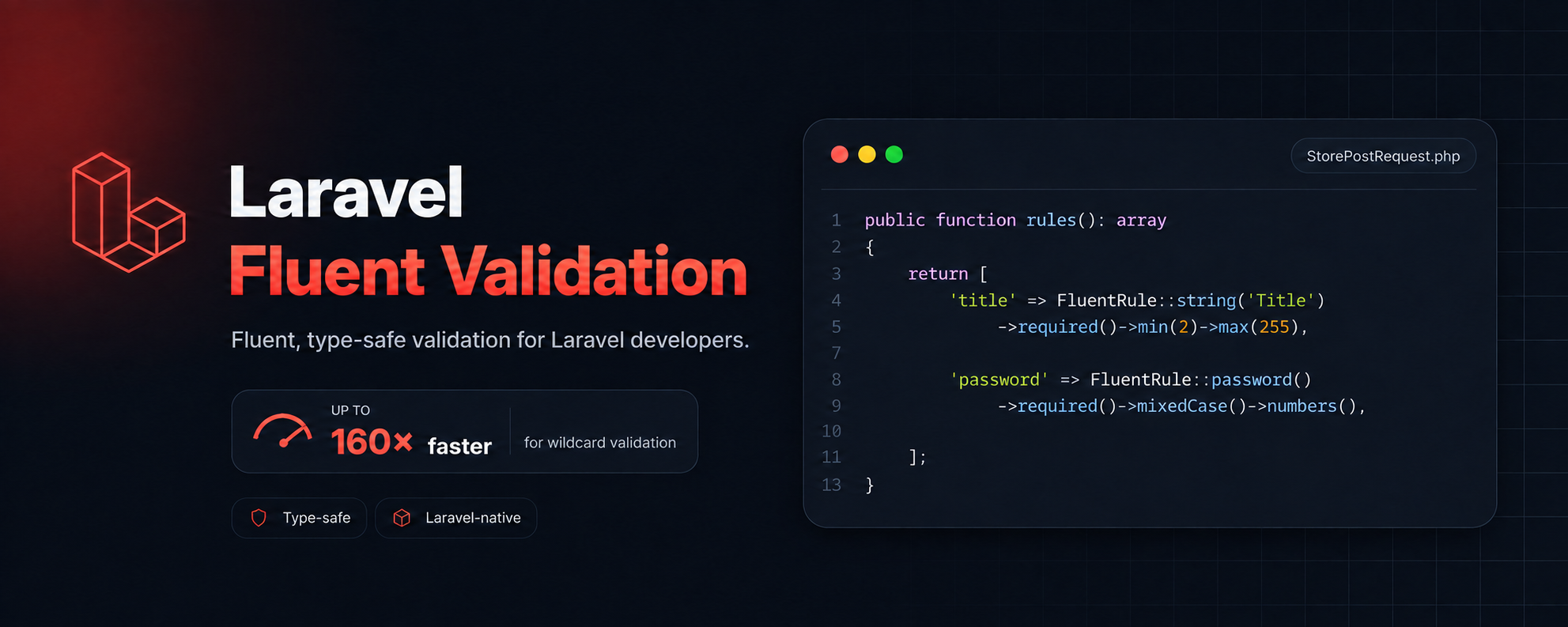
use Illuminate\Foundation\Http\FormRequest; use SanderMuller\FluentValidation\FluentRule; class StorePostRequest extends FormRequest { public function rules(): array { return [ 'title' => FluentRule::string('Title')->required()->min(2)->max(255), 'body' => FluentRule::string()->required(), 'email' => FluentRule::email('Email')->required()->unique('users'), 'date' => FluentRule::date('Publish Date')->required()->afterToday(), 'agree' => FluentRule::boolean()->accepted(), 'avatar' => FluentRule::image()->nullable()->max('2mb'), 'tags' => FluentRule::array(label: 'Tags')->required()->each( FluentRule::string()->max(50) ), 'password' => FluentRule::password()->required()->mixedCase()->numbers(), ]; } }
These rule objects implement Laravel's ValidationRule interface. They work in Form Requests, Validator::make(), Rule::forEach(), and Rule::when().
Gradual adoption
You don't need to convert all your rules at once. Fluent rules mix freely with string rules and native rule objects in the same array:
$rules = [ 'name' => FluentRule::string()->required()->min(2)->max(255), // fluent 'email' => 'required|string|email|max:255', // string, still works 'role' => ['required', LaravelRule::in(['admin', 'user'])], // array, still works ];
Relationship with Laravel's Rule class
FluentRule is intentionally named differently from Illuminate\Validation\Rule so both can be used without aliasing. You generally don't need Laravel's Rule at all:
Laravel's Rule |
FluentRule equivalent |
|---|---|
Rule::forEach(fn () => ...) |
FluentRule::array()->each(...) |
Rule::when($cond, $rules, $default) |
->when($cond, fn ($r) => ..., fn ($r) => ...) |
Rule::unique('users') |
FluentRule::string()->unique('users') |
Rule::exists('roles') |
FluentRule::string()->exists('roles') |
Rule::in([...]) |
FluentRule::string()->in([...]) |
Rule::enum(Status::class) |
FluentRule::string()->enum(Status::class) |
Rule::anyOf([...]) |
FluentRule::anyOf([...]) |
Why this package?
Better DX. IDE autocompletion for every rule. No more guessing required_with vs required_with_all, or whether it's digits_between or digitsBetween. The method names tell you.
Type-safe rule combinations. Each rule type only exposes methods that make sense for it. FluentRule::string() doesn't have digits(), FluentRule::numeric() doesn't have alpha(). Incompatible combinations like required|string|digits:5 become impossible. Your IDE catches them before you run a single test.
Inline error messages. Labels and per-rule messages live right next to the rules they belong to. No more maintaining a separate messages() array that drifts out of sync.
77x faster array validation. For large arrays (imports, bulk operations), RuleSet::validate() bypasses Laravel's O(n²) wildcard expansion and validates per-item with compiled fast-checks. See benchmarks.
Error messages
Labels
Pass a label to the factory method and every error message automatically uses it as the :attribute name:
return [ 'name' => FluentRule::string('Full Name')->required()->min(2)->max(255), 'email' => FluentRule::email('Email Address')->required(), 'age' => FluentRule::numeric('Your Age')->nullable()->integer()->min(0), 'items' => FluentRule::array(label: 'Import Items')->required()->min(1), ]; // "The Full Name field is required." // "The Email Address field must be a valid email address." // "The Import Items field must have at least 1 items."
Labels work in Form Requests, Validator::make(), and RuleSet::validate(). You may also set a label after construction using ->label('Name').
Per-rule messages
You may attach a custom error message to the most recently added rule using ->message():
FluentRule::string('Full Name') ->required()->message('We need your name!') ->min(2)->message('At least :min characters.') ->max(255)
Labels and messages compose naturally. Labels improve ALL error messages for the field, while ->message() overrides specific rules. For a field-level fallback that applies to any failure, use ->fieldMessage():
FluentRule::string()->required()->min(2)->fieldMessage('Something is wrong with this field.')
Note: Standard Laravel
messages()arrays andValidator::make()message arguments still work and take priority over->message()and->fieldMessage().
Array validation with each() and children()
When validating arrays of items, you may define the rules for each item inline using each():
// Scalar items: each tag must be a string under 255 characters FluentRule::array()->each(FluentRule::string()->max(255)) // Object items: each item has named fields FluentRule::array()->required()->each([ 'name' => FluentRule::string('Item Name')->required(), 'email' => FluentRule::string()->required()->rule('email'), 'qty' => FluentRule::numeric()->required()->integer()->min(1), ]) // Nested arrays FluentRule::array()->each([ 'items' => FluentRule::array()->each([ 'qty' => FluentRule::numeric()->required()->min(1), ]), ])
each() works both standalone (passed directly to a validator) and through RuleSet. When used through RuleSet, wildcard expansion is automatically optimized for better performance on large datasets.
Fixed-key children with children()
For objects with known keys (not wildcard arrays), you may use children() to co-locate the child rules with the parent:
// Instead of: 'search' => FluentRule::array()->required(), 'search.value' => FluentRule::string()->nullable(), 'search.regex' => FluentRule::string()->nullable()->in(['true', 'false']), // Write: 'search' => FluentRule::array()->required()->children([ 'value' => FluentRule::string()->nullable(), 'regex' => FluentRule::string()->nullable()->in(['true', 'false']), ]),
children() produces fixed paths (search.value), while each() produces wildcard paths (items.*.name). Both may be used together on the same array when needed.
children() is also available on FluentRule::field() for untyped fields with known sub-keys. You may combine it with rule() for polymorphic fields (e.g., FluentRule::field()->rule(FluentRule::anyOf(...))->children([...])).
Performance
Laravel's wildcard validation (items.*.name) has known O(n²) performance issues for large arrays. This package solves them.
Benchmarks
| Scenario | Native Laravel | RuleSet::validate() | Speedup |
|---|---|---|---|
| 500 items, 7 fields (string, numeric, date, boolean, in) | ~165ms | ~2.1ms | 77x |
100 items, 47 fields with exclude_unless |
~3,000ms | ~76ms | 40x |
How it works
RuleSet::validate() applies three optimizations automatically. You don't need to configure anything:
| Optimization | What it does | Speedup |
|---|---|---|
| Per-item validation | Reuses one small validator per item instead of one giant validator for all items | ~40x for complex rules |
| Compiled fast-checks | Compiles string rules to native PHP closures, skipping Laravel entirely for valid items | ~77x for simple rules |
| Conditional rule rewriting | Rewrites exclude_unless references to relative paths for per-item context |
Enables per-item for real-world validators |
How to use it
Option 1: RuleSet::validate() for inline validation:
$validated = RuleSet::from([ 'items' => FluentRule::array()->required()->each([ 'name' => FluentRule::string('Item Name')->required()->min(2), ]), ])->validate($request->all());
Option 2: ExpandsWildcards trait for Form Requests:
use SanderMuller\FluentValidation\ExpandsWildcards; class ImportRequest extends FormRequest { use ExpandsWildcards; public function rules(): array { return [ 'items' => FluentRule::array()->required()->each([ 'name' => FluentRule::string('Item Name')->required()->min(2), 'email' => FluentRule::string('Email')->required()->rule('email'), ]), ]; } }
Note: Without
RuleSetor theExpandsWildcardstrait, rules work normally through Laravel's built-in validation. You just won't get the performance optimization for wildcards.
Benchmarks run automatically on PRs via GitHub Actions.
RuleSet
RuleSet provides a structured way to define and validate complete rule sets. You may create one from an array of rules or build it fluently:
use SanderMuller\FluentValidation\RuleSet; // From an array $validated = RuleSet::from([ 'name' => FluentRule::string('Full Name')->required()->min(2)->max(255), 'email' => FluentRule::email('Email')->required(), 'items' => FluentRule::array()->required()->each([ 'name' => FluentRule::string()->required()->min(2), 'price' => FluentRule::numeric()->required()->min(0), ]), ])->validate($request->all()); // Or fluently, with conditional fields and merging $validated = RuleSet::make() ->field('name', FluentRule::string('Full Name')->required()) ->field('email', FluentRule::email('Email')->required()) ->when($isAdmin, fn (RuleSet $set) => $set ->field('role', FluentRule::string()->required()->in(['admin', 'editor'])) ->field('permissions', FluentRule::array()->required()) ) ->merge($sharedAddressRules) ->validate($request->all());
when() and unless() are available via Laravel's Conditionable trait. merge() accepts another RuleSet or a plain array.
| Method | Returns | Description |
|---|---|---|
RuleSet::from([...]) |
RuleSet |
Create from a rules array |
RuleSet::make()->field(...) |
RuleSet |
Fluent builder |
->merge($ruleSet) |
RuleSet |
Merge another RuleSet or array into this one |
->when($cond, $callback) |
RuleSet |
Conditionally add fields (also: unless) |
->toArray() |
array |
Flat rules with each() expanded to wildcards |
->validate($data) |
array |
Validate with full optimization (see Performance) |
->expandWildcards($data) |
array |
Pre-expand wildcards without validating |
RuleSet::compile($rules) |
array |
Compile fluent rules to native Laravel format |
Using with custom Validators
If you extend Illuminate\Validation\Validator directly (e.g., for import jobs), you may use RuleSet::compile() to convert FluentRules to native format:
class JsonImportValidator extends Validator { public function __construct($translator, $data, $user) { parent::__construct( $translator, $data, rules: RuleSet::compile($this->buildRules()), ); } private function buildRules(): array { return [ '*.type' => FluentRule::string()->required()->in(InteractionType::cases()), '*.end_time' => FluentRule::numeric() ->requiredUnless('*.type', ...InteractionType::withoutDuration()) ->greaterThanOrEqualTo('*.start_time'), ]; } }
Note: When rules reference other fields using wildcards (e.g.,
requiredUnless('*.type', ...)), useRuleSet::compile()so the outer validator handles wildcard expansion. FluentRules used as standaloneValidationRuleobjects self-validate in isolation and can't resolve cross-field wildcard references.
Tip: For validators with many cross-field references using a dynamic prefix, a simple helper reduces repetition:
protected function ref(string ...$parts): string { return $this->prefix . '*.' . implode('.', $parts); } // Then: ->excludeUnless($this->ref('type'), ...) instead of // ->excludeUnless($this->prefix . '*.' . ExternalInteraction::TYPE, ...)
Rule reference
String
Validate string values with length, pattern, format, and comparison constraints:
FluentRule::string()->min(2)->max(255)->between(2, 255)->exactly(10) FluentRule::string()->alpha()->alphaDash()->alphaNumeric() // also: alpha(ascii: true) FluentRule::string()->regex('/^[A-Z]+$/')->notRegex('/\d/') FluentRule::string()->startsWith('prefix_')->endsWith('.txt') // also: doesntStartWith(), doesntEndWith() FluentRule::string()->lowercase()->uppercase() FluentRule::string()->url()->uuid()->ulid()->json()->ip()->macAddress()->timezone()->hexColor() FluentRule::string()->confirmed()->currentPassword()->same('field')->different('field') FluentRule::string()->inArray('values.*')->inArrayKeys('values.*')->distinct()
Validate email addresses with configurable strictness:
FluentRule::email()->rfcCompliant()->strict()->validateMxRecord()->preventSpoofing() FluentRule::email()->withNativeValidation(allowUnicode: true) FluentRule::email()->required()->unique('users', 'email')
Tip:
FluentRule::string()->email()is also available if you prefer keeping email as a string modifier.
Password
Validate password strength with readable, chainable requirements:
FluentRule::password(min: 12)->letters()->mixedCase()->numbers()->symbols()->uncompromised()
Numeric
Validate numbers with type, size, digit, and comparison constraints:
FluentRule::numeric()->integer(strict: true)->decimal(2)->min(0)->max(100)->between(1, 99) FluentRule::numeric()->digits(4)->digitsBetween(4, 6)->minDigits(3)->maxDigits(5)->multipleOf(5) FluentRule::numeric()->greaterThan('field')->lessThan('field') // also: greaterThanOrEqualTo(), lessThanOrEqualTo()
Date
Validate dates with boundaries, convenience shortcuts, and format control. All comparison methods accept DateTimeInterface|string:
FluentRule::date()->after('today')->before('2025-12-31')->between('2025-01-01', '2025-12-31') FluentRule::date()->afterToday()->future()->nowOrPast() // also: beforeToday(), todayOrAfter(), past(), nowOrFuture() FluentRule::date()->format('Y-m-d')->dateEquals('2025-06-15') FluentRule::dateTime()->afterToday() // shortcut for format('Y-m-d H:i:s')
Boolean
Validate boolean values and acceptance/decline:
FluentRule::boolean()->accepted()->declined() FluentRule::boolean()->acceptedIf('role', 'admin')->declinedIf('type', 'free')
Array
Validate arrays with size constraints, structure requirements, and allowed keys:
FluentRule::array()->min(1)->max(10)->between(1, 5)->exactly(3)->list() FluentRule::array()->requiredArrayKeys('name', 'email') FluentRule::array(['name', 'email']) // restrict allowed keys FluentRule::array(MyEnum::cases()) // BackedEnum keys
File
Validate uploaded files with size and type constraints. Size methods accept integers (kilobytes) or human-readable strings:
FluentRule::file()->max('5mb')->between('1mb', '10mb') FluentRule::file()->extensions('pdf', 'docx')->mimes('jpg', 'png')->mimetypes('application/pdf')
Image
Validate images with dimension constraints. Inherits all file methods:
FluentRule::image()->max('5mb')->allowSvg() FluentRule::image()->minWidth(100)->maxWidth(1920)->minHeight(100)->maxHeight(1080) FluentRule::image()->width(800)->height(600)->ratio(16 / 9)
Field (untyped)
When a field needs modifiers but no type constraint, you may use FluentRule::field():
FluentRule::field()->present() FluentRule::field()->requiredIf('type', 'special') FluentRule::field('Answer')->nullable()->in(['yes', 'no'])
AnyOf
Validate that a value passes at least one of the given rule sets (Laravel's Rule::anyOf equivalent):
FluentRule::anyOf([ FluentRule::string()->required()->min(2), FluentRule::numeric()->required()->integer(), ])
Embedded rules
String, numeric, and date rules support embedded Laravel rule objects for in, unique, exists, and enum. Both in() and notIn() accept either an array of values or a BackedEnum class:
FluentRule::string()->in(['draft', 'published']) FluentRule::string()->in(StatusEnum::class) // all enum values FluentRule::string()->notIn(DeprecatedStatus::class) FluentRule::string()->enum(StatusEnum::class) FluentRule::string()->unique('users', 'email') FluentRule::string()->exists('roles', 'name')
Field modifiers
All rule types share common modifiers for controlling field presence, prohibition, and exclusion:
// Presence ->required() ->nullable() ->sometimes() ->filled() ->present() ->missing() // Conditional presence: accepts field references or Closure|bool ->requiredIf('role', 'admin') ->requiredUnless('type', 'guest') ->requiredIf(fn () => $cond) ->requiredWith('field') ->requiredWithAll('a', 'b') ->requiredWithout('field') ->requiredWithoutAll('a', 'b') // Prohibition & exclusion ->prohibited() ->prohibitedIf('field', 'val') ->prohibitedUnless('field', 'val') ->prohibits('other') ->exclude() ->excludeIf('field', 'val') ->excludeUnless('field', 'val') ->excludeWith('f') ->excludeWithout('f') // Messages ->label('Name') ->message('Rule-specific error') ->fieldMessage('Field-level fallback') // Other ->bail() ->rule($stringOrObjectOrArray) ->whenInput($condition, $then, $else?)
Note:
excluderules only affectvalidated()output when placed at the outer validator level. To exclude a field from validated data, placeexcludealongside the fluent rule:'field' => ['exclude', FluentRule::string()]
Conditional rules
All rule types use Laravel's Conditionable trait, so you may conditionally apply rules using when():
FluentRule::string()->required()->when($isAdmin, fn ($r) => $r->min(12))->max(255)
For data-dependent conditions that need to inspect the input at validation time, you may use whenInput():
FluentRule::string()->whenInput( fn ($input) => $input->role === 'admin', fn ($r) => $r->required()->min(12), fn ($r) => $r->sometimes()->max(100), )
The condition closure receives the full input as a Fluent object and is evaluated during validation, not at build time. You may also pass string rules instead of closures: ->whenInput($condition, 'required|min:12').
Escape hatch
You may add any Laravel validation rule via rule(). Accepts strings, objects, and array tuples:
FluentRule::string()->rule('email:rfc,dns') FluentRule::string()->rule(new MyCustomRule()) FluentRule::file()->rule(['mimetypes', ...$acceptedTypes])
Macros
Macros let you create reusable rule chains that can be shared across fields and files:
// In a service provider NumericRule::macro('percentage', fn () => $this->integer()->min(0)->max(100)); StringRule::macro('slug', fn () => $this->alpha(true)->lowercase()); // Then use anywhere FluentRule::numeric()->percentage() FluentRule::string()->slug()
Testing
composer test
Changelog
Please see CHANGELOG for more information on what has changed recently.
Security Vulnerabilities
Please review our security policy on how to report security vulnerabilities.
Credits
License
The MIT License (MIT). Please see License File for more information.