
roundly-consulting / safe-fetch-for-laravel

SSRF protection for Laravel's HTTP client: strict URL canonicalising, private and cloud-metadata address blocking, DNS pinning, re-vetted redirects and a validation rule.
Package info
github.com/roundly-consulting/safe-fetch-for-laravel
pkg:composer/roundly-consulting/safe-fetch-for-laravel
Fund package maintenance!
Requires
- php: ^8.4
- illuminate/console: ^13.0
- illuminate/contracts: ^13.0
- illuminate/http: ^13.0
- illuminate/support: ^13.0
- illuminate/translation: ^13.0
- illuminate/validation: ^13.0
- roundly-consulting/enums-for-laravel: ^2.0
- roundly-consulting/package-toolkit-for-laravel: ^2.0
Requires (Dev)
- larastan/larastan: ^3.0
- laravel/pint: ^1.18
- nunomaduro/collision: ^8.5
- orchestra/testbench: ^11.0
- pestphp/pest: ^5.0
- pestphp/pest-plugin-arch: ^5.0
- pestphp/pest-plugin-laravel: ^5.0
- phpstan/extension-installer: ^1.4
- roundly-consulting/testing-for-laravel: ^2.0
Suggests
- ext-curl: Required to send guarded requests: DNS pinning uses CURLOPT_RESOLVE. Without it vet(), allows() and precheck() still judge URLs, but Http::safe(), guard(), http(), fetch(), download() and VettedDestination::pinningOptions() refuse with cannot_pin.
- ext-intl: International (IDN) host names; without it they are refused.
Provides
None
Conflicts
None
Replaces
None
README
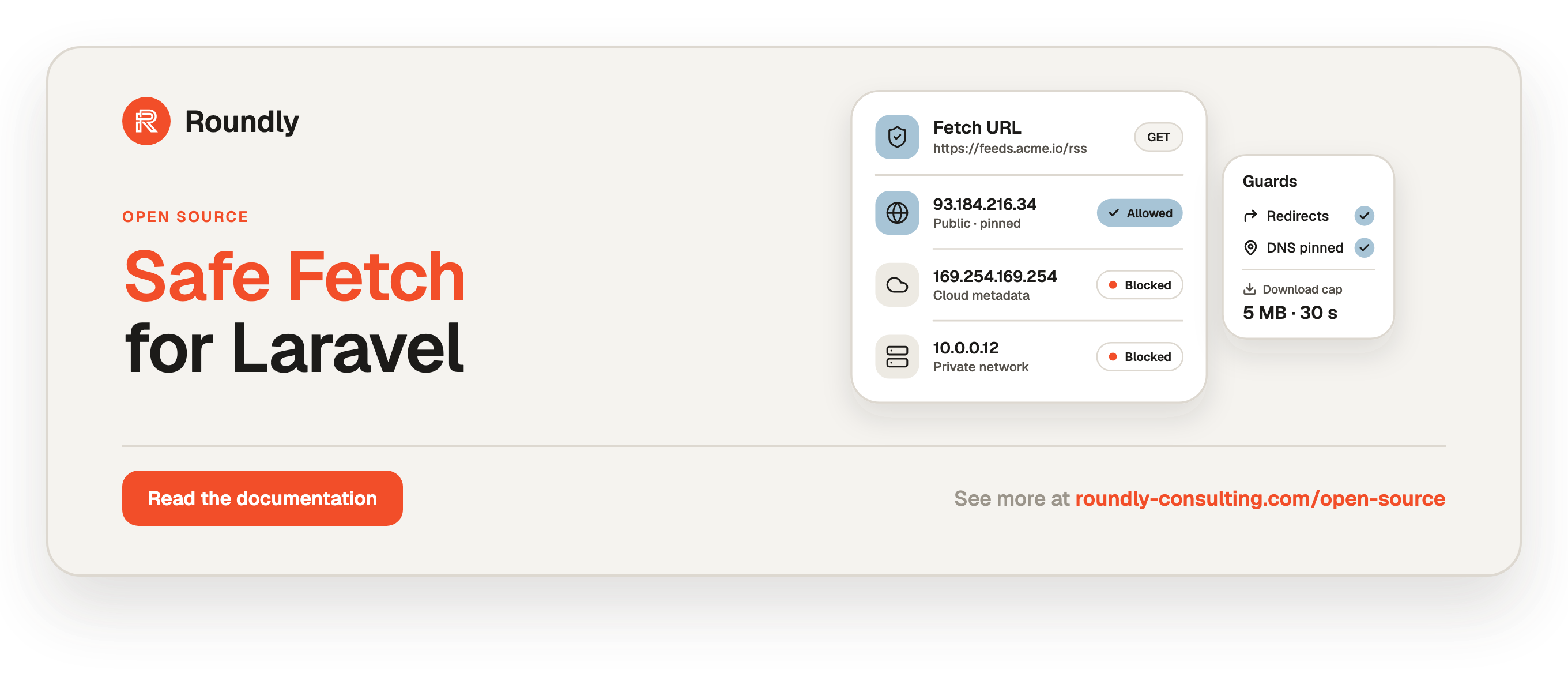
Safe Fetch for Laravel
Make server-side requests to URLs you do not control — webhook targets, link previews, avatar, feed and import URLs — without reaching your own network. Every URL is parsed strictly, every address it resolves to must be public, and the connection is pinned to exactly those addresses, redirects included.
Installation
Requires PHP 8.4 and Laravel 13; ext-curl to send requests (ext-intl for international
host names).
composer require roundly-consulting/safe-fetch-for-laravel
Usage
Validate a URL a user hands in, then fetch it — capped, with errors that say whether a retry can help:
use Illuminate\Support\Facades\Http;
use RoundlyConsulting\SafeFetch\Exceptions\SafeFetchException;
use RoundlyConsulting\SafeFetch\Facades\SafeFetch;
use RoundlyConsulting\SafeFetch\Rules\SafeUrl;

$request->validate(['feed' => ['required', 'string', 'max:2048', new SafeUrl]]);

try {
    $feed = SafeFetch::fetch($request->input('feed'), maxBytes: 2_000_000);
    // $feed->body, $feed->contentType, $feed->url
} catch (SafeFetchException $e) {
    $e->retryable(); // a 5xx or a timeout can heal; a blocked address never does
}
Or guard any Laravel HTTP call:
Http::safe()->withToken($token)->post($hookUrl, $payload);
Documentation
The full documentation — configuration, every feature and its API, and testing — lives on our website: roundly-consulting.com/open-source/docs/safe-fetch-for-laravel
Release notes are in CHANGELOG.md. To contribute, see the contributing guide.
Support our work
This package is free and open source, built and maintained by Roundly Consulting. If it saves you time, please consider supporting our open-source work — a one-time donation, a monthly pledge on Patreon or a crypto donation helps fund maintenance, new features and new packages.
License
The MIT License (MIT). See LICENSE.md.