
jeffersongoncalves / laravel-zapsign

Laravel client for the ZapSign API (e-signature): documents, templates, signers, rate-limit aware requests, database persistence, queued jobs and webhooks.
Package info
github.com/jeffersongoncalves/laravel-zapsign
pkg:composer/jeffersongoncalves/laravel-zapsign
Requires
- php: ^8.2|^8.3|^8.4
- laravel/framework: ^12.61.1|^13.12.0
- spatie/laravel-package-tools: ^1.16
Requires (Dev)
- jeffersongoncalves/pest-plugin-database-migrations: ^1.0
- larastan/larastan: ^3.0
- laravel/pint: ^1.24
- orchestra/testbench: ^10.0|^11.0
- pestphp/pest: ^3.7.4|^4.0
- pestphp/pest-plugin-laravel: ^3.0|^4.0
Suggests
None
Provides
None
Conflicts
None
Replaces
None
README
Laravel ZapSign
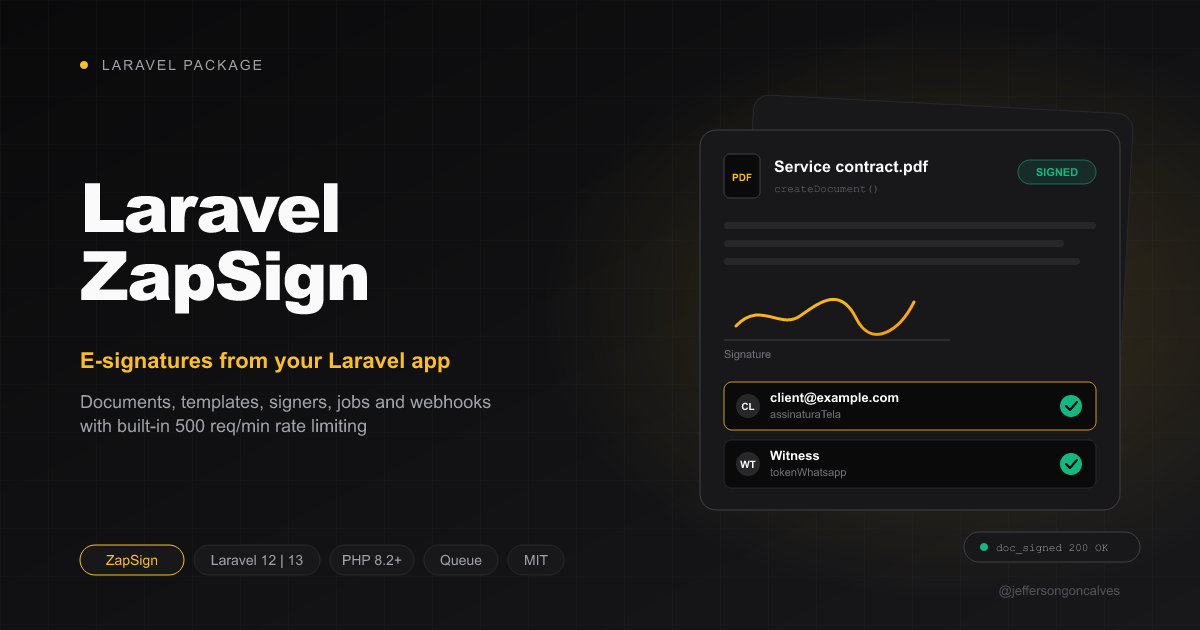
Laravel client for the ZapSign e-signature REST API: documents, templates, signers and webhooks — rate-limit aware out of the box, with database persistence and queued jobs.
ZapSign allows 500 requests per minute per token/IP and answers 429 above that. This package:
- throttles requests client-side through your cache store, so every worker sharing the store stays under the limit;
- waits for a free slot (up to
max_waitseconds) instead of failing, or throws aRateLimitExceptionyou can use torelease()a queued job; - retries any
429/503that still reaches the API with exponential backoff, honouringRetry-After(never timeouts/502, which could create a document twice); - queued jobs release themselves on a rate limit instead of failing.
Documents and signers can be stored in your database and kept up to date by queued jobs and webhooks, and signed PDFs copied to any filesystem disk before ZapSign's 60-minute links expire.
Installation
composer require jeffersongoncalves/laravel-zapsign
Publish the config and migrations, then migrate (creates zapsign_documents, zapsign_signers and zapsign_webhook_calls):
php artisan zapsign:install
# or
php artisan vendor:publish --tag="zapsign-config"
php artisan vendor:publish --tag="zapsign-migrations"
php artisan migrate
Add your API token (ZapSign > Settings > Integration > ZapSign API):
ZAPSIGN_TOKEN=your-token
# Sandbox account:
# ZAPSIGN_URL=https://sandbox.api.zapsign.com.br
Usage
use JeffersonGoncalves\ZapSign\Facades\ZapSign;

// Create a document from a PDF URL (or base64_pdf, url_docx, base64_docx, markdown_text)
$document = ZapSign::createDocument([
    'name' => 'Service contract',
    'url_pdf' => 'https://example.com/contract.pdf',
    'lang' => 'pt-br',
    'external_id' => 'order-42',
    'signers' => [
        ['name' => 'Client', 'email' => 'client@example.com', 'auth_mode' => 'assinaturaTela', 'send_automatic_email' => true],
    ],
]);

$document['token'];
$document['signers'][0]['sign_url'];

// From a template
ZapSign::createDocumentFromTemplate([
    'template_id' => 'your-template-id',
    'signer_name' => 'Client',
    'data' => [['de' => '{{NOME COMPLETO}}', 'para' => 'Client Name']],
]);

// Async variants (large files): ZapSign answers right away and notifies via webhook
ZapSign::createDocument($data, async: true);
ZapSign::createDocumentFromTemplate($data, async: true);

// Documents
ZapSign::document($token);
ZapSign::documents(page: 1, filters: ['status' => 'signed', 'include_signers' => true]);
ZapSign::addExtraDocument($token, ['name' => 'Annex', 'url_pdf' => '...']);
ZapSign::placeSignatures($token, [['page' => 0, 'relative_position_bottom' => 52.5, 'relative_position_left' => 75.7, 'relative_size_x' => 19.55, 'relative_size_y' => 9.42, 'type' => 'signature', 'signer_token' => $signerToken]]);
ZapSign::cancelDocument($token, reason: 'Canceled by the company', notifySigners: true);
ZapSign::deleteDocument($token);

// Signers
ZapSign::addSigner($token, ['name' => 'Witness', 'email' => 'witness@example.com']);
ZapSign::signer($signerToken);
ZapSign::updateSigner($signerToken, ['name' => 'New name']);
ZapSign::deleteSigner($signerToken);
ZapSign::signInBatch($userToken, [$signerToken1, $signerToken2]);

// Any other endpoint under /api/v1/
ZapSign::request('get', 'templates/');
Every method returns the decoded JSON response as an array. Request bodies follow the ZapSign docs field names as-is.
Errors
use JeffersonGoncalves\ZapSign\Exceptions\RateLimitException;
use JeffersonGoncalves\ZapSign\Exceptions\ZapSignException;

try {
    ZapSign::document('missing');
} catch (RateLimitException $e) {
    $e->retryAfter; // seconds
} catch (ZapSignException $e) {
    $e->getMessage(); // ZapSign's `detail`/`message`
    $e->getCode();    // HTTP status
    $e->errors();     // decoded error body
}
Database and jobs
Models
| Model | Table | Holds |
|---|---|---|
Models\Document |
zapsign_documents |
token, external_id, name, status (pending/signed/refused), sandbox, original_file, signed_file, signed_file_path, rejected_reason, finished_at, raw payload, optional documentable (any model) — soft deletes |
Models\Signer |
zapsign_signers |
token, external_id, name, email, phone, status, sign_url, times_viewed, last_view_at, signed_at, raw payload |
Models\WebhookCall |
zapsign_webhook_calls |
every received webhook (body hash unique), event_type, document_token, processed_at, exception |
use JeffersonGoncalves\ZapSign\Models\Document;

$documents = Document::query()->forModel($contract)->with('signers')->get();

$document->isSigned();
$document->isRefused();
$document->documentable; // the model you linked
Document::query()->where('status', Document::STATUS_PENDING)->get();
Document::sync(array $data, ?Model $documentable = null) upserts any document array returned by the API or a webhook (same shape) with its signers — signers missing from the payload are removed — so you can store results of your own calls too.
Jobs
use JeffersonGoncalves\ZapSign\Jobs\CreateDocument;
use JeffersonGoncalves\ZapSign\Jobs\SyncDocument;

// Send a file (local path, or a path on any filesystem disk — S3 included) as base64, store and link to a model
CreateDocument::dispatch(
    data: ['name' => 'Service contract', 'signers' => [['name' => 'Client', 'email' => 'client@example.com']]],
    documentable: $contract,
    path: 'contracts/42.pdf', // .pdf or .docx
    disk: 's3',
);

// Or with url_pdf / a template
CreateDocument::dispatch(['template_id' => '...', 'signer_name' => 'Client'], $contract, fromTemplate: true);

// Refresh a document (and its signers) from the API
SyncDocument::dispatch($token);
- On a rate limit the jobs
release()themselves for theRetry-Aftertime ($tries = 10). CreateDocumentis not retried after an error ($maxExceptions = 1): the document may already exist at ZapSign and credits may be spent.SyncDocumentis unique per document for 60 s, so bursts collapse into one request.StoreSignedFiledownloads the signed PDF toZAPSIGN_FILES_DISK(ZAPSIGN_FILES_DIRECTORY/{token}.pdf) and savessigned_file_path; it is queued automatically when a webhook marks a document signed, or dispatch it yourself:StoreSignedFile::dispatch($document).- Set
ZAPSIGN_QUEUE_CONNECTION/ZAPSIGN_QUEUEto run them on a dedicated queue.
Rate limit in your own jobs
The client already waits for a free slot. In your own jobs, keep max_wait small and release the job instead of blocking the worker:
public function handle(): void
{
    try {
        ZapSign::createDocument([...]);
    } catch (RateLimitException $e) {
        $this->release($e->retryAfter);
    }
}
Option (config/zapsign.php) |
Env | Default |
|---|---|---|
rate_limit.enabled |
ZAPSIGN_RATE_LIMIT_ENABLED |
true |
rate_limit.max_attempts |
ZAPSIGN_RATE_LIMIT_MAX_ATTEMPTS |
500 |
rate_limit.decay_seconds |
ZAPSIGN_RATE_LIMIT_DECAY_SECONDS |
60 |
rate_limit.max_wait |
ZAPSIGN_RATE_LIMIT_MAX_WAIT |
60 |
rate_limit.cache_store |
ZAPSIGN_RATE_LIMIT_CACHE_STORE |
default store |
rate_limit.retry_times |
ZAPSIGN_RETRY_TIMES |
3 |
rate_limit.retry_sleep_ms |
ZAPSIGN_RETRY_SLEEP_MS |
1000 (doubles each retry) |
Use a shared store (Redis, database) when you run several servers/workers — the array or file store only limits a single process/host.
Webhooks
ZapSign does not sign webhook requests, so the endpoint is protected by a secret header that you register together with the webhook:
ZAPSIGN_WEBHOOK_SECRET=a-long-random-string
ZAPSIGN_WEBHOOK_HEADER=X-ZapSign-Secret
ZAPSIGN_WEBHOOK_PATH=zapsign/webhook
Register https://your-app.com/zapsign/webhook in ZapSign (Settings > Integration > Webhooks) with a custom header X-ZapSign-Secret: a-long-random-string, or via the API:
ZapSign::request('post', 'user/company/webhook/', [
    'url' => route('zapsign.webhook'),
    'type' => '', // all events
    'headers' => [['name' => 'X-ZapSign-Secret', 'value' => config('zapsign.webhook.secret')]],
]);
The POST /zapsign/webhook route (name zapsign.webhook) is registered only when a secret is set. It:
- checks the secret header (
403otherwise); - stores the call in
zapsign_webhook_calls— once per body (ZapSign sends no event id and redelivers until it gets a200), so duplicate deliveries are ignored; - answers
200right away and queuesProcessWebhookCall, which upserts the document and its signers from the body, soft-deletes ondoc_deleted, queuesStoreSignedFilewhen the document is signed and a disk is configured, and finally dispatchesWebhookReceived.
The route has no web middleware, so CSRF does not apply. Schedule php artisan model:prune to remove stored calls older than ZAPSIGN_WEBHOOK_PRUNE_AFTER_DAYS (30).
use Illuminate\Support\Facades\Event;
use JeffersonGoncalves\ZapSign\Events\WebhookReceived;
use JeffersonGoncalves\ZapSign\Models\Document;

Event::listen(function (WebhookReceived $event) {
    $document = Document::query()->where('token', $event->documentToken())->first();

    match ($event->type()) {
        'doc_signed' => /* $event->payload['signer_who_signed'] */ null,
        'doc_refused', 'email_bounce' => /* ... */ null,
        default => null,
    };
});
The listener runs after the local tables are updated. $event->payload holds the full body.
Testing
composer test
Changelog
Please see CHANGELOG for more information on what has changed recently.
License
The MIT License (MIT). Please see License File for more information.