
jeffersongoncalves / laravel-telegram-logger

Send Laravel logs to a Telegram chat with deduplication, configurable error grouping, rate limiting, async delivery, forum topics and a graceful no-op when the bot is not configured.
Package info
github.com/jeffersongoncalves/laravel-telegram-logger
pkg:composer/jeffersongoncalves/laravel-telegram-logger
Requires
- php: ^8.2|^8.3|^8.4
- laravel/framework: ^12.61.1|^13.12.0
- spatie/laravel-package-tools: ^1.14.0
Requires (Dev)
- larastan/larastan: ^3.0
- laravel/pint: ^1.24
- orchestra/testbench: ^10.0|^11.0
- pestphp/pest: ^3.7.4|^4.0
- pestphp/pest-plugin-laravel: ^3.0|^4.0
Suggests
None
Provides
None
Conflicts
None
Replaces
None
README
Laravel Telegram Logger
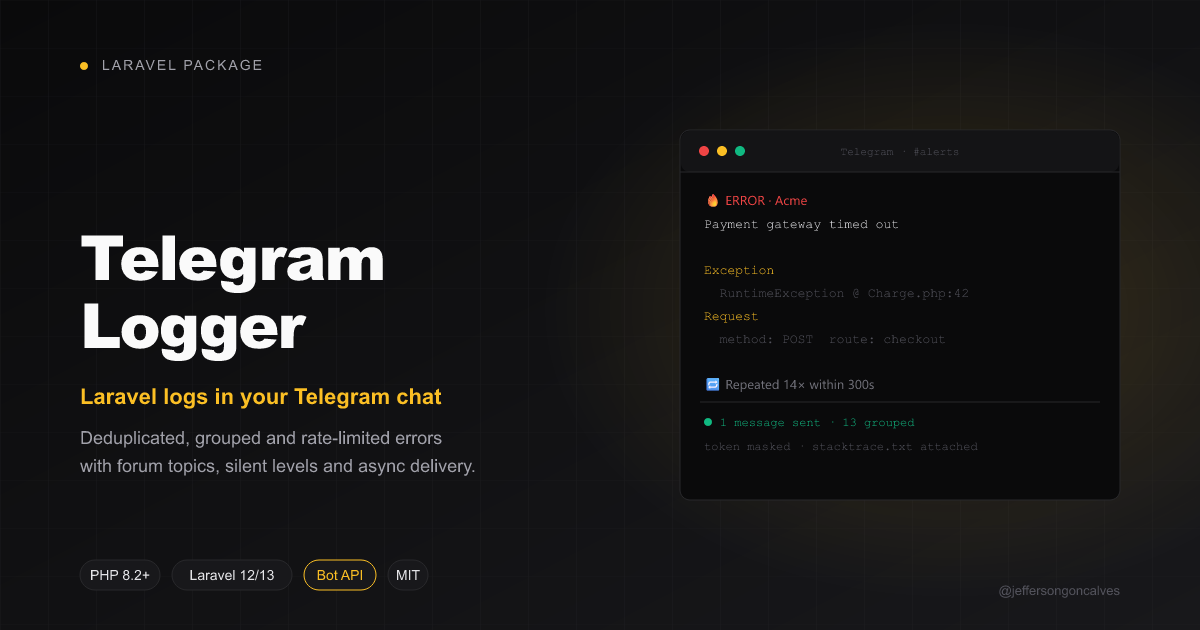
Send Laravel logs to a Telegram chat — built for production. A Monolog channel with deduplication, configurable error grouping, rate limiting, async delivery with 429 backoff, forum topics, silent levels and a graceful no-op when the bot isn't configured.
The sibling of laravel-discord-logger: same pipeline, Telegram Bot API transport.
Installation
composer require jeffersongoncalves/laravel-telegram-logger
Publish the config (optional):
php artisan vendor:publish --tag="laravel-telegram-logger-config"
Create the bot
- Talk to @BotFather, send
/newbotand copy the token (123456789:AA...). - Add the bot to the group or channel that should receive the logs (in a channel, as an admin that can post).
- Get the chat id: send any message in the group, then open
https://api.telegram.org/bot<TOKEN>/getUpdatesand readmessage.chat.id(groups are negative, e.g.-1001234567890). For a private chat with the bot, it's your user id. - Using a supergroup with topics? The topic id is
message.message_thread_idin the same response.
Configuration
Add a channel to config/logging.php:
'telegram' => [
    'driver'    => 'custom',
    'via'       => \JeffersonGoncalves\TelegramLogger\Logger::class,
    'level'     => env('LOG_TELEGRAM_LEVEL', 'error'),
    'token'     => env('LOG_TELEGRAM_BOT_TOKEN'),
    'chat_id'   => env('LOG_TELEGRAM_CHAT_ID'),
    'thread_id' => env('LOG_TELEGRAM_THREAD_ID'), // optional forum topic
],
Stack it onto your default channel so errors fan out:
'stack' => [
    'driver'   => 'stack',
    'channels' => ['single', 'telegram'],
    'ignore_exceptions' => false,
],
Set the bot (leave empty in local/testing — nothing will be sent, nothing will break):
LOG_TELEGRAM_BOT_TOKEN=123456789:AA...
LOG_TELEGRAM_CHAT_ID=-1001234567890
Check it:
php artisan telegram-logger:test
How it works
Message format
Each log becomes one HTML message: the level and app name, the (redacted) message, then sections — Exception, Request / Livewire / Job / Command (where it came from), Stacktrace, Context and Extra — and the time. Everything is HTML-escaped. When the text would pass Telegram's 4096-character limit, sections are dropped from the end, so the message always goes through.
Error grouping (fingerprint)
config/telegram-logger.php → grouping.strategy:
message— group by message textlevel_message— group by level + messageexception(default) — group by exception class + file + line- a
callbackfn (\Monolog\LogRecord $record): stringfor full control
With grouping.normalize on, volatile tokens (numbers, UUIDs, hashes) are stripped before hashing, so User 123 not found and User 456 not found collapse together.
Deduplication
Within deduplication.window seconds, only the first occurrence of a fingerprint is sent. Repeats are counted silently. When the window closes, a single summary (🔁 Repeated N×) is delivered — turn it off with deduplication.summary => false.
Rate limiting
rate_limit.global— hard cap on total messages app-wide (default 20/minute, Telegram's limit for a group)rate_limit.per_fingerprint— extra guard against a single looping error
Async delivery
Delivery runs through a queued job by default (queue.enabled). Telegram 429s are retried after parameters.retry_after; an unreachable Telegram (DNS/connect/timeout) or a 5xx is retried with backoff (10s, 30s, 60s, 120s); 4xx errors (bad token, chat not found, bot removed from the chat) fail fast and Telegram's description is written to the fallback channel. After the last attempt the job gives up quietly — the delivery job never throws, so a Telegram outage can't produce Telegram messages about itself. Tune timeout / connect_timeout (seconds). Set queue.enabled => false to send inline (best-effort, errors swallowed).
This means a queue worker must be running (
php artisan queue:work, Horizon, or supervisor) forLog::error(...)calls to actually reach Telegram.telegram-logger:testsends inline and bypasses the queue, so it succeeds even with no worker running — don't use it alone to confirm real logging works. If you don't run a worker, setTELEGRAM_LOGGER_QUEUE=false.
State store
Dedup + rate-limit counters live in the cache store named by store (null = default). Use Redis in production for atomic counters.
Per-level chats, mentions and silent levels
Route a level to another chat (same bot) or topic, ping someone when it matters, and keep low levels from buzzing phones:
'chats' => [
    'EMERGENCY' => env('TELEGRAM_LOGGER_CHAT_ALERTS'),
    'CRITICAL'  => ['chat_id' => env('TELEGRAM_LOGGER_CHAT_ALERTS'), 'thread_id' => 42],
],

'mentions' => [
    'EMERGENCY' => '@devops_lead @oncall',
],

// Sent with disable_notification (no sound)
'silent' => ['DEBUG', 'INFO', 'NOTICE'],
A plain per-level chat id doesn't inherit the channel's thread_id; use the array form to target a topic.
Runtime context
Each message says where it came from (turn off with TELEGRAM_LOGGER_RUNTIME_CONTEXT=false):
- Request — method, URL, route name, user id (only if already resolved — logging never triggers a user lookup) and IP
- Livewire — on a Livewire update request (which always hits
/livewire/update), the component name(s) it targeted and the page path, read from the component snapshots - Job — class, queue, connection, attempt and id of the queued job being processed, including when the log is the job's own failure
- Command — the artisan command name (never its arguments, which may carry secrets), for console logs outside a job
To add your own sections — the tenant, the user kept in the session... — point context_resolver in config/telegram-logger.php to an invokable class. It runs at log time; each key becomes a section (a scalar, or an array shown as key: value lines), redacted like the rest. It works with runtime_context off too, and a resolver that throws only costs its own sections:
// config/telegram-logger.php
'context_resolver' => App\Logging\TelegramContext::class,

// app/Logging/TelegramContext.php
class TelegramContext
{
    public function __invoke(): array
    {
        if (! session('logged_in')) {
            return ['User' => 'Guest'];
        }

        return [
            'Company' => session('company.name'),
            'User' => ['id' => session('user_id'), 'name' => session('user_name')],
        ];
    }
}
Anything in the record's extra — e.g. data added with Laravel's Context::add(), or Monolog processors — is shown in an Extra section. All of it goes through redaction, so ?token=... in a URL is masked.
Full stacktrace document
The message shows at most 1000 characters of stacktrace (vendor frames dropped in smart mode). When the exception is longer, the whole thing — message, every frame and each chained previous exception, redacted — is also sent as a stacktrace.txt document replying to the message, so nothing is lost to truncation. Disable with TELEGRAM_LOGGER_ATTACH_STACKTRACE=false; it's also skipped when stacktrace is none. The file is capped at 64 KiB to keep the queued job under SQS's 256 KiB limit.
Context redaction
Sensitive data is masked before it ever reaches Telegram, via two complementary strategies:
- Key matching (
redact) — case-insensitive key fragments whose values are masked. Defaults coverpassword,secret,token,authorization,api_key,apikey. Scrubbing recurses into nested arrays and the public properties of objects carried in the context. - Value patterns (
redact_value_patterns) — PCRE regexes matched against scalar values, so a secret leaking under an innocuous key (e.g.url,auth) — or inside the message text and the stacktrace — is still caught. Defaults coverBearertokens, JWTs,Basiccredentials, sensitive"key":"value"pairs inside serialized JSON text, and?token=...-style query strings; leave the array empty to disable value-based redaction. A pattern may declare a named(?<safe>...)group to keep that part of the match in the output (e.g. the key name) — any other capture group is ignored, so it can't leak part of the secret back out.
Fallback channel & safety
The handler never throws and is guarded against logging-while-logging recursion. If delivery fails (inline, or after the queued job's last retry), the error is swallowed; set fallback_channel (e.g. 'single') to record those failures instead of losing them. The fallback message is redacted, and a fallback channel that reaches Telegram (the Telegram channel itself, or a stack containing it) is ignored so a failure can't loop.
Bot tokens (<bot id>:<secret>, alone or inside api.telegram.org/bot.../ URLs) are always masked by the redactor — in fallback messages, telegram-logger:test output and anything sent to Telegram — independently of redact_value_patterns.
Troubleshooting
telegram-logger:test works, but Log::error(...) never shows up in Telegram.
The test command sends inline. Real log calls go through a queued job by default (see Async delivery), so nothing is delivered until a queue worker processes it. Run a worker (php artisan queue:work, or Horizon/supervisor in production), or set TELEGRAM_LOGGER_QUEUE=false. On a fresh Laravel install QUEUE_CONNECTION defaults to database, but no worker runs automatically — jobs just sit pending in the jobs table.
Also check the channel's level in config/logging.php — if it's above the level you're logging at (e.g. level => 'error' while calling Log::info(...)), Monolog filters the record before it reaches the handler.
Bad Request: chat not found / Forbidden: bot was kicked. The bot must be a member of the chat (an admin that can post, in a channel), and group ids are negative. telegram-logger:test prints Telegram's description.
Commands
# Publish the config + optionally star the repo
php artisan telegram-logger:install

# Send a test message to verify the bot and chat
php artisan telegram-logger:test --channel=telegram

# Send a sample exception through the real converter (message + stacktrace.txt)
php artisan telegram-logger:test --exception
Testing
composer test
Changelog
Please see CHANGELOG for more information on what has changed recently.
Contributing
Please see CONTRIBUTING for details.
Security Vulnerabilities
Please review our security policy on how to report security vulnerabilities.
Credits
License
The MIT License (MIT). See License File.