
jeffersongoncalves / laravel-gdpr

GDPR toolkit core for Laravel: declare personal data on Eloquent models with its Art. 6 lawful basis, build the data inventory, export and anonymize data subjects, check k-anonymity.
Package info
github.com/jeffersongoncalves/laravel-gdpr
pkg:composer/jeffersongoncalves/laravel-gdpr
Requires
- php: ^8.2
- illuminate/console: ^12.0|^13.0
- illuminate/contracts: ^12.0|^13.0
- illuminate/database: ^12.0|^13.0
- illuminate/support: ^12.0|^13.0
- spatie/laravel-package-tools: ^1.16
Requires (Dev)
- larastan/larastan: ^3.0
- laravel/pint: ^1.24
- orchestra/testbench: ^10.0|^11.0
- pestphp/pest: ^3.0|^4.0
- pestphp/pest-plugin-laravel: ^3.0|^4.0
Suggests
None
Provides
None
Conflicts
None
Replaces
None
README
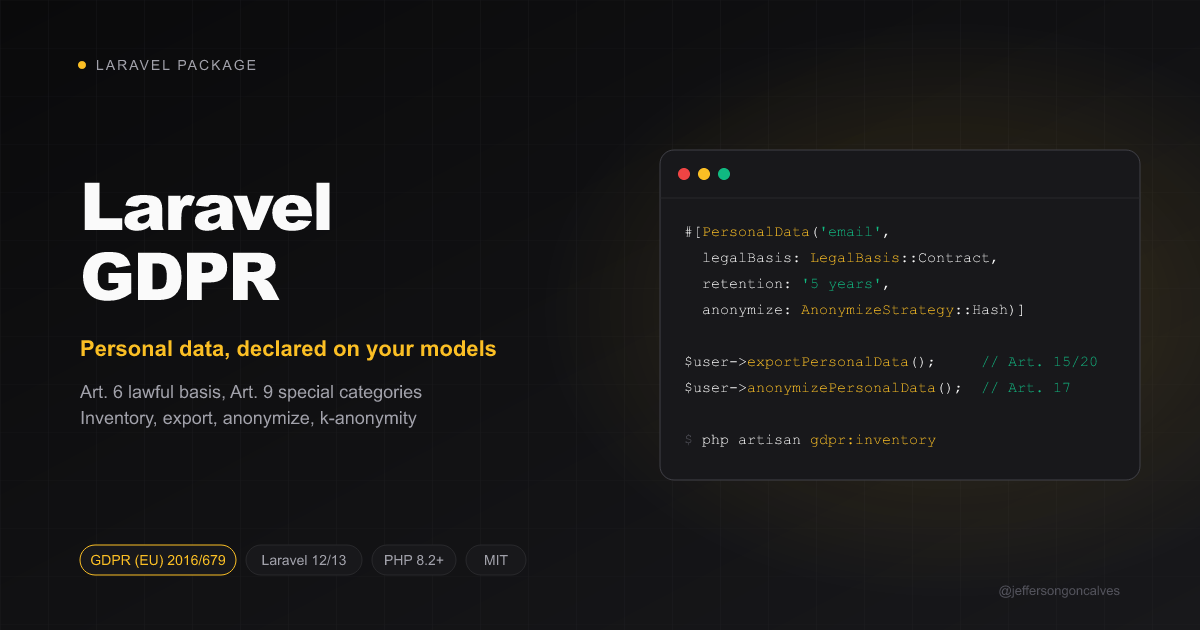
Core of a toolkit for the EU General Data Protection Regulation (GDPR, Regulation (EU) 2016/679) in Laravel. You declare which columns of your Eloquent models hold personal data. With those declarations the package can:
- build the personal data inventory (data mapping that feeds the records of processing activities, Art. 30);
- export a record's personal data (right of access and data portability, Arts. 15 and 20);
- anonymize a record, choosing a strategy per column (right to erasure, Art. 17).
This package gives you tooling. It does not make you compliant on its own. You still need legal review for lawful bases, retention periods and your privacy notice.
Installation
composer require jeffersongoncalves/laravel-gdpr
php artisan vendor:publish --tag="gdpr-config"
Declaring personal data
use JeffersonGoncalves\Gdpr\Attributes\PersonalData;
use JeffersonGoncalves\Gdpr\Concerns\InteractsWithPersonalData;
use JeffersonGoncalves\Gdpr\Contracts\HasPersonalData;
use JeffersonGoncalves\Gdpr\Enums\{AnonymizeStrategy, DataCategory, LegalBasis};

#[PersonalData('name', purpose: 'Account identification', legalBasis: LegalBasis::Contract, anonymize: AnonymizeStrategy::Mask)]
#[PersonalData('email', legalBasis: LegalBasis::Contract, retention: '5 years', anonymize: AnonymizeStrategy::Hash)]
#[PersonalData('health_notes', category: DataCategory::Special, legalBasis: LegalBasis::Consent)]
#[PersonalData('tax_id', legalBasis: LegalBasis::LegalObligation, anonymize: AnonymizeStrategy::Keep)]
class User extends Authenticatable implements HasPersonalData
{
    use InteractsWithPersonalData;
}
Lawful bases (LegalBasis, Art. 6(1)): consent, contract, legal_obligation, vital_interests, public_task, legitimate_interests. Categories (DataCategory): personal, special (Art. 9) and criminal (Art. 10). Special categories also need an Art. 9(2) condition. Write it in the purpose.
Register the model in config/gdpr.php:
'models' => [
    App\Models\User::class,
],
Anonymize strategies
| Strategy | Result |
|---|---|
Nullify (default) |
null |
Hash |
HMAC-SHA256 keyed by GDPR_HASH_KEY (falls back to APP_KEY). It gives a stable pseudonym, so unique indexes keep working |
Mask |
Maria Silva → M********** |
Keep |
untouched, for data you must keep by law (e.g. tax records) |
Encrypted casts ('encrypted') work as expected: the value is decrypted, then anonymized, then encrypted again.
Usage
use JeffersonGoncalves\Gdpr\Facades\Gdpr;

Gdpr::inventory();                 // one row per declared column
$user->exportPersonalData();       // ['name' => ..., 'email' => ..., ...]
$user->anonymizePersonalData();    // applies each strategy and saves
anonymizePersonalData() fires JeffersonGoncalves\Gdpr\Events\PersonalDataAnonymized with the model and the columns it changed. Columns marked Keep are not in that list. laravel-gdpr-retention listens to it to write tombstones. With those, it can erase again any data that a backup restore brings back.
php artisan gdpr:inventory          # table
php artisan gdpr:inventory --json   # machine readable
k-anonymity
Before you share or publish a dataset as anonymous (Recital 26), check that nobody can be singled out by combining quasi-identifiers such as ZIP code, birth date and gender. A dataset is k-anonymous when every combination of those values is shared by at least k rows. It is l-diverse when each of those groups also holds at least l distinct sensitive values.
use JeffersonGoncalves\Gdpr\Facades\Gdpr;
use JeffersonGoncalves\Gdpr\Generalize;

Gdpr::kAnonymity(Patient::class, [
    'zip' => Generalize::prefix(3),         // 10115 → 101
    'birth_date' => Generalize::date('Y'),  // 1990-03-01 → 1990
    'age' => Generalize::range(10),         // 34 → 30-39
    'gender',                               // as stored
], k: 5, sensitive: 'diagnosis');

// ['rows' => 1200, 'groups' => 87, 'k' => 3, 'rows_below_k' => 14, 'l' => 1]
k is the smallest group, rows_below_k counts the rows you still need to generalize further or suppress, and l is the smallest number of distinct sensitive values in a group. It accepts a model class or a query builder. Values are read through the model, so casts apply. The generalizers are plain closures, so you can also use them to build the dataset you export.
php artisan gdpr:k-anonymity "App\Models\Patient" zip birth_date --k=5 --sensitive=diagnosis
The command fails (exit code 1) when the data is below the target k, so it can run in CI or before a scheduled export. It scans every row, so run it off-peak on big tables.
Testing
composer test
Changelog
See CHANGELOG.
License
The MIT License (MIT). See License File.