
jeffersongoncalves / laravel-customer-io

Laravel client for Customer.io's Track and App APIs: customer profiles, events, campaigns and transactional messaging.
Package info
github.com/jeffersongoncalves/laravel-customer-io
pkg:composer/jeffersongoncalves/laravel-customer-io
Fund package maintenance!
Requires
- php: ^8.2
- illuminate/http: ^12.0|^13.0
- illuminate/support: ^12.0|^13.0
- spatie/laravel-package-tools: ^1.14.0
Requires (Dev)
- larastan/larastan: ^3.0
- laravel/pint: ^1.21
- orchestra/testbench: ^10.0|^11.0
- pestphp/pest: ^3.0|^4.0
- pestphp/pest-plugin-laravel: ^3.0|^4.0
Suggests
None
Provides
None
Conflicts
None
Replaces
None
README
Laravel Customer.io
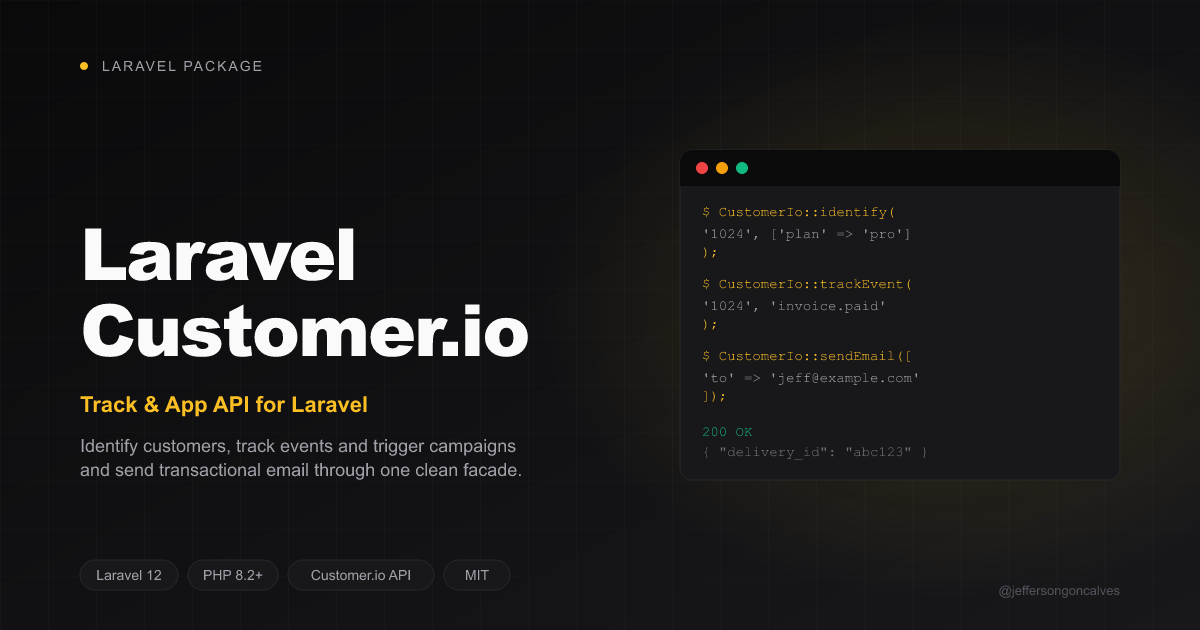
A Laravel client for Customer.io's Track API and App API. Covers customer profiles, events, campaigns and transactional messaging through a simple, typed API built on Laravel's Http client.
Features
- Customers (Track/App API):
identify,get,delete,trackEvent - Campaigns (App API):
list,get,metrics,trigger - Transactional messaging (App API):
sendEmail - Throws
CustomerIoException(with the original API error body) on any non-2xx response
Installation
You can install the package via composer:
composer require jeffersongoncalves/laravel-customer-io
Publish the config file:
php artisan vendor:publish --tag=customer-io-config
Set your Customer.io credentials in .env:
CUSTOMERIO_SITE_ID=your-site-id
CUSTOMERIO_API_KEY=your-track-api-key
CUSTOMERIO_APP_KEY=your-app-api-key
The site ID and Track API key are found under Settings > Account Settings > API Credentials. The App API key is created under Settings > API Credentials > App API Keys.
Configuration
// config/customer-io.php
return [
    'site_id' => env('CUSTOMERIO_SITE_ID', ''),
    'api_key' => env('CUSTOMERIO_API_KEY', ''),
    'app_key' => env('CUSTOMERIO_APP_KEY', ''),
    'track_url' => env('CUSTOMERIO_TRACK_URL', 'https://track.customer.io/api/v1'),
    'app_url' => env('CUSTOMERIO_APP_URL', 'https://api.customer.io/v1'),
];
Usage
The package is resolved via the CustomerIo facade or by injecting JeffersonGoncalves\CustomerIo\CustomerIo. Each resource is exposed as a method returning a dedicated resource class.
Customers
use JeffersonGoncalves\CustomerIo\Facades\CustomerIo;

// Create or update a customer profile (Track API)
CustomerIo::customers()->identify('123', [
    'email' => 'jane@example.com',
    'first_name' => 'Jane',
    'plan' => 'premium',
]);

// Fetch a customer's attributes (App API)
$customer = CustomerIo::customers()->get('123');

// Delete a customer (Track API)
CustomerIo::customers()->delete('123');

// Track a custom event (Track API)
CustomerIo::customers()->trackEvent('123', 'purchase', ['amount' => 42]);
Campaigns
$campaigns = CustomerIo::campaigns()->list();

$campaign = CustomerIo::campaigns()->get(1);

$metrics = CustomerIo::campaigns()->metrics(1);

CustomerIo::campaigns()->trigger(1, [
    'emails' => ['jane@example.com'],
    'data' => ['coupon' => 'SAVE10'],
]);
Transactional messaging
CustomerIo::transactional()->sendEmail([
    'transactional_message_id' => '5',
    'to' => 'jane@example.com',
    'identifiers' => ['id' => '123'],
    'message_data' => ['name' => 'Jane'],
]);
Error handling
Any non-2xx API response throws JeffersonGoncalves\CustomerIo\Exceptions\CustomerIoException, which exposes the decoded error body:
use JeffersonGoncalves\CustomerIo\Exceptions\CustomerIoException;

try {
    CustomerIo::customers()->identify('123', ['email' => 'not-an-email']);
} catch (CustomerIoException $e) {
    logger()->error($e->getMessage(), $e->errorBody());
}
Testing
composer test
Changelog
Please see CHANGELOG for more information on what has changed recently.
Contributing
Please see CONTRIBUTING for details.
Security Vulnerabilities
Please review our security policy on how to report security vulnerabilities.
Credits
License
The MIT License (MIT). Please see License File for more information.