
jeffersongoncalves / filament-saml2

Filament 5 plugin for SAML2 single sign-on with multi-tenant Identity Providers, powered by jeffersongoncalves/laravel-saml2.
Package info
github.com/jeffersongoncalves/filament-saml2
pkg:composer/jeffersongoncalves/filament-saml2
Requires
- php: ^8.2
- filament/filament: ^5.0
- jeffersongoncalves/laravel-saml2: ^1.0
- spatie/laravel-package-tools: ^1.16
Requires (Dev)
- larastan/larastan: ^3.0
- laravel/pint: ^1.21
- orchestra/testbench: ^10.0|^11.0
- pestphp/pest: ^3.0|^4.0
- pestphp/pest-plugin-laravel: ^3.0|^4.0
Suggests
None
Provides
None
Conflicts
None
Replaces
None
README
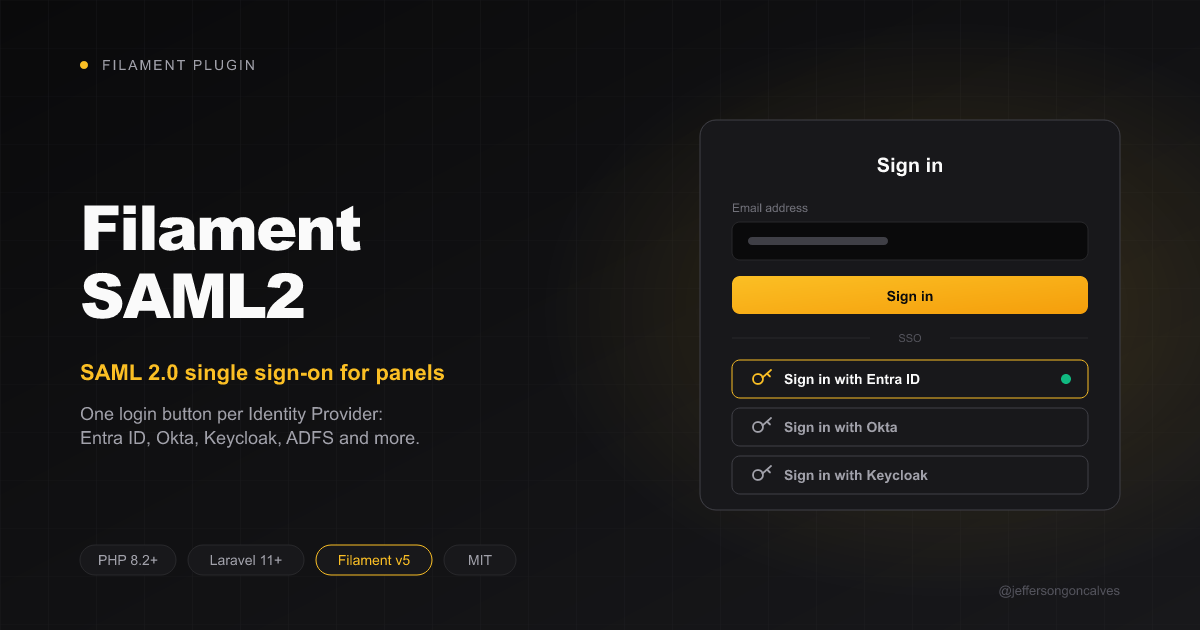
Filament SAML2
SAML 2.0 single sign-on for Filament v5 panels, powered by jeffersongoncalves/laravel-saml2. Every Identity Provider registered in laravel-saml2 (Entra ID, Okta, Google Workspace, Keycloak, ADFS, OneLogin…) gets a button on the panel login page; users are provisioned on first sign-in and linked to their SAML identity in a polymorphic table, so the host application's users table is never altered.
Compatibility
| Plugin Version | Filament |
|---|---|
| 1.x | ^3.2 |
| 2.x | ^4.0 |
| 3.x | ^5.0 |
Installation
composer require jeffersongoncalves/filament-saml2:"^3.0"
Publish and run the migrations (saml2_tenants comes from laravel-saml2, saml2_identities from this plugin):
php artisan vendor:publish --tag="filament-saml2-migrations"
php artisan migrate
Optionally publish the configuration and translations:
php artisan vendor:publish --tag="filament-saml2-config"
php artisan vendor:publish --tag="filament-saml2-translations"
Register your Identity Providers with the laravel-saml2 commands, e.g.:
php artisan saml2:create-tenant --key=acme --metadata-url="https://idp.acme.com/metadata.xml"
See the laravel-saml2 README for the URLs to configure at the IdP, certificates, per-tenant settings and proxies.
Registering the plugin in a panel
use JeffersonGoncalves\Filament\Saml2\Saml2Plugin;

public function panel(Panel $panel): Panel
{
    return $panel
        ->id('admin')
        ->path('admin')
        ->login()
        ->plugin(Saml2Plugin::make());
}
The login page now shows a Sign in with … button per tenant (labelled with metadata.name, the tenant key or the IdP entity ID).
Options
Saml2Plugin::make()
    ->tenants(['acme', 'okta'])        // only these tenants (key or UUID); null = all
    ->guard('admin')                   // defaults to the panel auth guard
    ->userModel(\App\Models\Admin::class)
    ->autoCreateUsers(false)           // only let in users that already exist
    ->matchUsersByEmail(false)         // only link by NameID, never by e-mail
    ->position('before');              // buttons before the login form
How it works
- The button sends the user to
saml2.loginwithreturnToset to the panel callback route (filament.{panel}.saml2.callback, path/{panel}/saml2/callback). - The IdP posts the assertion to
laravel-saml2's ACS endpoint, which firesSignedIn. - The plugin listener reads the panel from the
RelayState, resolves the user and logs them into the panel guard. - The ACS redirects to the callback route, which lands the user on the panel (or back on the login page with a notification if the sign-in was refused).
The panel travels in the RelayState rather than the session because the IdP posts cross-site and SameSite=Lax cookies are not sent with that request. SignedIn events whose RelayState is not a panel callback are ignored, so your own listeners keep working for the rest of the app.
For IdP-initiated sign-in, set the tenant relay_state_url to the panel callback path (/admin/saml2/callback).
User resolution
- The
saml2_identitiesrow for the tenant UUID + NameID. resolveUserUsing(), when set.- The user with the same e-mail (
Saml2User::email()), unlessmatchUsersByEmail(false). - A new user (
name,email, randompassword), unlessautoCreateUsers(false).
The identity is then created or refreshed with the latest e-mail and attributes.
Security: matching by e-mail trusts the IdP to only assert e-mails it owns. If a panel allows an IdP you do not control (e.g. a customer-managed tenant), limit it with
->tenants([...])and disablematchUsersByEmail.
Add the HasSaml2Identities trait to expose the relation on your user model:
use JeffersonGoncalves\Filament\Saml2\Concerns\HasSaml2Identities;

class User extends Authenticatable
{
    use HasSaml2Identities;
}
Customising user provisioning
use JeffersonGoncalves\LaravelSaml2\Saml2User;

Saml2Plugin::make()
    ->userAttributesUsing(fn (Saml2User $saml) => [
        'name' => $saml->mapped()['name'] ?? $saml->email(),
        'email' => $saml->email(),
        'department' => $saml->first('department'),
        'password' => bcrypt(\Illuminate\Support\Str::random(40)),
    ])
    ->resolveUserUsing(fn (Saml2User $saml) => \App\Models\User::query()
        ->where('employee_id', $saml->first('employeeNumber'))
        ->first()); // null falls back to the default lookup
Logout
Filament's logout ends the local session. To also end the IdP session (Single Logout), send the user to laravel-saml2's logout route:
use JeffersonGoncalves\LaravelSaml2\Facades\Saml2;

redirect(Saml2::logoutUrl(returnTo: filament()->getLoginUrl()));
IdP-initiated logout is handled by laravel-saml2; set saml2.logout.guard to the panel guard.
Testing
composer test
Changelog
Please see CHANGELOG for more information on what has changed recently.
Security Vulnerabilities
Please review our security policy on how to report security vulnerabilities.
Credits
License
The MIT License (MIT). Please see License File for more information.