
amjadiqbal / filament-record-settings

Edit per-record settings in Filament 4 and 5: per-user, per-team and per-tenant preferences from a settings page, a modal action or a resource form. Works with glorand/laravel-model-settings or a plain JSON column.
Package info
github.com/amjadiqbal/filament-record-settings
pkg:composer/amjadiqbal/filament-record-settings
Requires
- php: ^8.2
- filament/filament: ^4.0|^5.0
- illuminate/contracts: ^12.0|^13.0
- spatie/laravel-package-tools: ^1.16
Requires (Dev)
- glorand/laravel-model-settings: ^8.0|^9.0
- larastan/larastan: ^3.0
- laravel/pint: ^1.18
- orchestra/testbench: ^10.0|^11.0
- pestphp/pest: ^3.0|^4.0
- pestphp/pest-plugin-laravel: ^3.0|^4.0
Suggests
- glorand/laravel-model-settings: Store settings in a JSON field, a settings table, Redis or the cache (^8.0 or ^9.0).
Provides
None
Conflicts
None
Replaces
None
README
Record Settings for Filament
Edit per-record settings in Filament 4 and 5: a user's preferences, a team's or a tenant's options, any model's settings. Use a settings page, a modal action on a table row or record page, or fields inside a resource form. The settings live in glorand/laravel-model-settings (v8 or v9, any driver) or in a plain JSON column.
Docs: amjad.com.pk/filament/plugins/filament-record-settings
What it does
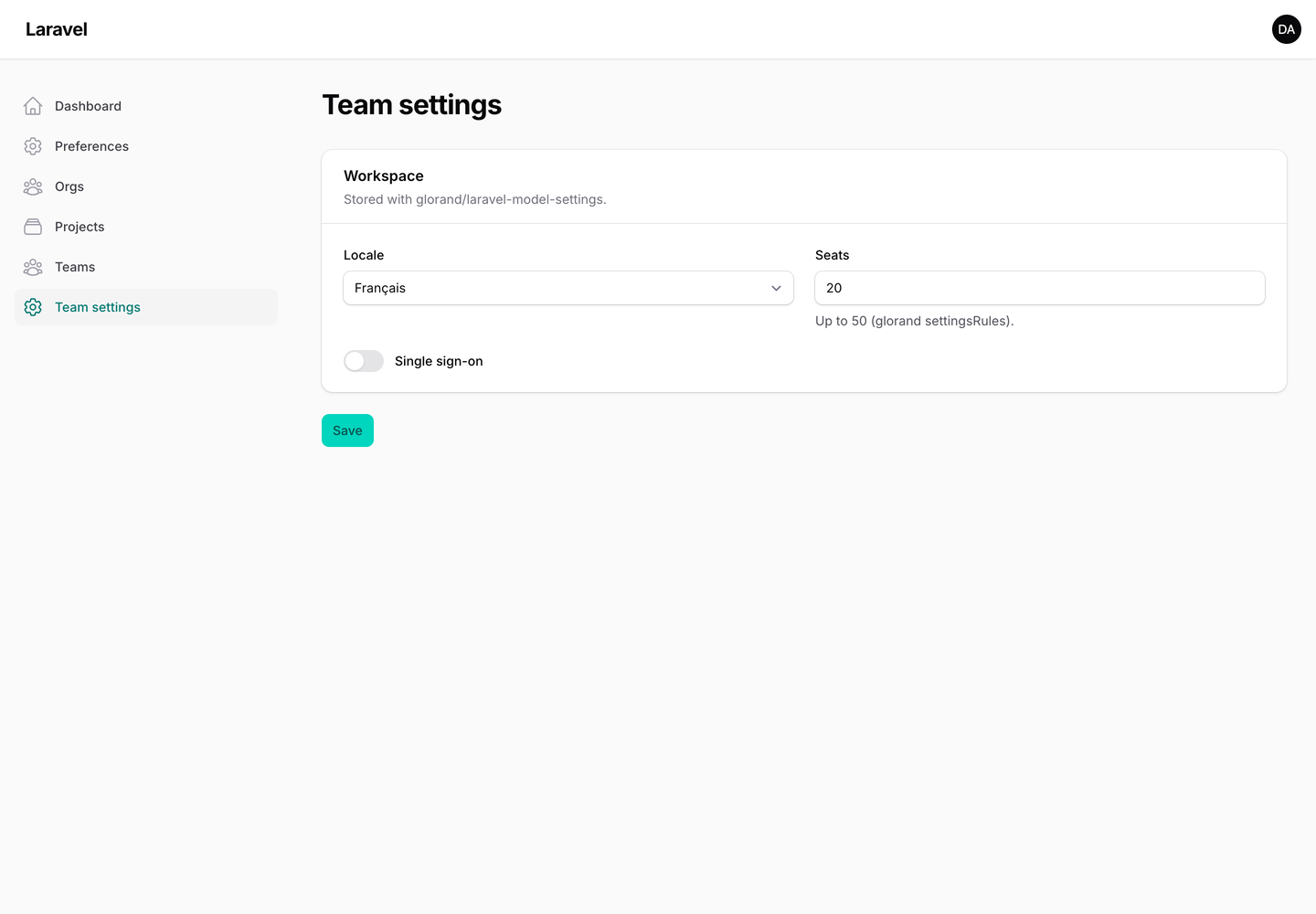
- A settings page (
RecordSettingsPage). With only aform()it edits the signed-in user's settings, so a preferences page is one small class. PointgetSettingsRecord()at a tenant, a team or any other model instead. - A modal action (
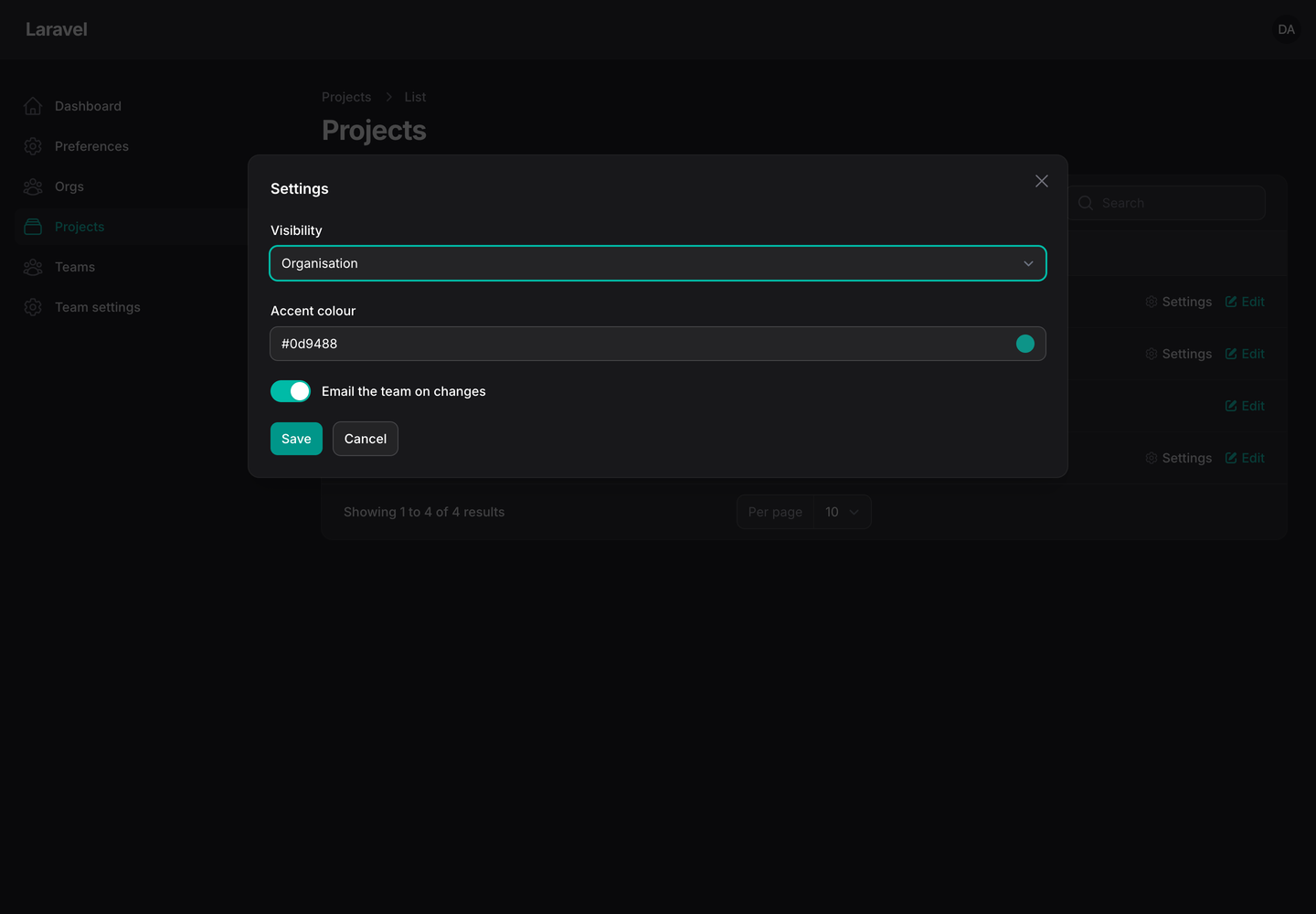
EditRecordSettingsAction) for table rows and record pages: open a record's settings, change them, save. - Fields inside a resource form (
->recordSetting()): settings next to the record's own fields, saved on create and on edit. - Two backends, picked for you. A model that uses glorand/laravel-model-settings goes through glorand, with its
defaults, its
$settingsRulesand whichever driver it uses (field, table, Redis, cache). Any other model keeps its settings in a JSON column (settingsunless you name another one). - Only the keys the form shows are written. Other top-level settings in the same column or store are kept. A field that holds an array (a repeater, a key-value field) replaces that key as a whole.
- Policies. When the record's policy has an
updateSettingsmethod, the page and the action ask it. The ability name is configurable. Without such a method the plugin adds no check (see Policies). - Plain Filament UI. Only core components, so it looks right in any panel and theme, light and dark, with no stylesheet or build step.
Requirements
| Version | |
|---|---|
| PHP | 8.2+ |
| Laravel | 12 or 13 |
| Filament | 4 or 5 |
| glorand/laravel-model-settings | optional: 8 or 9 |
Installation
composer require amjadiqbal/filament-record-settings
There is nothing to publish. If you want glorand's storage drivers, install and set up glorand/laravel-model-settings as its README says. Without it, add a JSON column to the model's table:
$table->json('settings')->nullable();
and cast it on the model:
protected function casts(): array
{
    return ['settings' => 'array'];
}
Usage
A settings page
php artisan make:filament-record-settings-page ManagePreferences
This writes app/Filament/Pages/ManagePreferences.php (or the panel's page directory; pass --panel= to choose,
and --force to overwrite an existing file).
Fill in the form:
use AmjadIqbal\FilamentRecordSettings\Pages\RecordSettingsPage;
use Filament\Forms\Components\Select;
use Filament\Forms\Components\Toggle;
use Filament\Schemas\Schema;

class ManagePreferences extends RecordSettingsPage
{
    protected static ?string $title = 'Preferences';

    public function form(Schema $schema): Schema
    {
        return $schema->components([
            Select::make('theme')->options(['system' => 'System', 'light' => 'Light', 'dark' => 'Dark']),
            Toggle::make('email_digest'),
        ]);
    }
}
That page edits the signed-in user's settings. For another record, override getSettingsRecord():
use Filament\Facades\Filament;
use Illuminate\Database\Eloquent\Model;

public static function getSettingsRecord(): ?Model
{
    return Filament::getTenant();
}
Options on the page class:
protected static ?string $settingsColumn = 'preferences';       // JSON column; null = glorand or `settings`
protected static ?string $settingsAbility = 'updateSettings';   // policy method; null = no policy check

public static function getSettingsDefaults(): array             // fallback defaults, JSON column only
{
    return ['theme' => 'system'];
}
To open it from the user menu instead of the sidebar:
use Filament\Actions\Action;

// In your panel provider
->userMenuItems([
    Action::make('preferences')
        ->label('Preferences')
        ->url(fn (): string => ManagePreferences::getUrl())
        ->icon('heroicon-o-cog-6-tooth'),
])

// In the page
public static function shouldRegisterNavigation(): bool
{
    return false;
}
The page has the usual hooks: beforeFill, afterFill, beforeValidate, afterValidate, beforeSave,
afterSave, plus mutateFormDataBeforeFill() and mutateFormDataBeforeSave().
A modal action
use AmjadIqbal\FilamentRecordSettings\Actions\EditRecordSettingsAction;
use Filament\Forms\Components\ColorPicker;
use Filament\Forms\Components\Toggle;

public static function table(Table $table): Table
{
    return $table
        ->columns([...])
        ->recordActions([
            EditRecordSettingsAction::make()
                ->settingsColumn('prefs')                // optional
                ->settingsDefaults(['color' => '#0d9488']) // optional fallbacks, JSON column only
                ->schema([
                    ColorPicker::make('color'),
                    Toggle::make('archived_view'),
                ]),
        ]);
}
It works as a header action on a view or edit page too. ->settingsAbility('manageSettings') changes the policy
method; ->settingsAbility(null) turns the check off. Your own ->authorize() or ->visible() adds to the policy
check; it does not replace it.
Fields in a resource form
use Filament\Forms\Components\Toggle;

Toggle::make('settings.email_digest')->recordSetting(),
Toggle::make('prefs.public')->recordSetting(),              // JSON column `prefs`
The part before the first dot is the prefix: the JSON column for the column store. On a glorand model the prefix only
groups the fields, and the value goes through glorand. On the edit page the field is filled from the stored settings
and the model's defaults; on the create page the field's own ->default() applies. The value is written after the
record is saved, so it works on create too. A nested name (settings.notify.email) writes inside its key and keeps
that key's other values.
A glorand $settingsRules failure shows under the field, and that value is not saved. On the edit page the record's
own fields are not saved either. Each setting field writes on its own, so a field that passed before the failing one
is already stored; on the create page the new record is kept unless the panel uses ->databaseTransactions().
Defaults
Values are read in this order, the later one winning:
- the page's
getSettingsDefaults()or the action's->settingsDefaults()(JSON column only), - the model's defaults:
getDefaultSettings()or a$defaultSettingsproperty, - the stored settings.
A glorand model uses glorand's own defaults ($defaultSettings, or config('model_settings.defaultSettings.<table>')
keyed by the model's table), and
page and action defaults are not used for it. Defaults are only shown: a default is saved when the form shows it and
the user submits the form.
Policies
The page and the action call the record's policy when it has the ability, updateSettings by default:
class TeamPolicy
{
    public function updateSettings(User $user, Team $team): bool
    {
        return $user->ownsTeam($team);
    }
}
With no such method, the plugin adds no check of its own. Then anyone who can open the page, see the table row
or edit the record can change its settings. The page still needs a record (a signed-in user, or whatever
getSettingsRecord() returns) and its usual canAccess(); on the action, add ->visible() or ->authorize()
conditions (they are added to the policy check); resource fields follow the resource's own policy. For a per-user
preferences page that is usually what you want; for team, tenant or record settings, add the policy method.
Coming from quadrubo/filament-model-settings
This package is a separate, new implementation for Filament 4 and 5, Laravel 12 and 13 and glorand 8 and 9. The names you used still work, so moving is mostly an import change:
| quadrubo/filament-model-settings | Record Settings |
|---|---|
ModelSettingsPage + HasModelSettings |
RecordSettingsPage (no interface needed) |
public static function getSettingRecord() |
still read; getSettingsRecord() is the new name, and it defaults to the signed-in user |
->isModelSetting() / ->isModelSetting('prefix') |
still registered (unless another package registered it); ->recordSetting() is the new name |
make:filament-model-settings-page |
make:filament-record-settings-page |
Differences: the page form uses Filament 4/5's Schema, and saving writes only the keys in the form.
Static analysis
recordSetting() and isModelSetting() are macros on Filament's Field, so PHPStan doesn't know them. Ignore the
call in your phpstan.neon:
parameters:
    ignoreErrors:
        - '#Call to an undefined method .*::(recordSetting|isModelSetting)\(\)#'
Testing
composer test
composer analyse
scripts/ci-local.sh   # the full PHP x Laravel x Filament x glorand matrix
Changelog
See CHANGELOG.md.
Support
- 🐛 Bug or feature request: open an issue
- 🔒 Security issue: please report it privately through GitHub's security tab
Need this customised, or something built?
I'm available for custom development, package integration, and technical consulting.
More packages
This is part of a family of open-source packages. See all of them.
| filament-stat-cards | Progress bars, icon tiles, colours and trends for Filament stats |
| filament-deleted-records | A recycle bin for Filament: browse, restore or purge deleted models |
| filament-change-requests | Hold record edits in Filament for approval, with a field-by-field diff |
Credits
- Amjad Iqbal
- The idea and the
getSettingRecord()/isModelSetting()names follow quadrubo/filament-model-settings (MIT). No code is shared, and this package is not affiliated with or endorsed by its author. - Storage: glorand/laravel-model-settings.
License
The MIT License (MIT). See LICENSE.md.