
mahoudeau / universal-shipping-for-sylius

Shipping carriers for Sylius 2: pickup point picker at checkout, labels, tracking, and French address autocomplete. Mondial Relay through Sendcloud first.
Package info
github.com/mahoudeau/universal-shipping-for-sylius
Type:sylius-plugin
pkg:composer/mahoudeau/universal-shipping-for-sylius
Requires
- php: ^8.2
- sylius/sylius: ^2.1
- symfony/http-client: ^6.4 || ^7.4
Requires (Dev)
- phpstan/phpstan: ^2.1
- phpunit/phpunit: ^11.5
- sylius-labs/coding-standard: ^4.4
Suggests
None
Provides
None
Conflicts
None
Replaces
None
README

Shipping carriers for Sylius 2, starting with the part every French shop asks for first: letting the customer pick a Mondial Relay point at checkout.

Still 0.x, so a minor version may change things. Built alongside a small French shop that will be its first production user. What changed, and when: CHANGELOG.md.
Independent project. Not affiliated with, endorsed by, or connected to Sylius, Sendcloud or Mondial Relay. "Sylius" is used here only to say what this plugin is for.
Status
What has been checked, and how far. Updated as each item moves.
Checked against the real services, in the shop that runs it (Sylius 2.2, PHP 8.4, MariaDB 11.8):
- relay points from Sendcloud's live API: search, distance, opening hours, the chosen point saved on the shipment
- a relay point required before the order can go on
- the map, and choosing a point from its pins
- French address suggestions from the BAN, and the relay search centred on them
Installed from scratch on a fresh Sylius-Standard 2.2 (Sylius 2.2.10, MariaDB), following this README step by step, with the fake provider: the whole checkout, the summary, a paid order's label and the admin pages. The screenshots here come from that shop.
Covered by unit tests, not yet run against the real Sendcloud:
- labels: create, print, cancel, the house number sent apart, the additional insurance, a lost answer that no longer means a second paid label, and partly refunded orders weighed and valued on what still ships (#1)
- tracking by webhook (#2)
Not tried yet: PostgreSQL (#3), a shop with several channels (#4), addresses outside France.
CI runs the unit tests on PHP 8.2, 8.3 and 8.4, with Sylius 2.1.15 and the latest 2.x.
Configuration is in YAML and environment variables, not in the admin: the carrier keys, test labels and delivery options. The admin only links a shipping method to a delivery option. An admin settings page is planned (#5).
What it does today
-
A pickup point picker in the checkout's shipping step. Choose a method that needs a point and the nearest ones appear, with their address, distance and opening hours. Type another postcode and the list follows.
-
Mondial Relay through Sendcloud. Relay points only, or lockers only, or both: one setting per delivery option.
-
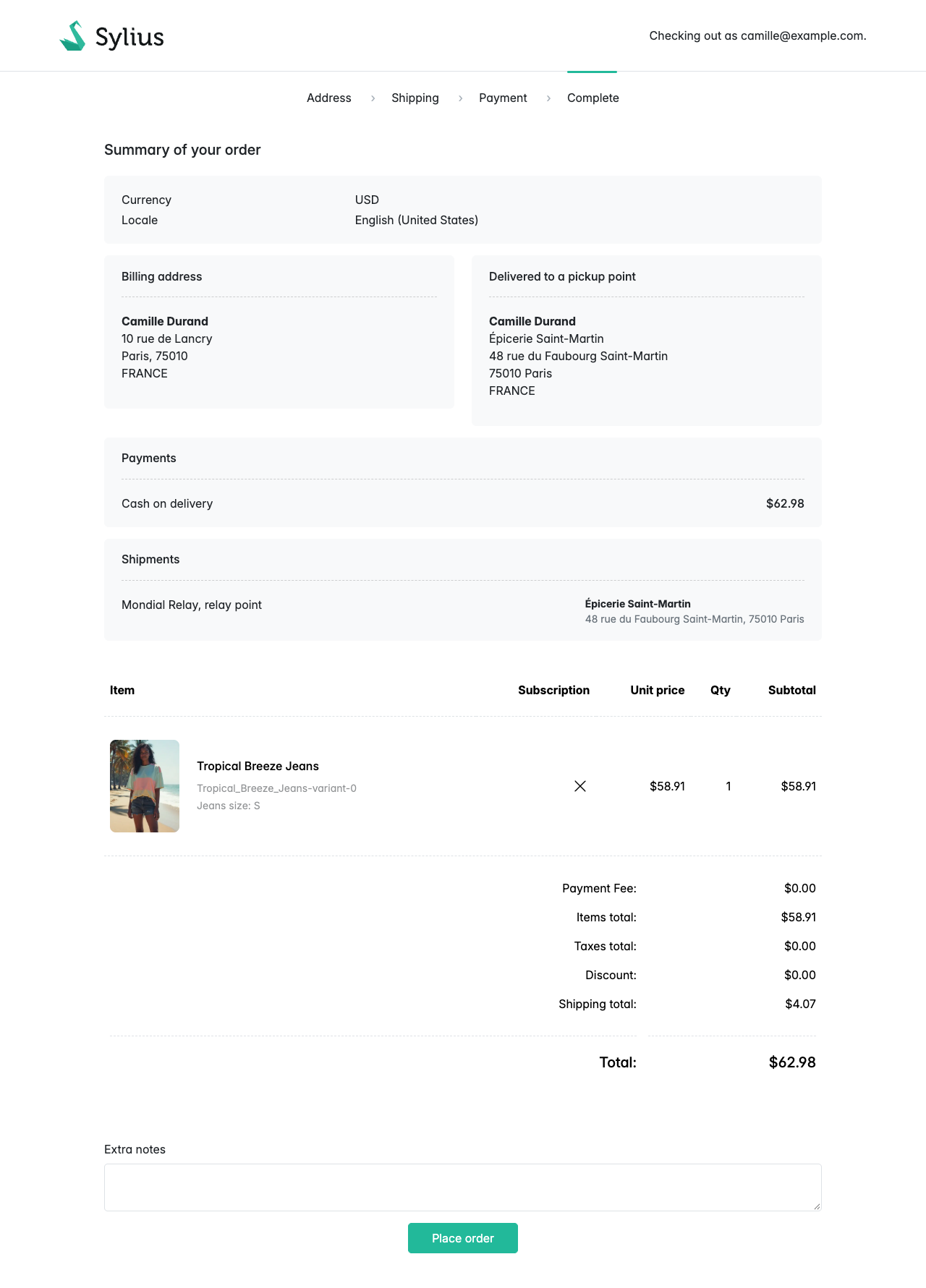
The chosen point is kept on the shipment, and shown on the checkout summary, the customer's order page and the admin order page, with the carrier's own point number for the drop-off. On the summary it takes the place of the shipping address, so the customer never reads their own address as where the parcel goes.
-
An optional map next to the list, drawn with MapLibre on OpenStreetMap data. Click a pin, the point is chosen. Free map sources only, and the checkout works the same without it. Keyboards and screen readers stay on the list, the real control: the map never takes the focus.
-
Labels from the admin order page. Create, print, and cancel while the carrier doesn't have the parcel yet. The tracking number goes into Sylius's own tracking field, so the "shipped" email carries it. A shipment never pays for two labels, and a partly refunded order's label leaves out what was refunded. Not yet run against the real Sendcloud: see Status.
-
Tracking by webhook. The order shows where the parcel is: label ready, in transit, at the pickup point, delivered. Not yet run against the real Sendcloud either.
-
Optional French addresses from the national address base (BAN): suggestions under the street fields and the relay search at checkout, and a relay search centred on the customer's actual door.
-
A fake provider with four fixed points and test labels, for demos, themes and tests without carrier credentials.
-
English and French out of the box.

Colissimo comes next. See the roadmap.
Why another shipping plugin
When this started, in September 2026, there was no maintained Mondial Relay integration for Sylius 2. The existing plugins stop at Sylius 1, and the one Sylius 2 plugin we tried did not work with the 2.2 checkout. French shops also increasingly reach Mondial Relay through Sendcloud rather than the carrier's own API, which none of them covered.
So this plugin is carrier-neutral from the start. Mondial Relay through Sendcloud is the first provider, not the whole design. Adding a carrier means writing one class.
How it works
A few choices worth knowing before you install it:
- The picker needs no JavaScript. Sylius 2 renders the shipping step as a live component, so the picker is a plain Symfony form that re-renders on the server. Choosing a method, searching an address and picking a point all work without a line of custom JS. The scripts only add to a form that works without them: the optional map and address suggestions, and a small one that makes the relay search send what the field holds on a phone, shows a spinner while it runs, and searches on Enter.
- The list of points is always built on the server. The browser only ever sends back the id of a point from that list, so a customer cannot forge a point or an address.
- The point is copied onto the shipment, not referenced. The address on the order stays what the customer chose, even if the carrier moves or closes the point later. A saved point is checked again with the carrier before it is offered a second time.
- A carrier outage never breaks the checkout. Searches are cached (the checkout re-renders on every change), providers are only loaded when a method needs them, and a failing carrier shows "no point found" and a log line instead of an error page.
One more thing, found on the way: Sylius declares its shipping step as a live component but its template never switches it on in the browser. This plugin replaces that one template with a fixed copy.
Everything else goes through Twig hooks, and no Sylius template file is
overridden. Besides adding its own blocks, the plugin swaps three of Sylius's
hookables for its own, all in config/twig_hooks.yaml:
- the shipping step's form, for the fix above;
- the order summary's shipping address box, which shows the point for a pickup point order (checkout's last step and the customer's order page);
- the admin order page's shipping address, titled "Customer's address" for a pickup point order.
If your theme replaces the same hookables, yours or the plugin's wins depending on bundle order: check those three first.
Requirements
- PHP 8.2 or later
- Sylius 2.1 or later (developed and used on 2.2)
- A Sendcloud account with an API integration and a sender address, for the Sendcloud provider
Installation
1. Require the package
composer require mahoudeau/universal-shipping-for-sylius
2. Enable the bundle in config/bundles.php. There is no Flex recipe yet,
so add the line yourself:
Mahoudeau\UniversalShipping\UniversalShippingPlugin::class => ['all' => true],
3. Add the fields to your entities. The point and the parcel live on the shipment, the delivery option on the shipping method.
Sylius-Standard already has both entities in src/Entity/Shipping/, mapped
with attributes: add the lines below to them.
// src/Entity/Shipping/Shipment.php
use Doctrine\ORM\Mapping as ORM;
use Mahoudeau\UniversalShipping\Model\ParcelAwareInterface;
use Mahoudeau\UniversalShipping\Model\ParcelAwareTrait;
use Mahoudeau\UniversalShipping\Model\PickupPointAwareInterface;
use Mahoudeau\UniversalShipping\Model\PickupPointAwareTrait;

#[ORM\Entity]
#[ORM\Table(name: 'sylius_shipment')]
#[ORM\Index(columns: ['universal_shipping_parcel_id'], name: 'IDX_universal_shipping_parcel_id')]
class Shipment extends BaseShipment implements PickupPointAwareInterface, ParcelAwareInterface
{
    use ParcelAwareTrait;
    use PickupPointAwareTrait;
    // ...
}
Leave out ParcelAwareInterface if you only want the picker: the label
buttons then stay hidden. The index is for the tracking webhook, which looks a
shipment up by its parcel id.
// src/Entity/Shipping/ShippingMethod.php
use Mahoudeau\UniversalShipping\Model\DeliveryOptionAwareInterface;
use Mahoudeau\UniversalShipping\Model\DeliveryOptionAwareTrait;

class ShippingMethod extends BaseShippingMethod implements DeliveryOptionAwareInterface
{
    use DeliveryOptionAwareTrait;
    // ...
}
Then generate and run the migration. It adds nullable columns only:
universal_shipping_pickup_point, universal_shipping_parcel and
universal_shipping_parcel_id on sylius_shipment, and
universal_shipping_delivery_option on sylius_shipping_method.
bin/console doctrine:migrations:diff
bin/console doctrine:migrations:migrate
Read the generated migration before running it. diff compares the whole
schema, so it also picks up anything else your project has drifted on: on a
fresh Sylius-Standard 2.2 that's an index on Symfony Messenger's table. Keep
or drop those lines as you would without the plugin.
On a brand new project, set Sylius up first (sylius:install), then add
the plugin. The other way round, the demo data is written before the
plugin's columns exist, and sylius:install stops on "Unknown column
'universal_shipping_delivery_option'". If that happened, generate and run the
migration as above, then bin/console sylius:fixtures:load.
4. Import the routes in config/routes/universal_shipping.yaml. The label
buttons go under the admin prefix, so the admin firewall guards them. The
webhook goes without a prefix: carriers call it, not people. The shop routes
serve the checkout's scripts (only address suggestions for now) and don't
depend on the locale.
universal_shipping_admin:
    resource: '@UniversalShippingPlugin/config/routes/admin.yaml'
    prefix: '/%sylius_admin.path_name%'

universal_shipping_webhooks:
    resource: '@UniversalShippingPlugin/config/routes/webhooks.yaml'

universal_shipping_shop:
    resource: '@UniversalShippingPlugin/config/routes/shop.yaml'
Leave the shop routes out and address suggestions stay off, whatever the config says. Nothing else breaks.
5. Declare your delivery options in config/packages/universal_shipping.yaml.
A delivery option is one way of delivering with one carrier. The Sylius
shipping method on top of it adds the price, the zone and the name customers
see.
universal_shipping:
    sendcloud:
        public_key: '%env(SENDCLOUD_PUBLIC_KEY)%'
        secret_key: '%env(SENDCLOUD_SECRET_KEY)%'
    delivery_options:
        mondial_relay_point_relais:
            label: 'Mondial Relay, relay point'
            provider: sendcloud
            carrier: mondial_relay
            delivery: pickup_point
            options:
                point_types: [servicepoint]   # Sendcloud also returns lockers
                shipping_option: 'mondial_relay:service_point,dualapi/size=l,c2c'   # for labels
The keys come from the Sendcloud panel: Settings > Connected stores > Sendcloud API. Turn on pickup point delivery there and tick the carriers you want. Keep the keys out of the repository.
6. Link a shipping method in the admin: edit it and choose the delivery option in the Universal Shipping field. That method now asks for a point at checkout.
7. Publish the scripts and styles under public/bundles/, then clear the
cache. Sylius-Standard's Composer scripts already run the first command after
every composer require and composer update; run it yourself if your
project doesn't, and again after each upgrade. The files are plain ES modules
and CSS: nothing to add to your Webpack Encore build.
bin/console assets:install
bin/console cache:clear

Configuration reference
universal_shipping:
    cache_ttl: 600                    # seconds a search stays cached
    address:
        enabled: false                # see Addresses below
        provider: ban                 # or the id of your own AddressProviderInterface service
        url: 'https://data.geopf.fr/geocodage'
        autocomplete: true            # suggestions under the checkout's street fields
        geocode_pickup_search: true   # search pickup points around the geocoded address
        cache_ttl: 86400              # seconds an address answer stays cached
    labels:
        weight_unit: kg               # unit of the weights on your product variants
        default_weight: 0.5           # parcel weight when no product has one
    sendcloud:
        public_key: ''
        secret_key: ''                # also checks the webhook's signature
        test_labels: false            # true: every label is a free "Unstamped letter"
        sender_address_id: ~          # only needed with several sender addresses
        paper_size: ~                 # A4, A5 or A6; ~ keeps the carrier's size
        service_points_url: 'https://servicepoints.sendcloud.sc/api/v2'
        api_url: 'https://panel.sendcloud.sc/api/v3'
    delivery_options:
        <code>:                       # what the admin links a method to
            label: ~                  # shown in the admin
            provider: ~               # sendcloud, fake, or your own
            label_provider: ~         # makes the labels, if not the provider
            carrier: ~                # e.g. mondial_relay
            delivery: pickup_point    # or home
            options: {}               # passed to the provider as is
Sendcloud options:
| Option | Default | Meaning |
|---|---|---|
point_types |
all | servicepoint for relay points, locker for lockers |
radius |
5000 | search radius in metres |
limit |
10 | how many points the customer sees |
shipping_option |
none | Sendcloud shipping option code for labels. POST /api/v3/shipping-options lists yours |
contract_id |
none | only when you have several contracts with the carrier |
insure_above |
none | orders above this total, in euros, get Sendcloud's additional insurance (additional_insured_price, charged per label by Sendcloud) |
carrier_cover |
0 | what the carrier already covers, in euros, taken off the insured amount (Mondial Relay: 25) |
To develop or test without credentials, point a delivery option at the fake provider:
when@test:
    universal_shipping:
        delivery_options:
            mondial_relay_point_relais:
                label: 'Mondial Relay (fake)'
                provider: fake
                carrier: mondial_relay
The map
Off by default. Turn it on and pick where the map comes from:
universal_shipping:
    map:
        enabled: true
        style: 'https://tiles.openfreemap.org/styles/positron'   # the default
style is the URL of any MapLibre style. Three free sources work well:
| Source | style |
Notes |
|---|---|---|
| OpenFreeMap | https://tiles.openfreemap.org/styles/positron (or liberty, bright) |
OpenStreetMap data, worldwide, no key, no account. The default |
| IGN Géoplateforme | https://data.geopf.fr/annexes/ressources/vectorTiles/styles/PLAN.IGN/standard.json |
The French state's map, open licence, no key. Best in France, thin elsewhere |
| Protomaps, self-hosted | a style whose source is pmtiles://https://your-server/france.pmtiles |
One file on your own server or object storage: no third party at all |
MapLibre and PMTiles ship with the plugin (both BSD-3), so no script comes from a CDN. MapLibre is only downloaded on a page that shows a map.
Privacy. With OpenFreeMap or IGN, the customer's browser loads map tiles from their servers, so they see the customer's IP address. Say so in your privacy policy, or self-host with Protomaps. The pickup point list itself never talks to a third party from the browser: carrier calls happen on your server.
Theming. Give the map your shop's colours:
universal_shipping:
    map:
        theme:
            accent: '#9c4a2a'          # pins, and the chosen pin
            pin_text: '#fbf8f3'        # number on the chosen pin
            colors:                    # the map itself
                background: '#f5f0e8'
                buildings: '#eae1d3'
                roads: '#fbf8f3'
                parks: '#e4e7d8'
                water: '#d5ddd8'
                labels: '#6e604f'
Every key is optional: leave one out and the style keeps its own colour.
Colours must be #rgb or #rrggbb. The map colours apply to OpenMapTiles
styles, which covers OpenFreeMap and most free styles; other styles are only
partly recoloured. Street names keep the style's font, since the tile server
only has its own. For full control, design a style in
Maputnik and point style at it.
Addresses
Off by default. It uses the Base Adresse Nationale (BAN), France's official address base: free, open licence, no account, no key.
universal_shipping:
    address:
        enabled: true
That turns on two things, each of which can be turned off alone:
-
Suggestions at checkout (
autocomplete). In the address step, typing in a street field lists matching addresses. Choosing one fills the street, postcode and city, for the shipping and the billing address. In the shipping step's relay search, choosing one fills the field and searches around that address. The list works with the keyboard and screen readers (the ARIA combobox pattern).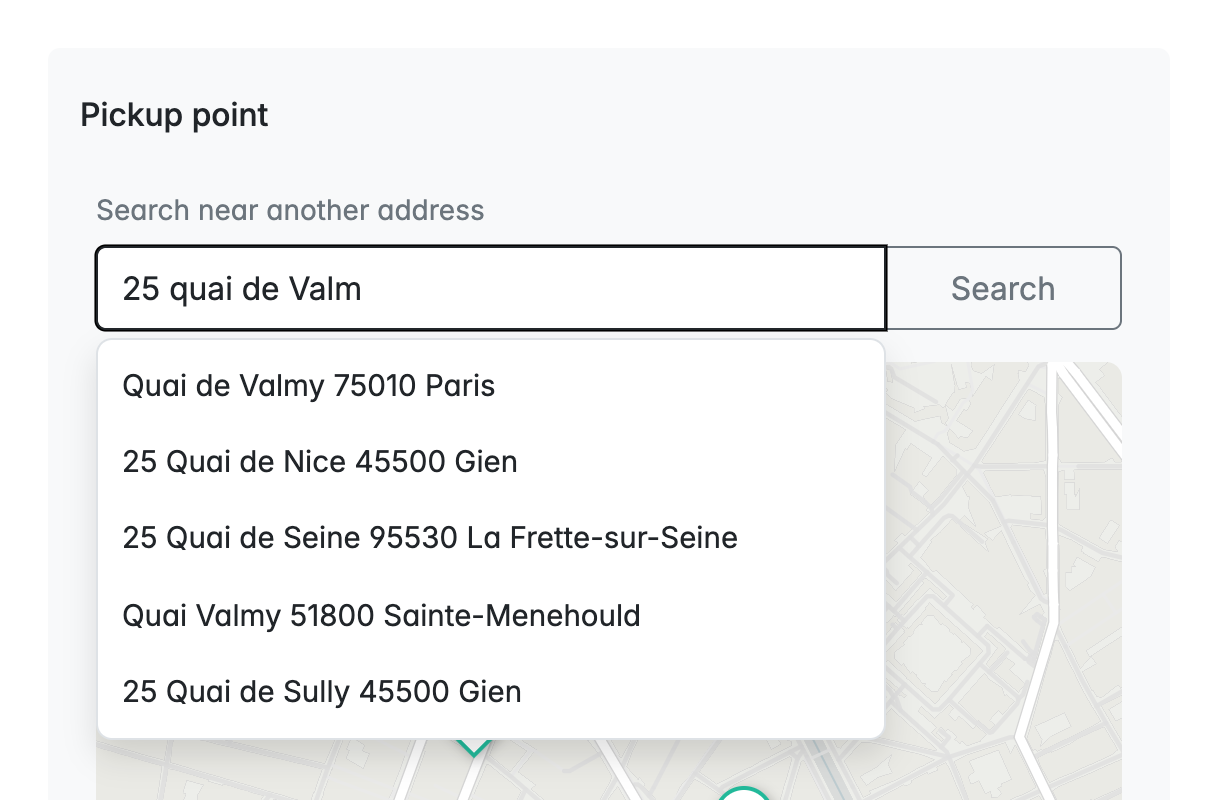
Without JavaScript the form is the same as before. Needs the shop routes from installation step 4.
-
A relay search around the real address (
geocode_pickup_search). The customer's address is turned into coordinates first, and the carrier searches around them instead of guessing from the text. If the BAN finds nothing it trusts, or doesn't answer, the search goes out as text, as without the module.

It covers metropolitan France and the five overseas departments (Guadeloupe, Martinique, Guyane, La Réunion, Mayotte). For any other country the street field stays a plain field and the relay search stays as it was.
Privacy. The customer's browser only talks to your shop. Your server asks the BAN, the same way carrier calls work. So the BAN sees your server's address and what customers type in the street field, never their IP address or anything else about them.
Where the BAN lives. Since 2025 it is served by the IGN Géoplateforme at
https://data.geopf.fr/geocodage, the default url. The older
api-adresse.data.gouv.fr was announced as closing in January 2026; don't
point url at it. The Géoplateforme allows 50 requests per second per IP
address. Answers are cached for a day, so a shop rarely gets near that, but
the suggestion route is public: put a rate limiter in front of
/universal-shipping/address/suggest if you expect abuse.
Labels. The house number goes to the carrier on its own, whatever this setting: "12 bis rue de la Paix" becomes number "12 bis" and street "rue de la Paix". A line without a leading number ("Lieu-dit Les Pins") stays whole.
Theming. The suggestion list reads Bootstrap's colours. Override them in your CSS:
.us-address-list {
    --us-address-accent: #9c4a2a;     /* bar on the active suggestion */
    --us-address-bg: #fbf8f3;
    --us-address-active-bg: #f5f0e8;
}
Another source. Implement AddressProviderInterface (supports,
suggest, geocode), register it as a service, and give its id as
provider. Throw ProviderUnavailableException when it can't be reached:
the plugin caches answers and turns outages into empty ones.
Labels and tracking
A paid shipment that hasn't left yet gets a Create label button on the admin order page, next to Sylius's Ship. It sends the carrier the customer's address, the chosen point, the order total and the parcel's weight. Then:
- Print label opens the PDF.
- The tracking number is already in Sylius's tracking field, so Ship sends the usual email with it.
- Cancel label voids it until the carrier has the parcel. The shipment can then get a new one.
Most carriers charge as soon as the label exists. Sendcloud refunds a label cancelled within 42 days if the parcel never shipped. A label is never paid twice for one shipment: if Sendcloud's answer gets lost after it created one, the next Create label finds that shipment and takes it.
Partly refunded orders. An order with a piece refunded still ships the
rest. The plugin doesn't depend on a refund module, so by default the label
weighs and values the whole shipment. With sylius/refund-plugin, tell it what
was refunded, and a piece refunded in full leaves the weight while every refund
comes off the declared and insured value:
use Mahoudeau\UniversalShipping\Label\RefundedAmountProviderInterface;
use Sylius\Component\Core\Model\OrderItemUnitInterface;
use Sylius\RefundPlugin\Model\RefundType;
use Sylius\RefundPlugin\Provider\RemainingTotalProviderInterface;
use Symfony\Component\DependencyInjection\Attribute\AsAlias;

#[AsAlias(RefundedAmountProviderInterface::class)]
final readonly class RefundedAmounts implements RefundedAmountProviderInterface
{
    public function __construct(private RemainingTotalProviderInterface $remaining)
    {
    }

    public function refundedAmount(OrderItemUnitInterface $unit): int
    {
        return $unit->getTotal() - $this->remaining->getTotalLeftToRefund((int) $unit->getId(), RefundType::orderItemUnit());
    }
}
Labels go through Sendcloud's shipments API v3. The older parcels API is closed to accounts opened since April 2026.
Test labels. With sendcloud.test_labels: true, every label is
Sendcloud's free "Unstamped letter", sent to the customer's address instead of
the point. Same flow, nothing charged. Keep it on everywhere but production:
universal_shipping:
    sendcloud:
        test_labels: '%env(bool:SENDCLOUD_TEST_LABELS)%'
Fake labels. No carrier account, or one you'd rather not touch? Give the
delivery option label_provider: fake. Points still come from the real
provider. Labels get a made-up tracking number and a PDF marked as a test.
You play the carrier from the console:
when@dev:
    universal_shipping:
        delivery_options:
            mondial_relay_point_relais:
                label_provider: fake
bin/console universal-shipping:fake-tracking fake-3f9a1c2b7e ready_for_pickup
The parcel id is on the admin order page. The command won't touch a real carrier's parcel.
Tracking. In Sendcloud, open Settings > Integrations, configure your API integration, tick Webhook feedback enabled and enter:
https://your-shop.example/universal-shipping/webhooks/sendcloud
Sendcloud signs every call with your secret key. The plugin refuses the ones that don't match, and an update that arrives late after a retry never overwrites a newer one. The order page shows:
| Status | Means |
|---|---|
| Label ready | announced, the carrier has not scanned it yet |
| In transit | the carrier has it |
| At the pickup point | waiting for the customer |
| Delivered | handed over or collected |
| Returned | refused or sent back |
| Needs attention | failed delivery, invalid address, carrier exception |
| Cancelling, Cancelled | the label was voided |
The plugin never marks a shipment shipped on its own. That stays a click on Ship, so the email goes out when you decide.
Adding a carrier
Implement PickupPointProviderInterface and give it a code:
use Mahoudeau\UniversalShipping\DeliveryOption\DeliveryOption;
use Mahoudeau\UniversalShipping\Model\PickupPoint;
use Mahoudeau\UniversalShipping\Provider\AsPickupPointProvider;
use Mahoudeau\UniversalShipping\Provider\PickupPointProviderInterface;
use Mahoudeau\UniversalShipping\Provider\PickupPointQuery;

#[AsPickupPointProvider('my_carrier')]
final class MyCarrierProvider implements PickupPointProviderInterface
{
    public function search(PickupPointQuery $query, DeliveryOption $option): array { /* ... */ }

    public function find(string $id, DeliveryOption $option): ?PickupPoint { /* ... */ }
}
Autoconfiguration registers it. Throw ProviderUnavailableException when the
carrier cannot be reached, and the plugin takes care of the rest. The
Sendcloud provider
is a complete example.
For labels, implement LabelProviderInterface with
#[AsLabelProvider('my_carrier')]: create a label, return its PDF, cancel it.
Throw LabelException with a message the shop owner can act on, since the
admin shows it word for word. A carrier without labels is fine, the buttons
just don't appear. For tracking, turn the carrier's webhook into a call to
ParcelTracker::update(), like the
Sendcloud webhook.

Roadmap
Roughly in this order. Nothing here is promised by a date. Each item is an issue, so you can follow it or add to it.
First, check what is built:
- Labels against the real Sendcloud (#1).
- Tracking webhooks from the real Sendcloud (#2).
- PostgreSQL (#3) and several channels (#4).
Then, build:
- Carrier settings in the admin: keys stored encrypted, test labels, paper size, with environment variables still winning when set (#5).
- Delivery options editable in the admin (#6).
- Colissimo, home delivery and point retrait. Sendcloud already offers both, so this is mostly a delivery option away (#7).
- Home delivery and lockers as first-class delivery options (#8).
- Addresses outside France, with a self-hosted Photon. French addresses are done (#9).
- Labels for several orders at once, and an option to mark a shipment shipped on the carrier's first scan (#10).
- A shop API endpoint for headless checkouts (#11).
- Functional tests of the whole checkout in a Sylius test application (#12).
Want one of these sooner, or a carrier that is not on the list? Open an issue.
Contributing
Contributions are welcome, from a typo to a carrier. See CONTRIBUTING.md for how to run the checks and what a pull request should look like.
License
MIT. See LICENSE.