
fpeposhi / lusen

Fast, SEO- and AI-agent-friendly API documentation for Laravel applications.
Requires
- php: ^8.2
- illuminate/console: ^12.0 || ^13.0
- illuminate/routing: ^12.0 || ^13.0
- illuminate/support: ^12.0 || ^13.0
- league/commonmark: ^2.4
- nikic/php-parser: ^5.0
Requires (Dev)
- larastan/larastan: ^3.0
- laravel/pint: ^1.18
- orchestra/testbench: ^10.0 || ^11.0
- pestphp/pest: ^3.0 || ^4.0 || ^5.0
- pestphp/pest-plugin-laravel: ^3.0 || ^4.0 || ^5.0
Suggests
None
Provides
None
Conflicts
None
Replaces
None
README

Lusen
Fast, SEO and AI-agent-friendly API documentation for Laravel.
See a live example → — a fictional commerce API serving two versions at once, built by the package's own emitters.
Lusen reads your application's routes, form requests and resources, and emits documentation as static files — HTML for people, OpenAPI and Markdown for machines. There is no build step for consumers, no database, and no JavaScript required to read a page.
Status: early —
0.7.1. Prose pages, route collection, FormRequest and attribute extraction, request-example generation, API versioning, and the static HTML, Markdown, OpenAPI,llms.txt, sitemap, search and Postman surfaces all work, as does the MCP server.Endpoint identifiers and the emitted URLs are already treated as a stability contract. Configuration keys and the IR are not yet, so pin to the minor you installed —
^0.7today. On a0.xversion a caret pins the minor, so an older^0.6will not pick this release up.
Install
composer require fpeposhi/lusen
That is the whole setup. Lusen discovers api/* routes and documents them with
no configuration. It supports Laravel 12 and 13 on PHP 8.2 and up (Laravel 13
itself needs 8.3), and is tested against every combination.
php artisan lusen:build
Writes to public/docs, which your web server serves as flat files. A rebuild takes
back pages it no longer writes — renaming a group does not leave the old one behind —
and only ever removes files a previous build recorded writing.
Prefer a live preview while developing? Set LUSEN_RUNTIME=true and visit
/docs — same Blade views, rendered on request.
Why another one
Most Laravel API docs packages optimise for one reader: a developer with a browser. Lusen assumes three, and treats them as equally important.
People get server-rendered HTML, one page per endpoint and one per group,
styled with Tailwind — a contents column beside the page, tabbed request
examples, search on ⌘K, and navigation that works on a phone. All of it
readable with JavaScript disabled: every control is an enhancement over markup
that already works without it.
Search engines get canonical URLs, real meta descriptions, JSON-LD
TechArticle and BreadcrumbList data, and a sitemap. Nothing is behind a
client-side router, so nothing is invisible to a crawler.
AI agents and generative search get first-class machine surfaces rather than scraped HTML:
| Surface | What it is |
|---|---|
/docs/endpoints/{id}.md |
Every page mirrored in Markdown — swap .html for .md |
/docs/groups/{slug}.html |
One page per group — what a resource is for and every operation on it, for the query that names no operation |
/docs/openapi.json |
OpenAPI 3.1 — real JSON Schema, so generated clients stop guessing |
/docs/llms.txt |
A curated index, one line per endpoint, per llmstxt.org |
/docs/llms-full.txt |
The entire API as Markdown in one file |
/.well-known/api-docs |
Discovery document listing every surface, from one guessable URL |
/docs/sitemap.xml |
Every page, for crawlers |
/docs/search-index.json |
Prebuilt index — search runs in the browser, with no server |
php artisan lusen:mcp |
An MCP server, so an agent queries your docs instead of scraping them |
/docs/pages/versioning.html |
Which API versions exist, and what changed between the newest two |
/docs/postman.json |
A Postman collection, for poking the API before writing code |
Accept: text/markdown |
Any docs URL returns Markdown instead of HTML (runtime mode) |
| Copy for an LLM | A button on every page that copies its Markdown, not its HTML |
| Ask ChatGPT / Ask Claude | A link that hands the page's Markdown to an assistant, question included |
Two rules make those surfaces actually usable:
- Every page is self-contained. Each endpoint repeats the base URL, the auth requirement, every parameter and a complete example. A model that retrieves one page never needs a second one.
- Identifiers are stable. An endpoint's
operationId, anchor and file name derive from its route name — one per verb for aPUT|PATCHroute — and do not change between builds, so links and citations keep working.
See it
lusen.oda.al/example — a fictional commerce API serving two
versions at once, 24 endpoints across 9 groups, v2 current and v1
deprecated with a retirement date. Nothing there is a mockup: it is produced by
running the package's real emitters, so it is exactly what lusen:build writes.
The site explains itself, too:
How these docs are built
walks through the three stages and links to the example folder that
produced it.
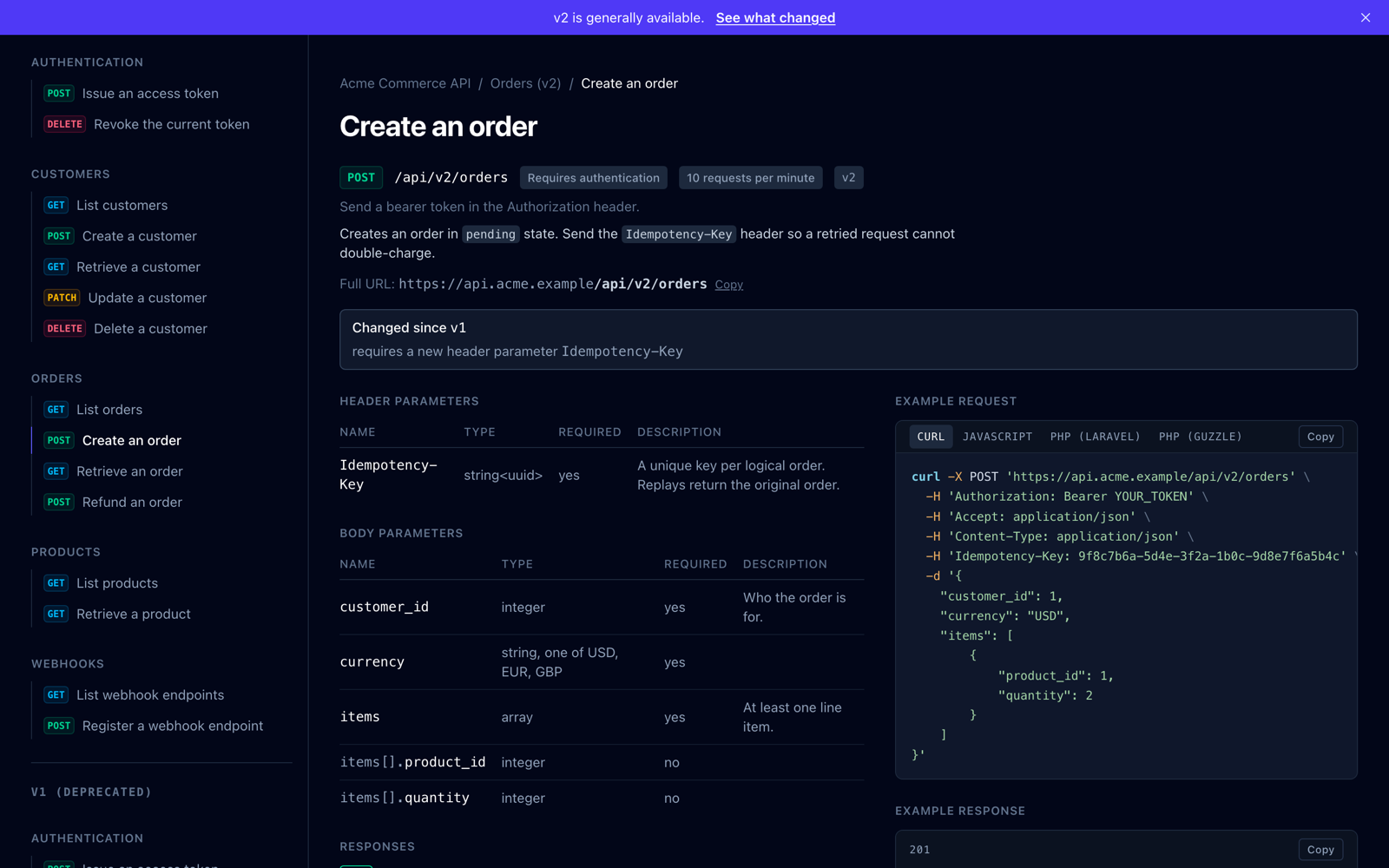
An endpoint page: the reference on the left, the call on the right. Note what
is derived rather than written — the rate limit and the scopes off middleware,
Changed since v1 from comparing the two editions of the operation, and
items[].product_id from a items.*.product_id validation rule.
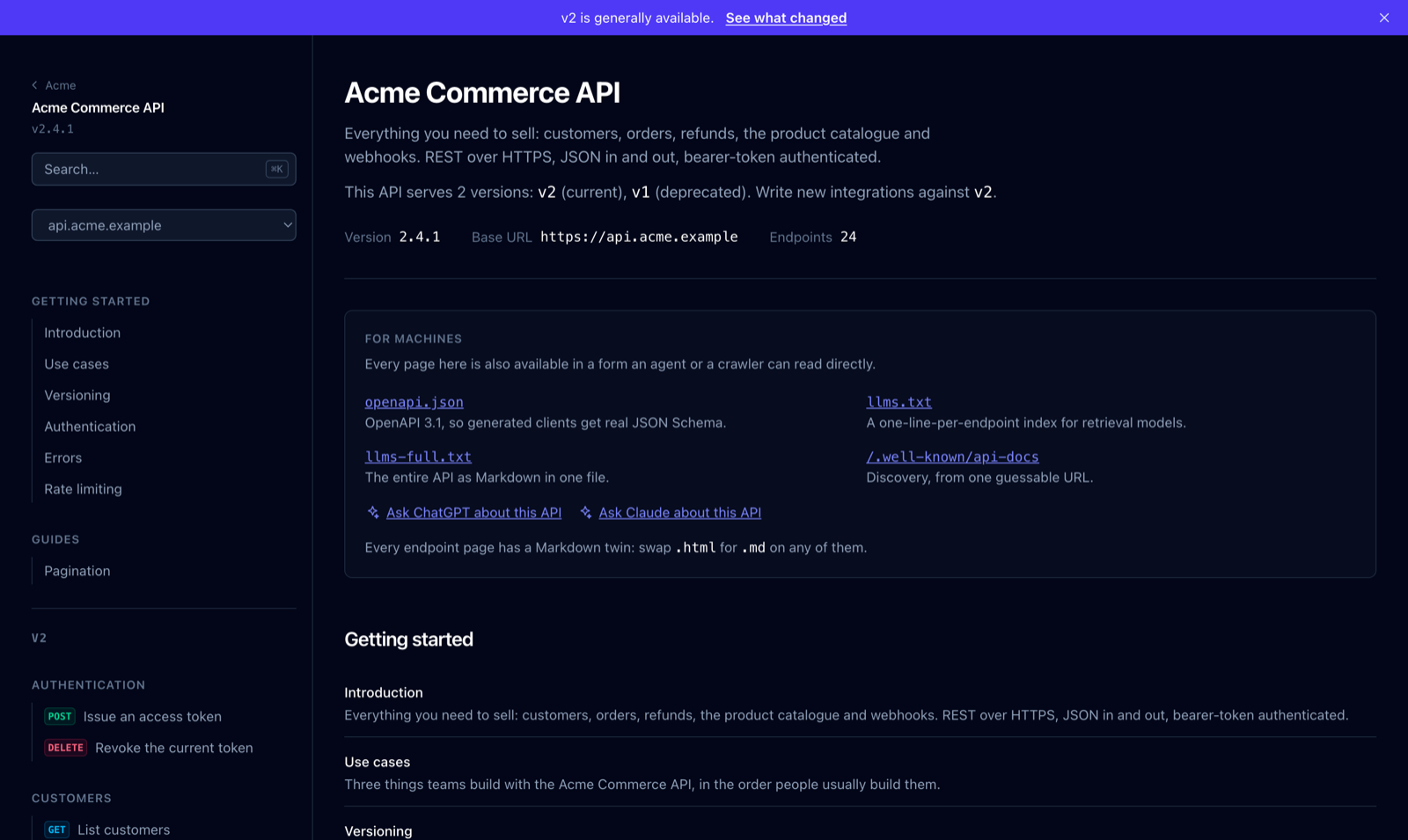
The index. Every page is also a Markdown twin, an OpenAPI operation and a line
in llms.txt — swap .html for .md on any URL and see for yourself.
Build it yourself in one command:
php tools/build-showcase.php   # 8 prose pages, 9 group pages, 24 endpoint pages, Markdown mirrors, OpenAPI, llms.txt, sitemap, search index
open docs/example/index.html
Prose, not just endpoints
An endpoint list is useless to someone who does not already know your endpoint names. Lusen builds a full documentation site: sidebar sections of written pages, an on-page table of contents, and previous/next links across the whole thing.
Write pages as Markdown in resources/docs:
---
title: Use cases
section: Guides
order: 10
---

Three things teams build with this API...
With no pages written at all, Lusen still generates Introduction, Authentication and Errors from the spec itself — the auth page reflects your actual middleware, and the error table lists the statuses your endpoints really return. Everything generated is derived, never invented: if there is no authenticated endpoint, there is no authentication page, and if the API serves one version there is no versioning page. Anything you write wins over the generated page of the same name.
For the editorial pages nothing can derive — use cases, quickstart — publish starter stubs to edit:
php artisan vendor:publish --tag=lusen-pages
MCP: let agents query the docs
Scraping HTML works and is worse — it breaks on every restyle and makes the model pay for markup it cannot use. Lusen exposes the same documentation as MCP tools:
php artisan lusen:mcp
Point a client at it. For Claude Code:
claude mcp add my-api -- php /path/to/your/app/artisan lusen:mcp
Or in a client's config file:
{
  "mcpServers": {
    "my-api": {
      "command": "php",
      "args": ["/path/to/your/app/artisan", "lusen:mcp"]
    }
  }
}
Five tools:
| Tool | What it does |
|---|---|
search_documentation |
Keyword search across endpoints and guides |
list_endpoints |
The whole surface, grouped |
get_endpoint |
One endpoint in full — parameters, responses, example |
read_guide |
Introduction, versioning, authentication, errors, rate limiting, use cases |
build_request |
A runnable request with your values filled in |
Every tool returns the same Markdown a person reads, so there is one set of documentation to keep correct rather than two.
Documenting an endpoint
Most of it is inferred. Path parameters and auth come from the route; request bodies and query strings come from your FormRequest, so an application that already validates its input documents itself:
public function rules(): array
{
    return [
        'email'              => 'required|email|max:255',
        'status'             => ['required', Rule::enum(OrderStatus::class)],
        'items'              => 'required|array|min:1',
        'items.*.product_id' => 'required|integer',
    ];
}
becomes a required email with format: email and maxLength: 255, a status
enum listing the enum's cases, and items as an array of objects — plus a
runnable cURL example whose values satisfy those rules. Lusen reads rules() by
parsing it, never by instantiating the request, so a docs build works in CI with
no .env and no database.
An action with no FormRequest documents what it reads. Plenty of controllers
take Request $request and pull out what they need, and those endpoints used to
show no input at all:
public function search(Request $request)
{
    $request->input('q');
    $request->integer('page');
    $request->input('per_page', 25);
    $request->enum('status', OrderStatus::class);
}
becomes four query parameters: page an integer, per_page an integer whose
example is 25, status an enum listing the cases. Nothing is marked required —
reading a field says the action uses it, not that a caller has to send it — and
only calls on the action's own request count, so a $collection->get('key') is
never mistaken for a query parameter.
Responses come from your API resources. A JsonResource's toArray() is a
precise statement of the response shape, so Lusen reads it — following nested
resources and collections, applying Laravel's data wrapper, and adding
pagination metadata when the collection is paginated.
Field types come from your models. A resource says $this->price and nothing
more, so Lusen looks at the model behind it: casts first, then the column
definitions in your migrations, which are also the only place nullability is
stated. So this:
return ['price' => $this->price, 'sku' => $this->sku, 'status' => $this->status];
documents price as a number, sku as a nullable string with your column's
length limit, and status as an enum listing its real cases — with no
annotations anywhere. Anything nothing can answer stays untyped rather than
guessed; an unknown type documented as string is a guess a reader would act on.
Prose comes from your docblocks. If your controllers are commented, that is
your API reference — summary, description, @group, @deprecated,
@authenticated. Laravel's scaffolded comments ("Display a listing of the
resource") are ignored rather than repeated on every endpoint, and undocumented
resource actions get conventional wording instead: index on a Customers
controller reads "List customers", not "Index".
Attributes are how you say something inference cannot see, and they always win over what was inferred.
use Lusen\Attributes\{ApiDoc, ApiGroup, ApiParam, ApiResponse, Hidden};

#[ApiGroup('Users', 'Create and read user accounts.')]
final class UserController extends Controller
{
    #[ApiDoc(summary: 'List users', description: 'A paginated list of every user.')]
    #[ApiParam('per_page', in: 'query', type: 'integer', example: 25)]
    #[ApiResponse(200, 'A page of users.', example: ['data' => [['id' => 1, 'name' => 'Ada']]])]
    public function index(): AnonymousResourceCollection
    {
        return UserResource::collection(User::paginate());
    }

    #[Hidden]
    public function internalMetrics(): JsonResponse { /* ... */ }
}
Responses, with or without API resources
Lusen documents response bodies from the API resource an action returns. When there is no resource — an API answering with plain arrays through a base-controller helper — it reads the shape you wrote instead:
/**
 * @response array{status: true, data: array{orders: list<OrderShape>, total: int}}
 */
That is the PHPStan grammar, and any class it names is read too: public typed properties become fields, their docblocks become descriptions. See AUTHORING.md.
Two versions at once
An API that has lived long enough serves /api/v1/orders next to
/api/v2/orders, and documenting that badly is the worst thing a reference can
do: two pages titled "List orders", two identical meta descriptions competing
for the same query, and an assistant with no way to tell which one to recommend.
Lusen reads the version out of the path. Nothing to configure:
- The reference is grouped by version, newest first, and every page badges the version it belongs to.
- A switcher scopes the sidebar to one version, and takes the reader to that version of whatever they have open.
- Each older endpoint links to its replacement — matched by method and path, so
GET /api/v1/ordersfindsGET /api/v2/orderson its own. - An endpoint with an earlier edition carries a table of what changed since it, a column per version, so a reader migrating can see both shapes of a field at once.
- Titles, meta descriptions, OpenAPI tags, Postman folders and search results all name the version, so nothing competes with itself.
- A Versioning page is derived: which versions exist, which to use, and what the newest one added or dropped compared with the one before it.
The two things a URL cannot tell you are configurable:
'versions' => [
    'current' => 'v2',                      // default: the newest found
    'deprecated' => ['v1' => '2026-06-01'], // a date, or just ['v1']
],
Deprecating a version marks every endpoint in it deprecated and points each one
at its successor. An API that negotiates its version in a header leaves nothing
in the path to read, so its controllers say so with
#[ApiDoc(version: 'v2')].
Built to be read
Documentation people avoid is documentation nobody maintains, so the reading experience is a feature rather than a skin:
- Two columns on an endpoint page. What the endpoint is on the left, what a call to it looks like on the right, sticky beside the reference — the parameter you are reading about and the example that uses it on screen together. One column, in reading order, on a narrow screen.
- Navigation at every width. Rendered once and moved by CSS — a column beside the content on a laptop, a panel behind one tap on a phone, and the end of the document with no JavaScript at all.
- A contents column on every page. Each of an endpoint's sections carries
a stable anchor, so
#users-index-responsesis a link worth citing. - Tabbed request examples, remembered across pages, and response bodies tabbed by status. Both ship stacked, so a reader without JavaScript — and a model reading the HTML — still gets every one.
- Search on
⌘Kover a prebuilt index, with the arrow keys. No search service, no API key. - A base URL switcher when
serverslists more than one, rewriting the host in every example so what gets copied is what was chosen. - Copy for an LLM, handing over the page's Markdown rather than its markup — or Ask ChatGPT / Ask Claude, which sends them the same file with the question already written. Which assistants, and what they are asked, is yours to set.
ui.edit_urlputs an Edit this page link on everything you wrote — the cheapest thing there is for keeping prose honest.
Try it, without a proxy
Turn it on and every documented GET grows a Try it dialog that sends the
request and shows what came back:
'try_it' => [
    'enabled' => env('LUSEN_TRY_IT', false),   // off until you say so
    'methods' => ['GET'],                      // a Send button beside a write is a footgun
],
The request goes straight from the browser to your API. There is no Lusen server in the middle, because static docs have nowhere to put one. So it works out of the box when the docs and the API share an origin — runtime mode, or docs on the API's own domain — and otherwise your API has to allow the docs origin:
Access-Control-Allow-Origin: https://docs.example.com
Access-Control-Allow-Headers: authorization, content-type
When that header is missing, the page says exactly that, names both origins and
prints the two lines above with your values in them. A browser reports a
blocked response and an API that is genuinely down in identical terms, and
TypeError: Failed to fetch sends people to look at the wrong thing.
The dialog repeats everything the page behind it says — the host, the scheme, the rate limit, each field's type and description — and shows the call as it stands, updated as you edit it, so nobody has to press send to find out what send would do.
Readers set their credential once, in a Set up to test section on the
Authentication page, and every dialog uses it. It stays in their browser for
the tab (persist_token can extend that to the browser, behind a checkbox they
tick), goes out only as the header it authenticates, is masked in the preview,
and never ends up in the snippet the copy button hands over.
#[ApiDoc(tryIt: false)] withdraws a single endpoint — an export that takes a
minute, a search that costs money per call.
Writing the parts Lusen cannot infer
Prose pages, examples worth writing by hand, attributes, docblock tags and every configuration knob are covered in AUTHORING.md.
The short version: what you write always wins, and Lusen would rather document a
field as any than guess at it.
Configuration
Every key has a working default; publish the file only if you need to change something.
php artisan vendor:publish --tag=lusen-config
Commands
php artisan lusen:build                      # emit every enabled surface
php artisan lusen:build --only=openapi       # just one
php artisan lusen:build --dry-run            # report what it would write and remove
php artisan lusen:build --path=/tmp/docs     # override the output directory
php artisan lusen:build --fresh              # ignore the incremental cache
php artisan lusen:check                      # report endpoints missing documentation
php artisan lusen:check --strict             # ...and fail CI when any are
php artisan lusen:check --json               # the same findings, for a script
php artisan lusen:diff --save                # record this build as the baseline
php artisan lusen:diff                       # what changed since, and what of it breaks
php artisan lusen:diff --strict              # ...and fail CI on the breaking ones
php artisan lusen:diff --json                # the same changes, for a script
php artisan lusen:record                     # capture real responses from your test suite
php artisan lusen:record --fresh             # re-record everything
php artisan lusen:record --clear             # delete them; examples fall back to the schema
Builds are incremental. An endpoint is re-analysed only when its route or one
of the files behind it actually changed — comparing contents, not timestamps,
so a fresh checkout or a CI runner still gets the benefit. Add .lusen to your
.gitignore.
A build also takes back the pages it no longer writes, so renaming a group does
not leave the old one behind. It removes only files a previous build recorded
writing, in .lusen-manifest.json inside the output directory — keep that file
wherever the output goes, and anything else in there is left alone.
Request examples
Every endpoint page carries the same request in several languages, tabbed where the script runs and stacked where it does not:
| On by default | curl, javascript, laravel, guzzle |
| Available | python (requests), go (net/http) |
Set ui.snippets to the ones your readers actually write. Python and Go are
off by default because six tabs is a strip nobody reads, and which two your
readers want is a question only you can answer.
All of them render the same assembled request, so no tab can drift from another or from the request the playground sends.
Real examples, not plausible ones
A generated example satisfies the schema and nothing else. It says
"status": "string" where your API says "paid", and a reader who copies one
into a client has learned the shape without ever seeing the thing.
Your test suite is already producing real responses. Borrow them:
php artisan lusen:record # runs your suite with capture on
Every response it saw is written to .lusen-recordings.json — commit it — and
the build uses those bodies instead of inventing them.
Recording borrows the tests because they have already booted the application,
which a docs build never does. The build only ever reads the file, so
lusen:build still runs against a checkout with no .env and no database.
Three things worth knowing. The first recording of an operation wins, so a
suite with random fixtures does not rewrite the file with fresh names on every
CI run; --fresh is how you ask for all of them again. Fields you name in
record.redact are replaced wherever they appear — the field, its name and
its position are kept, because the shape is what documents the API and the
value is the part nobody should be reading in a pull request. And an
#[ApiResponse(example: …)] still wins, because somebody wrote that down on
purpose.
Does this branch break somebody's client?
The docs already know every parameter, every response field and every validation rule, which makes them the one thing in the repository that can answer that before a customer does.
php artisan lusen:diff --save    # on main, once. Commit .lusen-baseline.json
php artisan lusen:diff --strict  # on every pull request
Changes come back in three grades, and only one of them fails a build:
| Breaking | A removed endpoint or response field, a new required parameter, a type change, a tightened max, a newly required scope, an operation id that moved |
| Added | New endpoints, optional parameters, extra enum members, relaxed rules |
| Notice | Deprecations, reworded summaries, and a field the extractors have only now managed to type |
That last row is the reason this is usable. Adding a cast to a model turns
any into integer on every endpoint that returns the field, and a gate that
went red for it would be switched off in a week — so a type arriving or
departing is never counted as breaking. An endpoint that stops requiring
authentication is the mirror image: it breaks nobody, so it cannot fail the
build, but it is reported in the words it deserves.
Contributing
composer install
composer test        # Pest + Orchestra Testbench
composer check       # Pint, PHPStan at level max, then the suite
The docs UI is Tailwind v4. dist/lusen.css is committed so installing Lusen
never requires Node — if you change classes in resources/views, run
npm install && npm run build and commit the CSS in the same change.
The name
Lusen is a high plateau above Kukës, in northern Albania, that ends in a sheer drop. The mark is its profile: high ground, an undercut face, the valley far below — which turns out to be the letter the name starts with.
art/lusen-mark.svg inherits currentColor, so beside text it is whatever
colour that text is. art/lusen-icon.svg is the badge form, carrying its own
colours — which is the one to use anywhere the surrounding theme is unknown, a
README on a site with a dark mode included.
Licence
MIT.