
asignua / filament-security-scanner

Detection (not protection) of intrusion traces for Filament: web shells and polyglots in uploads, drift from git and a vendor hash snapshot, obfuscated PHP, quarantine and alerts.
Package info
github.com/asignua/filament-security-scanner
pkg:composer/asignua/filament-security-scanner
Requires
- php: ^8.3
- filament/filament: ^5.0
- guzzlehttp/guzzle: ^7.8.2|^8.0
- illuminate/contracts: ^12.0|^13.0
- illuminate/support: ^12.0|^13.0
Requires (Dev)
- larastan/larastan: ^3.0
- laravel/pint: ^1.18
- orchestra/testbench: ^10.0|^11.0
- phpunit/phpunit: ^11.5|^12.0|^13.0
- spatie/laravel-medialibrary: ^11.0
Suggests
- spatie/laravel-medialibrary: Checks a file synchronously the moment it is added to the media library (MediaHasBeenAddedEvent).
Provides
None
Conflicts
- asign/eegnith-security-scanner: *
Replaces
None
README

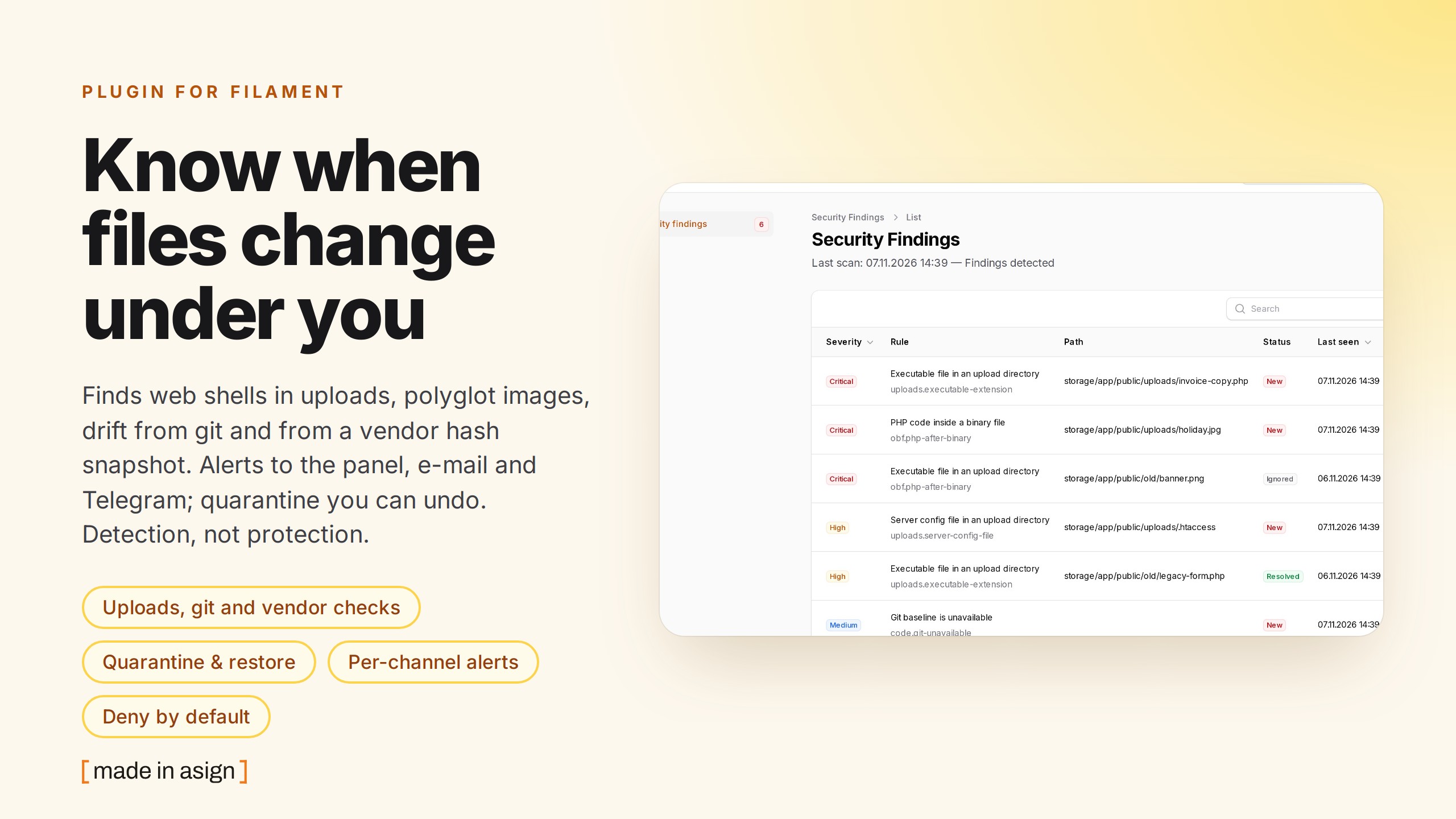
A file-system intrusion detector for Laravel apps with a Filament 5 panel. It looks for traces of files that were
already added, changed or swapped: executable code in upload folders, web shells hidden inside images, files that
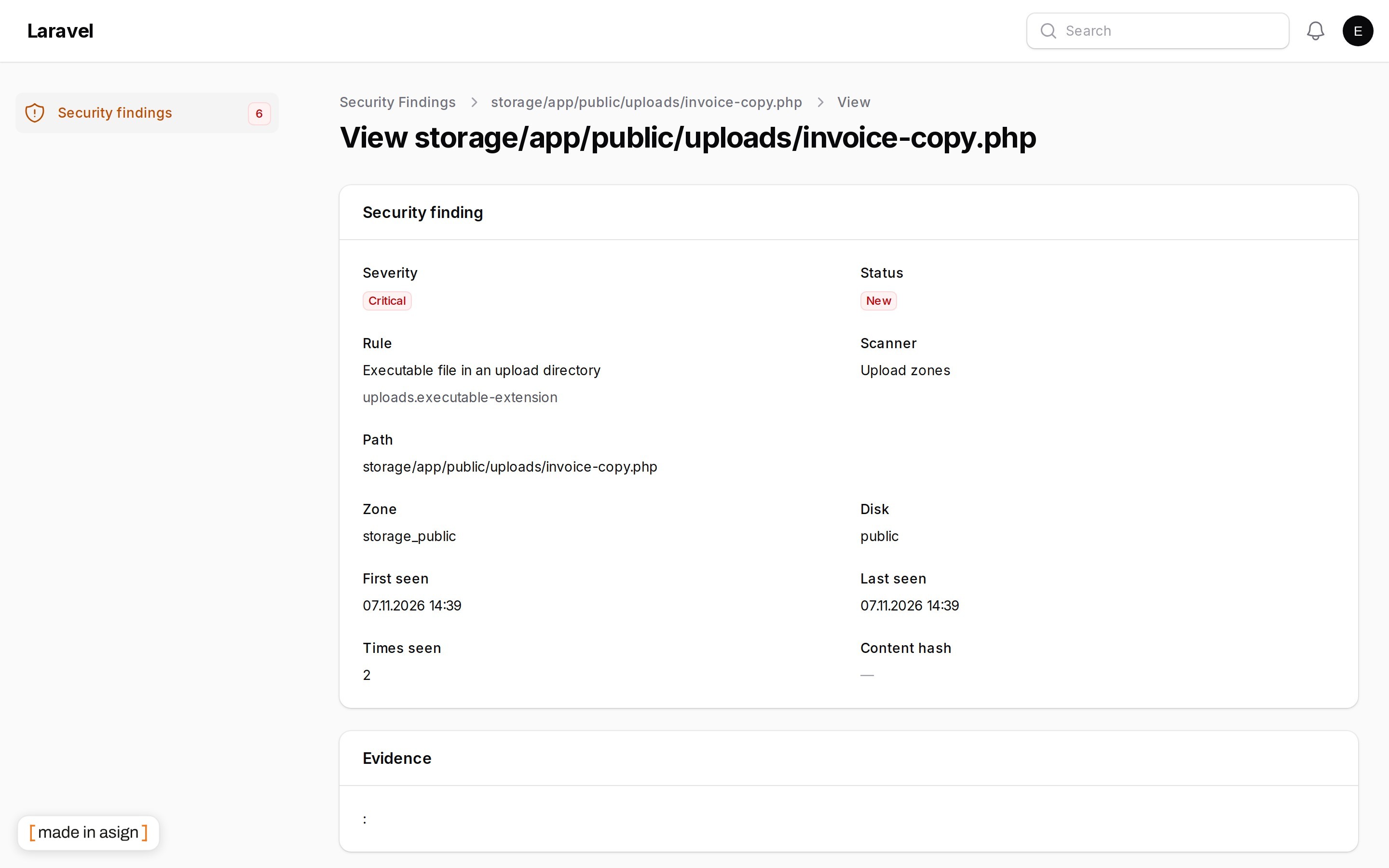
differ from git or from a hash snapshot of vendor/, obfuscated PHP, risky runtime settings. Findings go to a panel
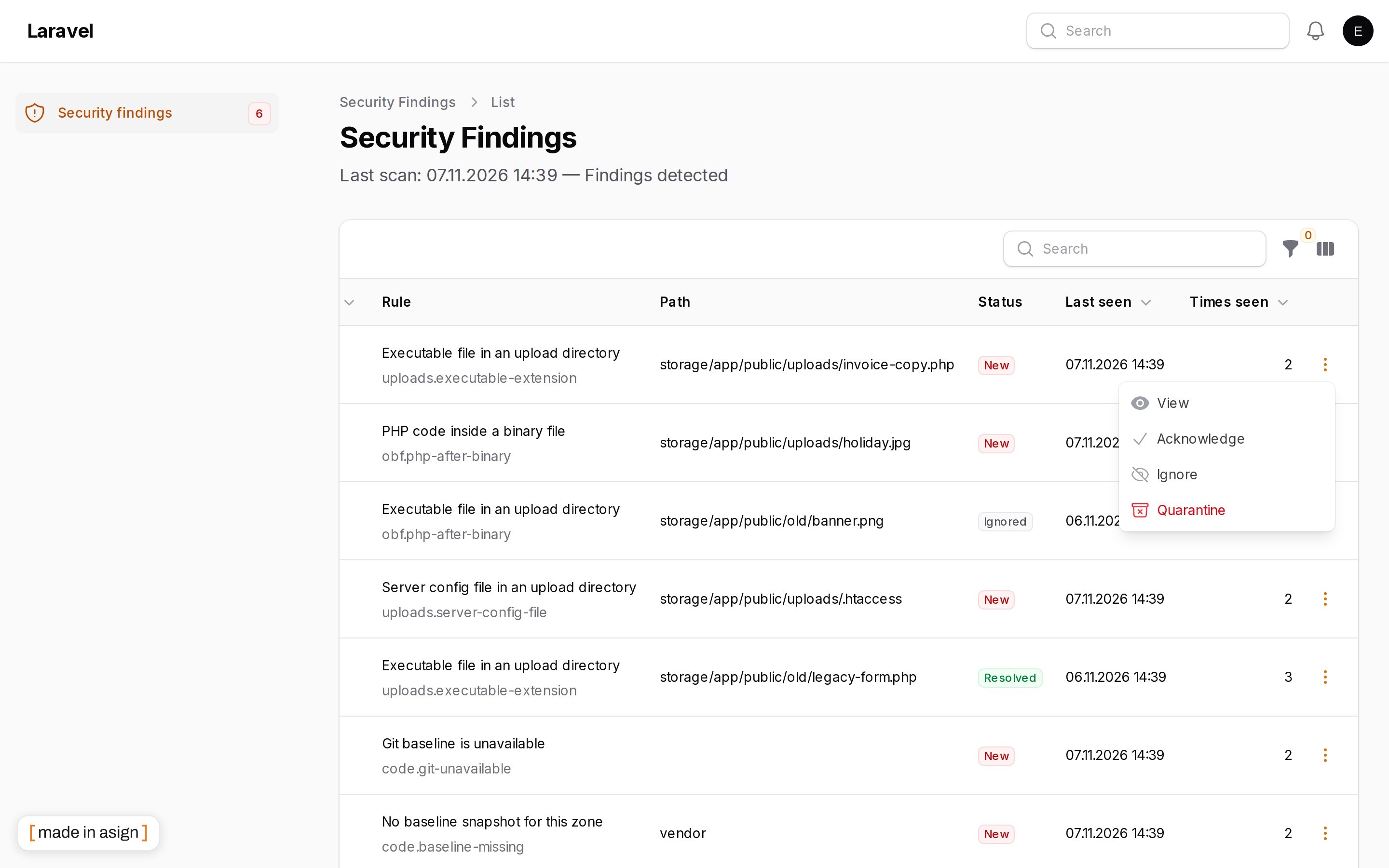
resource, e-mail and Telegram, and suspicious files from upload folders can be moved to quarantine and restored.
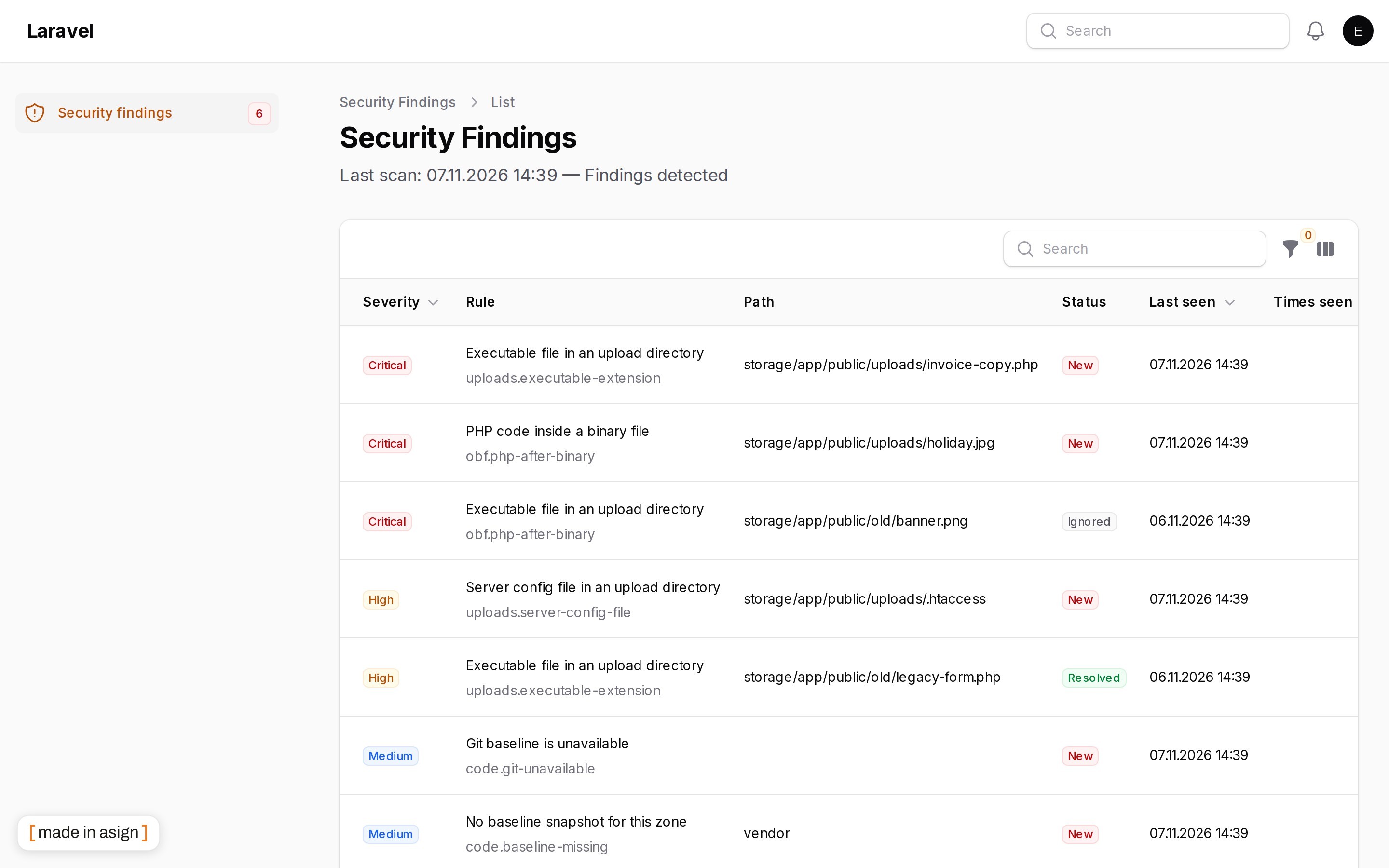
This is detection, not protection. It does not block a request, does not stop an upload, does not patch anything. It tells you, after the fact, that something is wrong. Prevention is the job of your web server and your deploy process (see Harden the web server). A clean list means "nothing found by these rules in the last run", not "the site is safe" - which is why the findings page always shows when the scanner last ran.
Screenshots
Requirements
- PHP 8.3+
- Laravel 12 or 13
- Filament 5
spatie/laravel-medialibrary is optional: when installed, a file is checked the moment it is added to the library.
Installation
composer require asignua/filament-security-scanner
php artisan migrate
Register the plugin on your panel:
use Asignua\FilamentSecurityScanner\SecurityScannerPlugin;

$panel->plugin(
    SecurityScannerPlugin::make()
        ->navigationGroup(fn (): string => __('System')) // a closure if the group is translatable
        ->navigationSort(10),
);
First step: define the gates
Nobody can see or act on findings until you define the gates. With no gate defined, view, quarantine, triage
and restore all deny, for every user, and the resource does not appear in the navigation. triage (acknowledge /
ignore) falls back to whatever quarantine says when it has no definition of its own.
// AppServiceProvider::boot()
use Asignua\FilamentSecurityScanner\SecurityScanner;
use Illuminate\Support\Facades\Gate;

Gate::define('security-scanner.view', fn ($user): bool => $user->isAdmin());
Gate::define('security-scanner.quarantine', fn ($user): bool => $user->isAdmin());
Gate::define('security-scanner.restore', fn ($user): bool => $user->isSuperAdmin());
// optional - without it, `triage` follows `quarantine`
Gate::define('security-scanner.triage', fn ($user): bool => $user->isAdmin());

// who receives the in-panel (database) notification
SecurityScanner::notifyUsersUsing(fn () => User::query()->where('is_admin', true)->get());
| Ability | Allows | If undefined |
|---|---|---|
security-scanner.view |
opening the findings resource | denied |
security-scanner.quarantine |
moving a file out of an upload folder | denied |
security-scanner.triage |
"Acknowledge" and "Ignore" (both silence alerts; ignore does so for good) | same as quarantine |
security-scanner.restore |
putting a quarantined file back (more dangerous than quarantining it, so gate it more tightly) | denied |
Gates are evaluated at call time, so a Gate::define in your own service provider wins regardless of boot order.
Quarantine is available for upload zones only; it can never move .env or application code.
Deploy step: take the vendor baseline
vendor/ is git-ignored, so its integrity is held by a hash snapshot. Take it on every deploy, straight after
composer install, and not from the scheduler (a snapshot taken on a schedule would bake in a swap that happened
before it):
php artisan security:baseline --zone=vendor
Until the first snapshot exists the scanner reports "no baseline snapshot for this zone".
The same command records the git HEAD of the deploy. A commit makes git status clean again, so a HEAD that differs
from the recorded one is reported as code.git-head-moved until the baseline is taken again: the deploy must run
security:baseline, otherwise every commit on the server raises that finding. While no HEAD was ever recorded the scanner
raises code.head-unrecorded instead (silence there would hide every commit made on the server). The HEAD SHA is part
of both findings' fingerprint, so ignoring one does not mask a later move.
Schedule
The package registers its own schedule; do not add it again. You only need the Laravel scheduler running
(php artisan schedule:run every minute).
| Command | When |
|---|---|
security:scan --trigger=schedule --fail-on=none |
04:40, without overlapping, synchronous |
security:prune |
05:00 |
security:notify |
hourly at :15 (sends throttled notifications that are due) |
Turn it off with SECURITY_SCANNER_SCHEDULE=false; the times live in config('security-scanner.schedule'). A manual
"scan now" button in your own UI should dispatch Jobs\SecurityScanJob (it needs a queue worker).
What it checks
Four scanners, driven by rules that are plain data (resources/heuristics/heuristics.php):
- Upload zones - executable files, server config files (
.htaccess,.user.ini), symlinks and PHP hidden inside binary files (polyglots: an image that also contains PHP) in folders the app writes to. - Code integrity - tracked files that differ from the git commit, untracked files in the repository, files in the
web root that are not expected, PHP files that a nested
.gitignorehides fromgit statusinapp,bootstrap(notbootstrap/cache),config,databaseandroutes(security-scanner.git.ignored_php_paths), tracked files markedassume-unchanged/skip-worktree, and a hash comparison ofvendor/against the deploy-time snapshot. - Obfuscation - decoded payloads passed to
eval,__halt_compilertricks, function names built from concatenation, code included from temporary streams. - Environment hygiene - debug mode in production, missing app key,
.envin the web root, dangerous PHP settings, world-writable files.
The file read is gated by max(mtime, ctime), so a nightly run does not re-read the whole disk. A run that did not see
a file never closes its finding ("not seen" is not "gone"), and a scanner that could not complete (for example git
timed out) never closes its findings either.
Zones
// config/security-scanner.php (publish with --tag=security-scanner-config)
'zones' => [
    'webroot'        => ['root' => 'public',      'kind' => 'webroot'],
    'storage_public' => ['disk' => 'public',      'kind' => 'upload:web'],      // reachable through public/storage
    'storage_app'    => ['root' => 'storage/app', 'kind' => 'upload:private'],
    'vendor'         => ['root' => 'vendor',      'kind' => 'vendor'],
],
Zones may nest; the more specific zone takes its folder out of the broader one's walk, so no file is visited twice.
mergeConfigFrom() merges only the top level: a published zones or allowlist replaces the whole list. To add one
zone from code: config(['security-scanner.zones.media' => ['disk' => 'media', 'kind' => 'upload:private']]). After
adding a zone run php artisan security:scan --reread once, because the read gate is per scanner and would otherwise
treat the new zone's old files as already checked.
The vendor integrity check does not flag this plugin's own files: the snapshot is taken after composer install, the
plugin's sample files are export-ignored from the dist archive and allow-listed under
vendor/asignua/filament-security-scanner/tests/fixtures/**, and a test scans a copy of the plugin installed in
vendor/ with its own rules and expects no finding.
Alerts
Three independent channels, each with its own minimum severity, throttling and "already sent" stamp:
| Channel | Setup | Default threshold |
|---|---|---|
| Panel (database notification) | SecurityScanner::notifyUsersUsing(...) + ->databaseNotifications() on the panel |
low |
SECURITY_SCANNER_NOTIFY_MAIL=ops@example.com |
high | |
| Telegram | SECURITY_SCANNER_TELEGRAM_BOT_TOKEN, SECURITY_SCANNER_TELEGRAM_CHAT_ID |
high |
The panel channel needs Laravel's notifications table. If the host has none yet, run php artisan make:notifications-table
and php artisan migrate, and enable ->databaseNotifications() on the panel; without both, panel alerts go nowhere.
Throttling is SECURITY_SCANNER_NOTIFY_THROTTLE minutes (default 60); thresholds are
SECURITY_SCANNER_NOTIFY_MIN_PANEL|MAIL|TELEGRAM. The first run is mailed as an "inventory", not as an alarm. A custom
mail view can be set in security-scanner.mail.view; it receives $findings, $newCount, $totalCount, $panelUrl,
$isFirstRun, $siteName. File names are written by the attacker: in a custom markdown view pass every cell through
SecurityPresenter::markdownText().
Quarantine
A manual quarantine moves the file to storage/app/private/quarantine, makes it non-executable and records who did it.
Nothing is ever deleted. Restore puts the file back only if the original path is free. Automatic quarantine is off
by default (SECURITY_SCANNER_QUARANTINE_AUTO=true), limited to upload:web zones, never happens on the first run, and
never on a regex-only match.
Commands
| Command | Purpose |
|---|---|
security:scan [--path=*] [--fail-on=high] [--budget=] [--trigger=] [--reread] |
full pass, or only the given paths; non-zero exit when open findings reach the threshold (none = never) |
security:baseline [--zone=*] [--keep=2] |
hash snapshot of vendor zones - a deploy step |
security:rules [--validate] [--against=<dir>] [--list] |
validate the rule registry; --against runs it over clean/ and malicious/ sample folders |
security:prune [--days=] |
rotate runs and closed findings |
security:notify |
send throttled notifications that are due |
Your own rules
Rules live in resources/heuristics/heuristics.php. A host overrides or adds rules in
config/security-scanner-heuristics.php (same format; the later file wins per rule id; an entry with the same id
and enabled => false switches a package rule off). Every rule is compiled when the file loads, not on the first file
at 04:40, and a rule that is not valid is reported as a finding instead of silently disabling the scan. Before adding a
rule, run it over a folder of known-clean files and a folder of known-bad samples with
php artisan security:rules --against=<dir> (the folder needs clean/ and malicious/ subfolders; sample files use
the .fixture extension so they are inert). A rule that fires on clean files teaches people to ignore the page.
Harden the web server
The scanner finds files after they are on the disk. What actually stops an uploaded file from running is the web
server. With nginx, never hand a path under the public/storage symlink to PHP:
location ^~ /storage/ { try_files $uri =404; }
Also keep PHP-FPM from writing to your code, and do not treat this package as a substitute for any of that.
Configuration
Everything is in config/security-scanner.php and the SECURITY_SCANNER_* environment variables (enabled, table prefix,
retention, zones, allowlists, quarantine, upload check, notifications, Telegram, schedule). Tables are
security_scans, security_findings and security_baseline, with an optional SECURITY_SCANNER_TABLE_PREFIX.
Deployed from an archive, without a .git? Set SECURITY_SCANNER_GIT=false (security-scanner.git.enabled): git is not run,
code.git-unavailable and its hygiene.scanner-degraded stay quiet and security:baseline skips the HEAD; if there is no
baseline at all, one code.baseline-missing hint (path git-off) remains. A storage symlink to a shared directory
(Deployer layout) is understood: tracked files below it are not reported as missing. code.git-dir-writable is not raised
when APP_ENV is local or testing.
SecurityScanner::validateConfig() returns a list of configuration problems you can call from your own health check.
How it differs from other packages
Compared with the READMEs of mkwebdesign/filament-watchdog-v5 (hash baseline, signatures fetched from GitHub, e-mail
alerts, lockdown, activity log) and johnrivera7/filament-antivirus (ClamAV upload scanning), as read on 2026-11-07.
They have different goals; the facts about this package:
- It compares tracked files with git and
vendor/with a deploy-time hash snapshot. - It looks for polyglots - valid image files that also carry PHP - in upload folders.
- Rules are data you can extend or switch off per application, with a
security:rulesgate that runs them over samples. - Notifications are per channel (panel, e-mail, Telegram), each with its own threshold, throttle and stamp.
- It never downloads signatures from the network, and it has no lockdown mode and no activity log.
Limits
What the scanner deliberately does not cover:
bootstrap/cache/*.php(compiled caches) andstorage/framework/views(compiled Blade) are allowlisted: they change on every request and every deploy. A shell written there is not reported. Keep those directories non-writable by anything but the application and rebuild them on deploy (php artisan optimize:clear/optimize).public/storageis trusted only while it is a symlink to the public storage directory (filesystems.disks.public.root); any other target is reported ashygiene.foreign-storage-link.- Filters of the git config are switched off while the scanner runs git, except exact git-lfs commands (those too once an
alias.lfsor another command-running key is present); anything else,alias.lfsand the partial-clone keys (remote.*.uploadpack,remote.*.promisor,extensions.partialClone) are reported ascode.git-executable-config. Git runs with overrides passed throughGIT_CONFIG_*,--no-lazy-fetch,--no-replace-objects,--ignore-submodules=all(gitlinks are listed once, not compared) and strict stat settings; every inheritedGIT_*variable is dropped. - The git comparison is only as trustworthy as
.git. Someone who can write to.gitcan make git say anything (replace refs, rewrite the index, weaken the stat checks), and the scanner does not try to detect each such trick. It hardens how it calls git and raises one honest signal,code.git-dir-writable, when the PHP user can write to.git(not inlocalandtesting, where that is normal). Keep.gitowned by the deploy user and read-only for the PHP user, or switch git off and rely on the hash baselines. - Zones must lie under
base_path(). A zone (arootor adisk, such as a media disk in/data/media) outside the project root is refused with an issue in the run (zone "…": … is outside the project root) and is not scanned, because findings are stored by a path relative to the project root. Mount such storage under the project (a symlink is fine) or accept that it is not covered. - The scanner is detection, not protection: it sees what the web user can read, runs as that user, and a root-level attacker can switch it off.
Gotchas
- A finding's title is a translation key resolved when it is shown, so switching language changes old findings too.
- Read the config at call time in your own code: host providers boot after package ones.
- Scanning a bind-mounted Docker volume (macOS/Windows) is many times slower than on Linux.
- An empty list can mean "all clear" or "the scanner is dead"; look at the last-scan line under the page title.
Upgrading from asign/eegnith-security-scanner
The two packages share tables, config, env, commands and gate names, so they cannot be installed together (this package
conflicts with the old one). Switching is a code change only; stored findings, quarantine and settings stay valid.
- Define all four gates before updating: undefined gates now deny (the old package allowed every panel user).
- Let queued scanner jobs finish (they carry the old class names), then
composer remove asign/eegnith-security-scannerandcomposer require asignua/filament-security-scanner. - Change the plugin import to
Asignua\FilamentSecurityScanner\SecurityScannerPlugin. - Run
php artisan migrate(idempotent) and, as part of your deploy,php artisan security:baseline --zone=vendoronce: the vendor path changed, so oldvendorsnapshot entries close as gone and the new ones are not findings.
Open "heuristics registry rejected a rule" findings are the only ones that may reappear as new, because their identity includes the (now English) message text.
Translations
The interface ships in English, Ukrainian, German, Spanish, French, Italian, Dutch, Polish, Brazilian Portuguese and
Turkish under the security-scanner:: namespace (ui and rules groups). English and Ukrainian are written by the
author; the other languages are machine translations that no native speaker has reviewed yet - corrections are welcome
as pull requests. A test keeps every language in step with the English keys and placeholders. Override a string by
publishing the translations (--tag=security-scanner-translations).
AI agents
The package ships Laravel Boost guidelines (resources/boost/guidelines/core.blade.php)
so a coding agent wires it up correctly.
Testing
composer install
vendor/bin/phpunit
vendor/bin/phpstan analyse --memory-limit=1G
vendor/bin/pint --test
Try it by hand with the workbench: vendor/bin/testbench workbench:build, then vendor/bin/testbench serve, and log in
at /admin as emma@example.com / password.
Security
Report vulnerabilities privately, see SECURITY.md.
Changelog
See CHANGELOG.md.
More plugins by asign
- XLSX Export - typed
.xlsxdownloads of what is on the screen - Activity Log Plus - an audit trail for resources
- Mail Log - every message your app sends
- Redirects - redirects and the 404 log
- Record Lock - stop two people editing the same record
All plugins: https://filamentphp.com/plugins?q=asign
License
The MIT License (MIT). See LICENSE.md.