
asignua / filament-group-summaries

Column summaries in the group header row of Filament tables, a default direction per group, and per-group control of the trailing summary row.
Package info
github.com/asignua/filament-group-summaries
pkg:composer/asignua/filament-group-summaries
Requires
- php: ^8.3
- filament/filament: ^5.9
- illuminate/contracts: ^12.0|^13.0
- spatie/laravel-package-tools: ^1.16
Requires (Dev)
- larastan/larastan: ^3.0
- laravel/pint: ^1.18
- orchestra/testbench: ^10.0|^11.0
- phpunit/phpunit: ^11.5|^12.0
- symfony/css-selector: ^7.4|^8.0
Suggests
None
Provides
None
Conflicts
None
Replaces
None
README

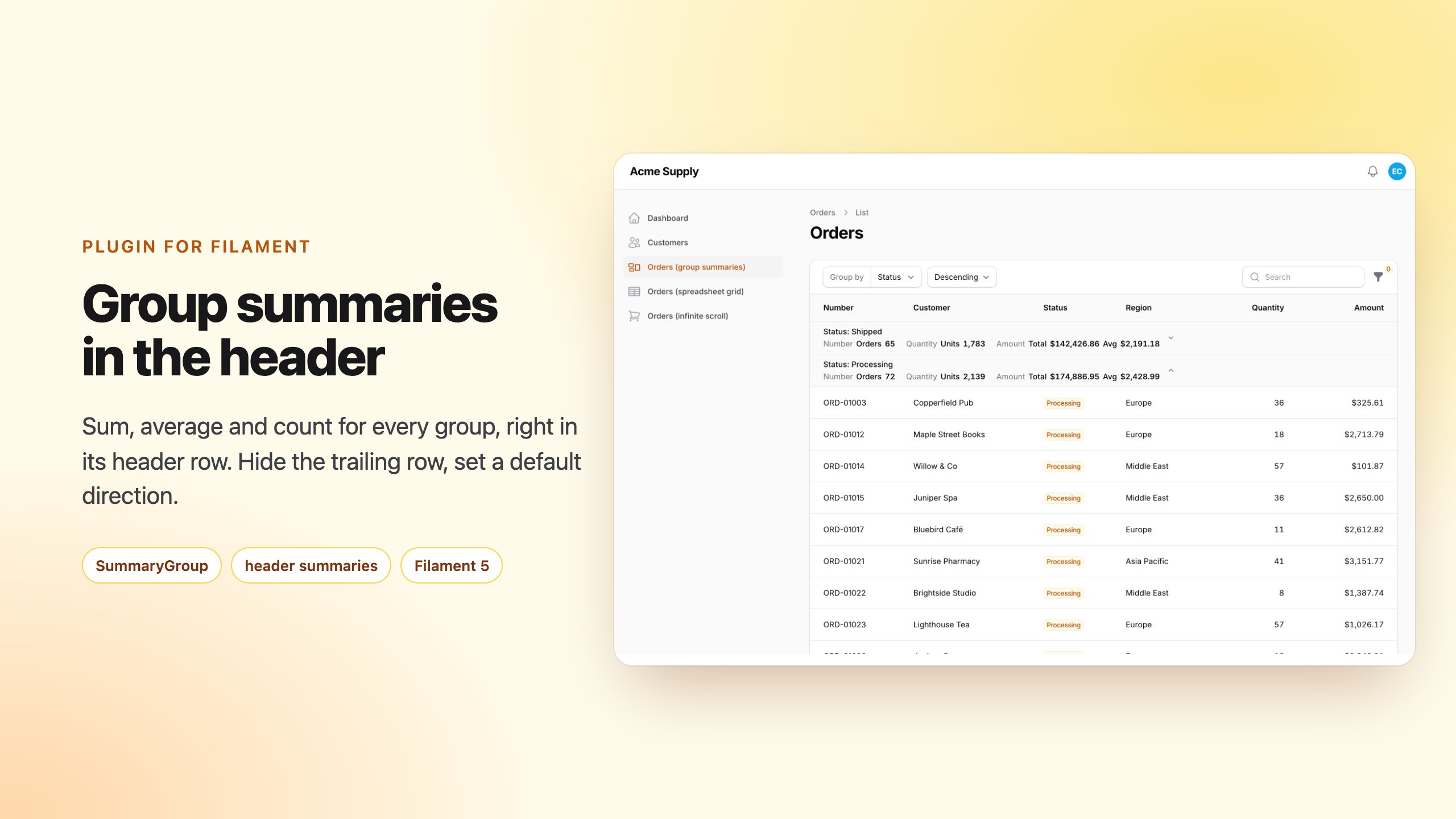
Show a Filament table's column summaries in the group header row (they stay visible when the group is collapsed), hide the summary row drawn after each group, and give a group its own default sort direction. No Filament view is forked.
Requested in filamentphp/filament#19615 (summaries in the group header), with related asks #15353 (hide the summary per group) and #19753 (default direction for groups).
- Screenshots
- Requirements
- Installation
- Usage
- How it works and its trade-offs
- Gotchas
- AI agents
- Testing
Screenshots
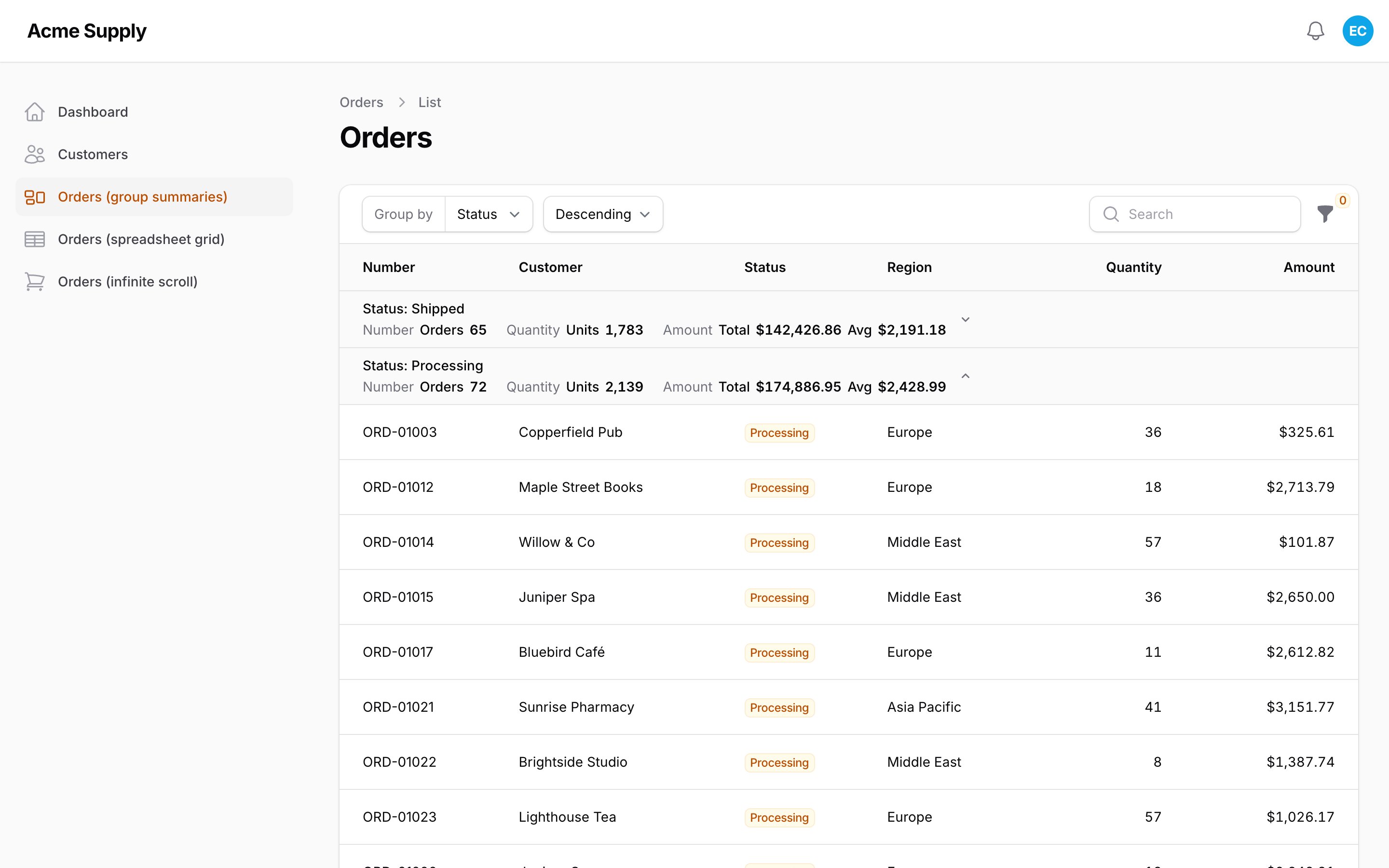
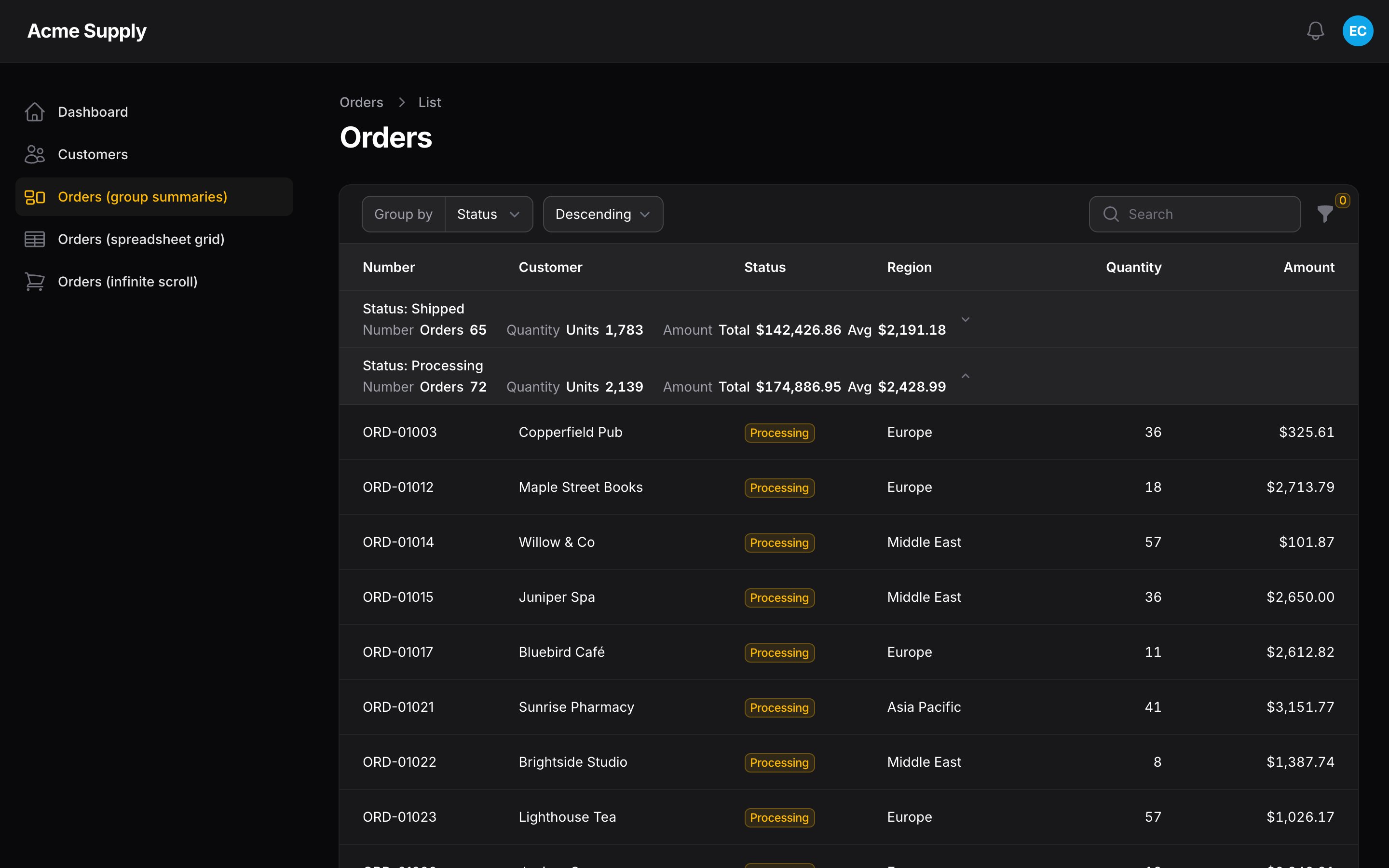
Requirements
- PHP 8.3+
- Filament 5.9+ (
composer.jsonrequires^5.9). Developed and tested against Filament 5.9 (filament/tablesv5.9.0). The plugin relies on a few Filament internals (listed in How it works);tests/FilamentInternalsTest.phpfails with a message naming what moved if a Filament update breaks one.
Installation
composer require asignua/filament-group-summaries
php artisan filament:assets
Register the plugin on the panel (it links a tiny stylesheet after your theme):
use Asignua\FilamentGroupSummaries\GroupSummariesPlugin;

$panel->plugin(GroupSummariesPlugin::make());
Usage
Use SummaryGroup wherever you used Group; it extends it, so everything you already call still works.
use Asignua\FilamentGroupSummaries\SummaryGroup;
use Filament\Tables\Columns\Summarizers\Sum;

$table
    ->columns([
        TextColumn::make('status'),
        TextColumn::make('amount')->summarize(Sum::make()->label('Total')),
    ])
    ->groups([
        SummaryGroup::make('status')
            ->collapsible()
            ->summariesInHeader()     // Sum / Average / Count / Range / Values / custom, per group
            ->hideTrailingSummary()   // drop the row Filament draws after each group
            ->defaultDirection('desc'),
    ]);
| Method | What it does |
|---|---|
summariesInHeader(bool|Closure = true) |
Prints each group's summaries in its header row. Values respect filters and search. |
summaryColumns(?array $names) |
Limits the header to these columns (default: every visible column with a summarizer). |
columnLabels(bool = true) |
Show or hide the column name before its summaries. |
hideTrailingSummary(bool|Closure = true) |
Hides the per-group summary rows after the groups (the page / all-records totals in the footer stay). |
defaultDirection('asc'|'desc') |
Direction applied when the user picks this group in the grouping dropdown. |
makeDefaultOn(Table $table) |
defaultGroup() that uses the group's own direction. |
For the table's default group use makeDefaultOn(); plain ->defaultGroup($group) keeps
Table::defaultGroup()'s own direction argument ('asc').
How it works and its trade-offs
Filament has no hook for a group header, and index.blade.php is huge and changes every release, so the view
is not overridden. Instead:
- Header summaries. The header prints the group's description with
{{ }}, which renders anyHtmlableunescaped.SummaryGroup::getDescription()returns your description (if any) plus a strip of summaries. The values come from Filament's owngetTableSummarySelectedState()(the same grouped query Filament runs for its summary rows), rendered by the columns' own summarizers, so formatting, labels and custom summarizers match the footer. The strip is cached per query, so any number of group headers cost one extra aggregate query per render. - Hide the trailing row. A marker element is emitted into the header and a CSS
:has()rule hides atr.fi-ta-summary-rowthat directly follows a record row and is not the last row of thetbody: that is always a per-group row (the next group header or the totals follow it). The page / all-records totals sit in the sametbodybut follow a summary row or the page-summary header row; when the last group continues on the next page Filament skips its trailing row, and without a page-summary header (page summaries off, cursor pagination) the all-records total follows a record row, but it is then the last row and stays visible. So the totals stay visible on single-page, multi-page, cursor-paginated and unpaginated tables alike. One limit: withsummaries(allTableCondition: false)on a page without a page-summary header row, the very last per-group row is the last row of thetbodyand stays visible. If a Filament update changes that markup, the rows simply stay visible. - Default direction. The dropdown always sends
group:ascthe moment a group is picked, so a Livewire component hook (registered by the service provider) swaps in the group's direction when the group changes. A later explicit direction change inside the same group is respected.
Trade-offs, honestly:
- The header is a single cell spanning the whole row, so the values are a strip of "Column Label value" items under the group title, not cells aligned under their columns. Aligned cells would need a fork of Filament's table view.
- Filament still computes its own grouped aggregate for the (hidden) trailing rows: header summaries add one query on top of Filament's one.
- The strip sits in the group description, which is a
<p>: summarizer HTML is flattened to inline elements (block tags such as<div>,<ul>,<li>become<span>,Valuesbecomes a comma-separated list).
Gotchas
- Only aggregate summarizers (Sum, Average, plain Count, Range) use the shared grouped query. Summarizers that query on
their own run their queries once per group header, on top of the ones Filament runs for its trailing rows:
->query(...)modifications,Values(adistinct()->pluck()),Count::icons()(a pluck plus a count per value) and->using(...)callbacks. hideTrailingSummary()is perSummaryGroup, not per group value (CSS cannot tell which trailing row belongs to which group).- Tables without an Eloquent summary query (custom array data) get no header summaries.
- Without the panel plugin the data is right but unstyled.
AI agents
resources/boost/guidelines/core.blade.php ships Laravel Boost guidelines.
Testing
composer install
vendor/bin/phpunit