
yu-dev / module-ai-catalog-search

Magento 2 AI catalog search: an LLM turns natural-language storefront queries into keywords and filters, applied either to the native search page (Native mode) or a dedicated AI results page with real-facet suggestions (AI mode).
Package info
github.com/yuriyakishin/magento2-ai-catalog-search
Type:magento2-module
pkg:composer/yu-dev/module-ai-catalog-search
Requires
- php: >=8.1
- magento/framework: *
- magento/module-catalog-search: *
- magento/module-search: *
- yu-dev/module-ai-llm: *
- yu-dev/module-ai-search-engine: ^1.3
Requires (Dev)
None
Suggests
None
Provides
None
Conflicts
None
Replaces
None
README
🔗 Demo: shop.yu.net.ua
Magento's native search matches literally on words: a customer who types
"red jacket for men under $50" gets results for that exact phrase -
Magento doesn't understand that "red" is a color, "for men" is a catalog
section, and "$50" is a price ceiling, unless the customer opens the
filters manually and sets them himself. Yu_AiCatalogSearch plugs AI
straight into the storefront search box: a plain-language query turns
itself into the right filters.
What the customer sees
The customer just types a query as usual:
"red jacket for men under $50" → the AI figures out on its own: color - red, category - men's, price - under $50, and applies it as ordinary search filters.
Two modes - the merchant's choice
The module offers two ways to show the result - switched by a single field in the admin panel:
-
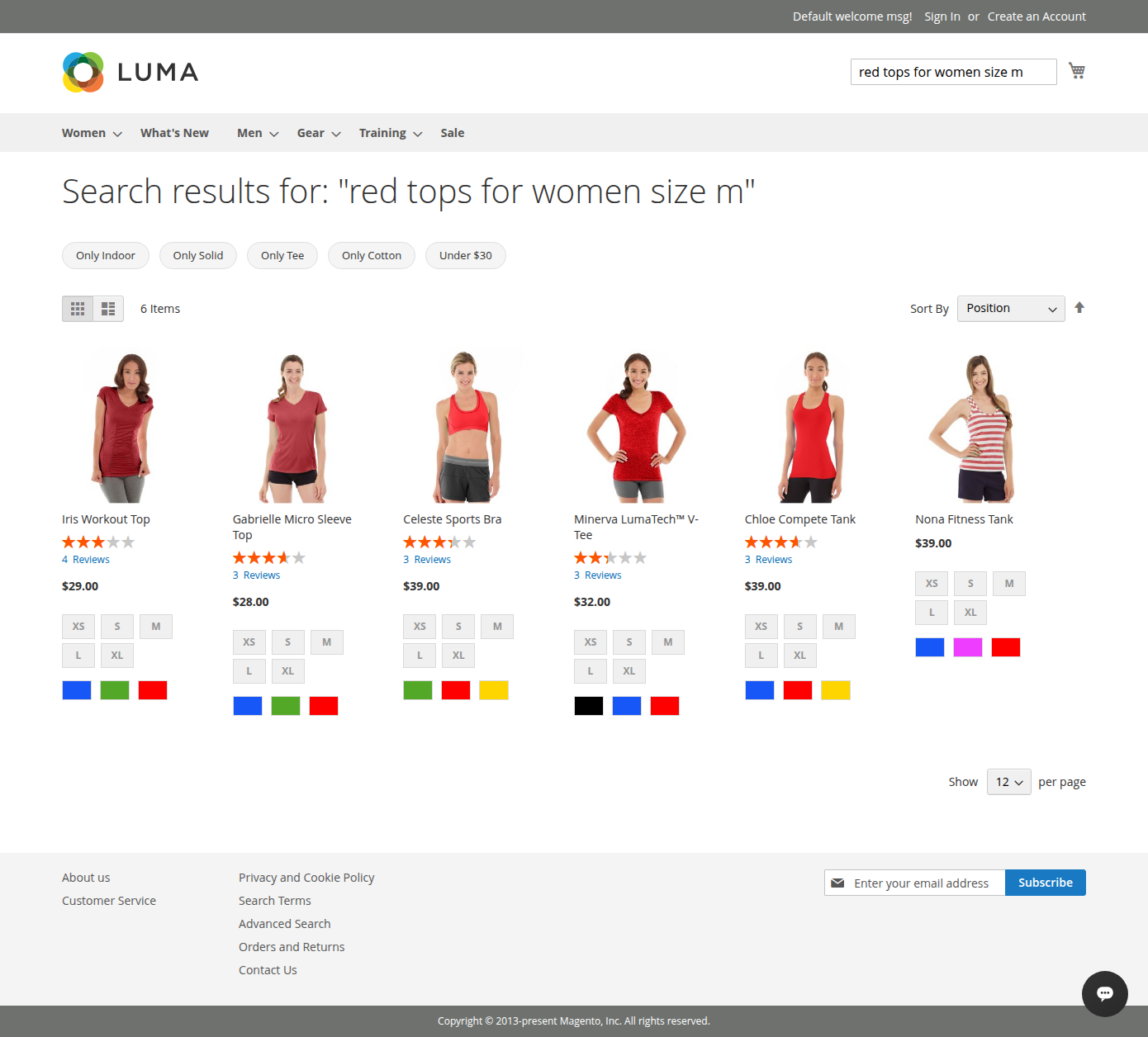
AI - the customer lands on a dedicated page with refinement chips above the results: categories first ("Men › Tops – 10"), then attributes ("Material: Cotton – 7"), then a price ceiling ("Under $40 – 5"), built from the products actually shown rather than a static filter tree. Each chip is a value that really splits the current results - not one nearly all of them share, not one only a single product has. The number on a chip is exactly how many products a click shows: a click narrows the products already on the page, the same way a layered-navigation filter does, instead of starting a new search. Chips stack (each click narrows further) and every active chip has a × that removes just that one. The product grid itself stays fully native: colors, swatches, wishlist, compare, sorting, pagination - all as usual.
-
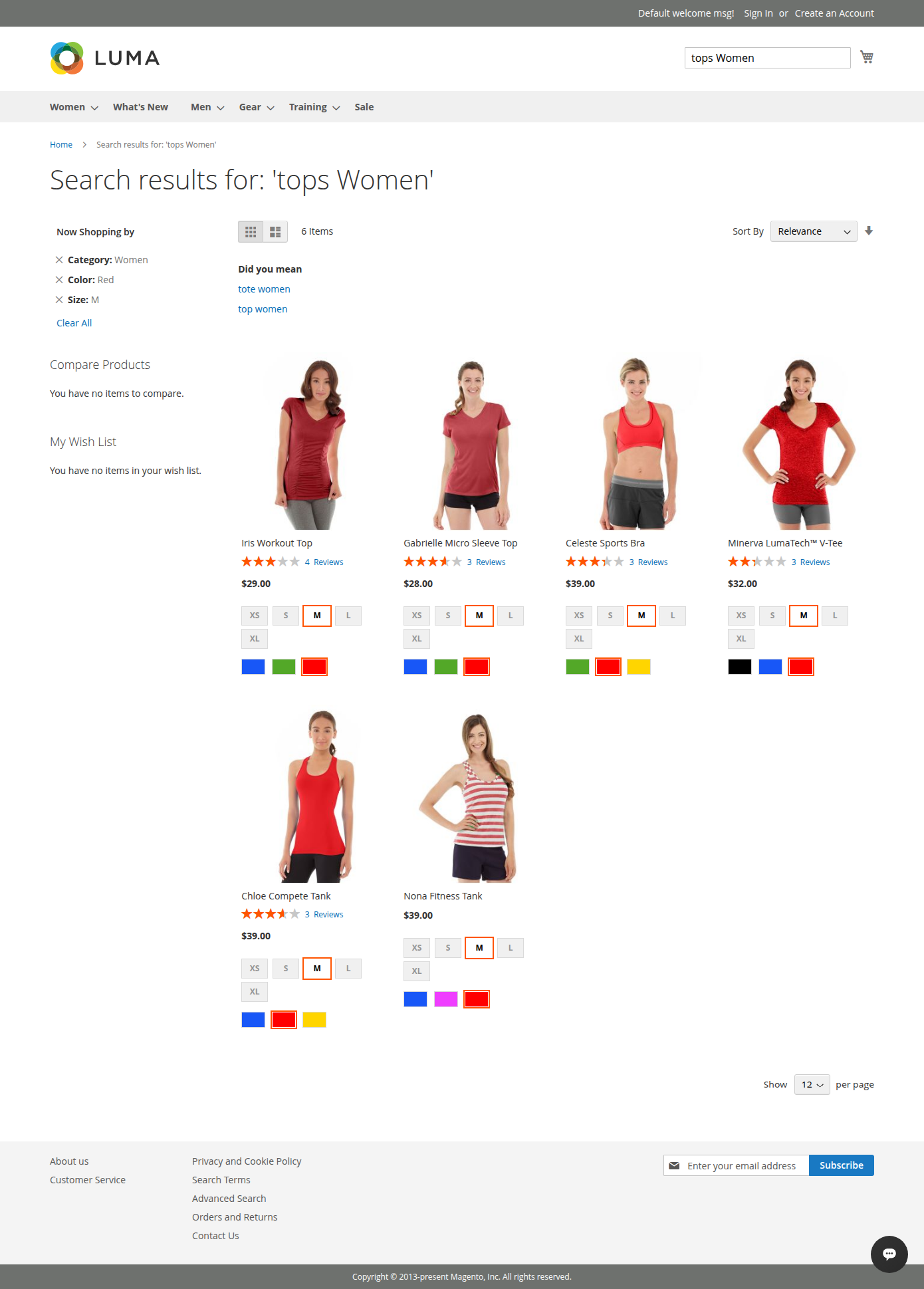
Native (default) - the customer lands on Magento's regular search results page, with the usual filter navigation on the left, just with the right filters already applied. Fully native storefront look, zero visual difference from the theme - the safest option to roll out.


If the AI is unavailable for any reason, or fails to parse the query, search simply works as usual, unchanged - the customer won't even notice.
Features
- Understands attributes, category and price in a single query, in whatever language the customer uses.
- Semantic matching in AI mode - when
Yu_AiSearchEngine's semantic search is enabled, product matching also considers meaning, not just literal words: a query like "warm winter jacket" can surface a product described only as "insulated parka". Off by default; seeYu_AiSearchEngine's README for how to turn it on. - Never breaks plain text search - if the query carries no filters, nothing changes compared to regular search.
- Query-parse caching - identical queries don't spend a repeat AI call.
- Query log - every parse is recorded (what the customer typed, what the AI recognized, the cost of the call).
- Never touches catalog settings - the module only reads which attributes the merchant has configured as filterable, and never changes those settings itself.
Requirements
- PHP >= 8.1
- Magento 2.4.x with Elasticsearch/OpenSearch configured
- The
Yu_AiLlmandYu_AiSearchEnginemodules (installed automatically as dependencies) - An API key for at least one supported LLM provider
Installation
composer require yu-dev/module-ai-catalog-search
bin/magento module:enable Yu_AiLlm Yu_AiSearchEngine Yu_AiCatalogSearch
bin/magento setup:upgrade
bin/magento setup:di:compile
bin/magento cache:flush
The module is installed disabled - search behavior won't change until you enable it in the admin panel and configure at least one LLM provider.
Configuration
Stores → Configuration → Search Product AI → General
- Enable AI Search - the main switch.
- Results Mode - Native or AI, see above.
- Minimum Query Length - queries shorter than this aren't sent to the AI (e.g. single letters or product codes).
- Parse Timeout - how long to wait for the AI's answer before falling back to unmodified regular search.
- Parse Cache Lifetime - how long to remember the parse of identical queries.
- Log Search Queries - keep a query log.
For Native mode to work fully, the merchant's catalog needs Magento's own "Use in Search Results Layered Navigation" setting enabled for the relevant attributes and for price (Stores → Attributes → Product → the attribute in question) - without it the AI still understands the query just fine, but can't apply the filter as a separate parameter, and instead just folds it into the keyword search. AI mode needs no such setting.
A category the AI is expected to recognize in a query (e.g. "for men", "women's") must be marked as Anchor (Catalog → Categories → the category → Display Settings → Is Anchor). Without this flag the category doesn't participate in search - the AI simply can't apply it as a filter, even when it correctly reads the customer's intent.
The LLM provider (OpenAI, Anthropic Claude, Google Gemini, xAI Grok and
others) is configured once, in Stores → Configuration → AI → LLM
AI - this section is shared across all AI modules on the store,
including Yu_AiChat.
Author
Yuriy Akishin:
- 📧 Email: yuriy.akishin@gmail.com
- 💼 LinkedIn: https://www.linkedin.com/in/yuriyakishin/
- 💻 GitHub: https://github.com/yuriyakishin