
tikhomirov / settings-codegen

Schema-first settings: generate typed readonly PHP config classes and admin UI fields from settings.json for WordPress/WooCommerce, Laravel, Symfony, Yii3 and MoonShine.
Requires
- php: >=8.1
- ext-json: *
- ext-mbstring: *
Requires (Dev)
- phpstan/phpstan: ^2.1
- phpunit/phpunit: ^10.5 || ^11.0 || ^12.0
- symfony/console: ^6.4 || ^7.0
- symfony/dependency-injection: ^6.4 || ^7.0
- symfony/http-kernel: ^6.4 || ^7.0
Suggests
- moonshine/moonshine: Use the generated {Module}Fields components in a MoonShine admin panel (moonshine adapter, PHP 8.2+).
- symfony/console: Run generation as a console command (Symfony bundle or Yii3 console).
- symfony/http-kernel: Register SettingsCodegenBundle in a Symfony application.
- yiisoft/config: Pick up the bundled config-plugin in a Yii3 application.
- yiisoft/yii-console: Run settings:generate from the Yii3 console.
Provides
None
Conflicts
None
Replaces
None
README
settings-codegen
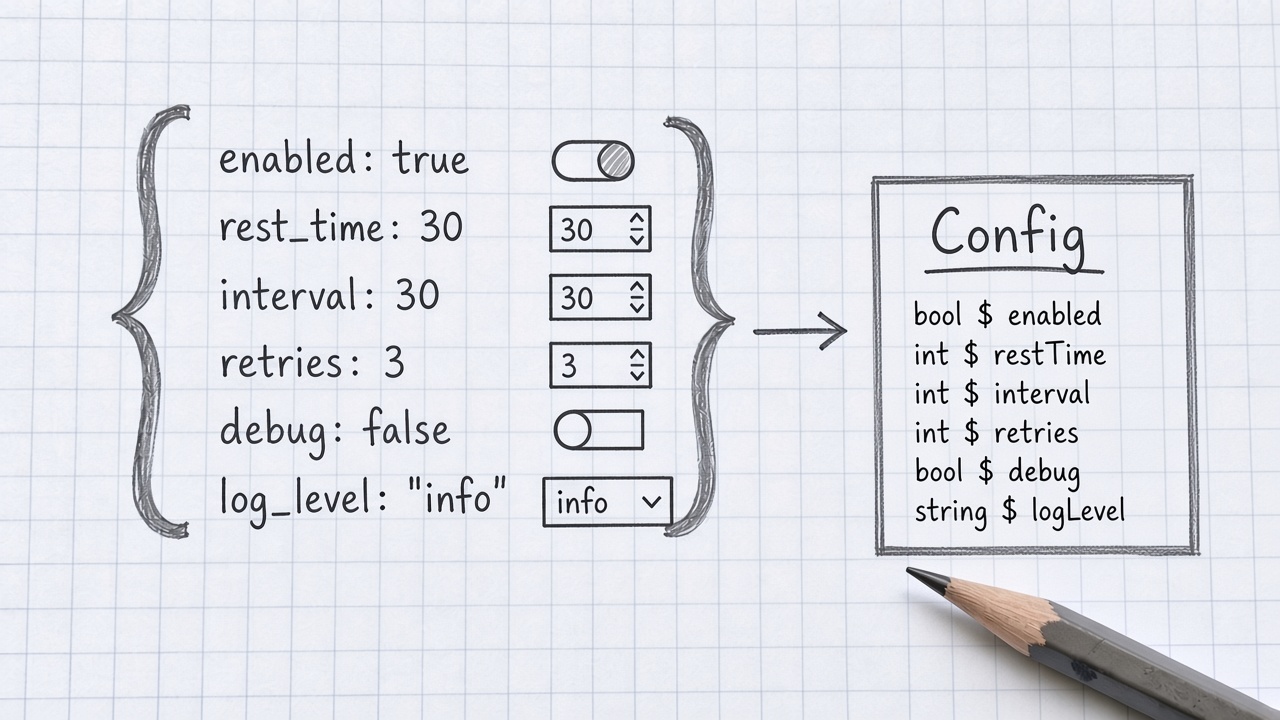
Describe settings once in settings.json — get typed PHP classes, admin UI fields and validation, checked in CI.

The problem
The two most popular ways to read settings in PHP look like this.
WordPress — option names are strings, every value is mixed:
$enabled = get_option('enabled', 'yes') === 'yes';   // "yes", "1", true, "on"…?
$apiKey  = (string) get_option('api_key', '');
$timeout = (int) get_option('timeout', 30);          // the default lives here…

// …and once more in the settings page definition
['id' => 'timeout', 'type' => 'number', 'title' => __('Timeout, seconds'), 'default' => 30],
Laravel — config() / env() are no better:
// config/shop.php
return [
    'enabled' => env('SHOP_ENABLED', true),
    'api_key' => env('SHOP_API_KEY', ''),
    'timeout' => env('SHOP_TIMEOUT', 30),
];

// somewhere in a service
$timeout = (int) config('shop.timeout', 30);   // default repeated, cast by hand
$apiKey  = config('shop.api_kye');             // typo: silently null, no tool notices
- String keys everywhere. A typo silently returns the default; PHPStan can't see it.
- Everything is
mixed.get_option()/config()return"0",0,falseor"no", so every call site casts by hand. - Defaults are duplicated.
30lives in the code and in the admin form or config file. Change one, forget the other. - A global
SettingsKeyconstants class gives autocomplete for key names only, staysmixed, and becomes a God Object every module depends on. - UI and code drift apart. The admin form, the validation rules and the code that reads the values are three separate lists.
The solution: schema first
1. Describe the module once, next to its code — src/Shop/settings.json. Only what matters:
an id, a label and a default. The property name (api_key → apiKey) and the PHP type
(true → bool, 30 → int) are derived; a section is just a title with nested fields.
{
    "sections": [
        {
            "title": "Shop API",
            "desc": "Connection to the shop backend.",
            "fields": [
                { "id": "enabled", "title": "Enable integration", "default": true },
                { "id": "api_key", "title": "API key", "default": "", "rules": ["required"] },
                { "id": "timeout", "title": "Timeout, seconds", "default": 30, "rules": ["integer", "min:1"] }
            ]
        },
        {
            "id": "newsletter",
            "title": "Newsletter",
            "fields": [
                { "id": "newsletter_enabled", "title": "Send newsletter", "default": false },
                {
                    "id": "newsletter_lists",
                    "type": "multiselect",
                    "title": "Mailing lists",
                    "options": { "news": "News", "offers": "Offers" },
                    "default": ["news"]
                }
            ]
        }
    ]
}
2. Generate:
vendor/bin/settings-codegen generate
3. Get plain, committed PHP. Real output, shortened. With the laravel adapter
("key_prefix": "shop."):
final readonly class ShopConfig
{
    public function __construct(
        public bool $enabled,
        public string $apiKey,
        public int $timeout,
        public bool $newsletterEnabled,
        /** @var array<array-key, mixed> */
        public array $newsletterLists,
    ) {}

    public static function load(\Illuminate\Contracts\Config\Repository $config): self
    {
        return new self(
            enabled: self::bool($config->get('shop.enabled'), true),
            apiKey: self::string($config->get('shop.api_key'), ''),
            timeout: self::int($config->get('shop.timeout'), 30),
            newsletterEnabled: self::bool($config->get('shop.newsletter_enabled'), false),
            newsletterLists: self::array($config->get('shop.newsletter_lists'), [
                'news',
            ]),
        );
    }
    // fromArray(), toArray() and the typed casts
}
// + ShopDefinition: fields(), defaults(), rules(), keys()
With the wordpress adapter the same schema gives load() on top of get_option() and a
WooCommerce settings array with both sections, checkbox / text / number field types and
translated labels:
    public static function load(): self
    {
        return new self(
            enabled: self::asBool(\get_option('enabled', 'yes')),
            apiKey: (string) \get_option('api_key', ''),
            timeout: (int) \get_option('timeout', 30),
            // ...
        );
    }

// ShopUiSchema::getFields()
[
    ['title' => \__('Shop API', 'shop'), 'desc' => \__('Connection to the shop backend.', 'shop'), 'type' => 'title'],
    ['id' => 'enabled', 'title' => \__('Enable integration', 'shop'), 'type' => 'checkbox', 'default' => 'yes'],
    ['id' => 'api_key', 'title' => \__('API key', 'shop'), 'type' => 'text', 'default' => ''],
    ['id' => 'timeout', 'title' => \__('Timeout, seconds', 'shop'), 'type' => 'number', 'default' => 30],
    ['type' => 'sectionend'],
    // Newsletter section...
]
4. Use typed values with full autocomplete:
$shop = ShopConfig::load(app('config'));   // Laravel; WordPress: ShopConfig::load()

if ($shop->enabled) {                      // bool, not "yes"
    $client = new ShopClient($shop->apiKey, timeout: $shop->timeout);
}

$shop->apiKye;                             // PHPStan: Access to an undefined property

$request->validate(ShopDefinition::rules());   // ['api_key' => ['required'], 'timeout' => [...]]
Business code depends on a plain object, so unit tests need no database, no framework and no mocks:
public function test_client_uses_configured_timeout(): void
{
    $shop = new ShopConfig(enabled: true, apiKey: 'test', timeout: 5, newsletterEnabled: false, newsletterLists: []);

    $client = ShopClient::fromConfig($shop);   // your code

    $this->assertSame(5, $client->timeout());
}
5. Keep it honest in CI: vendor/bin/settings-codegen generate --check exits with 1 when
someone changed settings.json and forgot to regenerate.
flowchart LR
    S["settings.json<br/>(one per module)"] --> G["settings-codegen generate"]
    G --> C["*Config<br/>typed readonly DTO"]
    G --> U["*UiSchema<br/>WooCommerce fields + __()"]
    G --> D["*Definition<br/>fields / defaults / rules"]
    C --> A["Your code<br/>$config->restTime"]
    U --> W["Admin settings page"]
    D --> V["Validation, forms"]
    S -. "generate --check" .-> CI["CI fails on drift"]
Loading
Why use it
- Single source of truth. Key, type, default, label and validation rules of a setting live in one JSON entry.
- Minimal schema.
id, label anddefaultare enough: property names, PHP types and sections are derived. - Type-safe DTOs.
bool,int,float,string,arrayproperties in afinal readonlyclass instead ofmixed. - 100% IDE autocomplete for every setting — no string keys in business code.
- PHPStan catches typos: a misspelled property is an error, a misspelled string key never was.
- Defaults and validation in one place:
UiSchema::getFields()/Definition::defaults()andrules()come from the same schema as the Config class. - CI drift check with
generate --check(exit codes0/1/2). - Zero runtime overhead. A dev-only dependency: production runs plain generated PHP, cached by OPcache — no JSON parsing, no reflection.
- Framework-agnostic. Adapters for WordPress/WooCommerce, Laravel, Symfony, Yii3 and the MoonShine admin panel, or your own
AdapterInterface.
Read the full rationale (in Russian) → “PHP settings architecture: why constants are a dead end, and why JSON”
Requirements
- PHP 8.1+, tested on 8.1, 8.2, 8.3, 8.4 and 8.5 (generated
readonly classneeds 8.2; set"readonly_class": falsefor 8.1). - No runtime dependencies. Framework packages are only suggested.
- Deterministic output: stable order and formatting. You don't need a code style fixer, but the
output can match one (see
style).
Contents
- The problem
- The solution: schema first
- Why use it
- Requirements
- Installation
- The schema
- Configuration
- Command line
- WordPress / WooCommerce
- Laravel
- Symfony
- Yii3
- MoonShine
- Custom reader
- Extensions and post steps
- CI
- For AI agents
- Development
Installation
composer require --dev tikhomirov/settings-codegen
Without Packagist (a fork or a mirror), add the repository first:
composer config repositories.settings-codegen vcs https://github.com/tikhomirov/settings-codegen
composer require --dev tikhomirov/settings-codegen:^0.1
require-dev is enough: only the generated classes are used at runtime.
The schema
A module's settings.json comes in two formats. Both generate the same code.
Structured format (recommended)
A JSON object with fields (outside of any section) and/or sections:
{
    "fields": [
        { "id": "mode", "title": "Mode", "default": "live" }
    ],
    "sections": [
        {
            "id": "api",
            "title": "API",
            "desc": "Connection settings.",
            "fields": [
                { "id": "api_key", "title": "API key", "default": "" },
                { "id": "timeout", "title": "Timeout, seconds", "default": 30 },
                { "id": "token", "property": "secret", "php_type": "string", "ui": false },
                { "id": "help", "type": "info", "text": "See the docs.", "property": false }
            ]
        }
    ]
}
- A section becomes a
titleentry (every section key exceptfields), its fields and asectionend. Itsidis optional and is used for both the title and the end, as WooCommerce does. - A field with an
idis a setting.propertydefaults to the camelCase of the storage key (api_key→apiKey, afterstrip_prefixes);"property": falsemakes a UI-only field. php_typeis inferred fromdefault:true/false→bool,30→int,1.5→float,[...]→array, anything else (or no default) →string. Set it explicitly when needed.- WordPress only: a missing
typebecomescheckbox(bool),number(int, float) ortext(string); arrays need an explicittypesuch asmultiselect. Boolean checkbox defaults are written as"yes"/"no", the way WooCommerce stores them. - Titles, sub-headings (
"type": "title") and other entries without a value need noid.
Flat list format
A JSON array of WooCommerce-style entries, the original format. It is still fully supported and
is passed through as is: nothing is inferred, property must be explicit and php_type defaults
to string.
[
    { "type": "title", "title": "API" },
    { "id": "api_key", "property": "apiKey", "type": "text", "title": "API key", "default": "" },
    { "id": "timeout", "property": "timeout", "php_type": "int", "type": "number", "title": "Timeout, seconds", "default": 30, "rules": ["integer", "min:1"] },
    { "type": "sectionend" }
]
Keys
| Key | Meaning |
|---|---|
id |
Storage key / option id, unique in the module. strip_prefixes removes prefixes from it for reading. |
property |
Property name in the Config class. Structured format: optional, false = UI-only. |
php_type |
string, int, float, bool, array. Flat format: defaults to string; structured: inferred from default. |
default |
Default value. With strict_defaults (on by default), it must match php_type. |
ui |
false keeps a setting out of the WordPress UI schema. |
rules |
Passed through to Definition::rules() (Laravel, Symfony, Yii3, MoonShine). |
desc_args_expr, text_args_expr |
WordPress: PHP expressions for sprintf() with the translated text. |
options_expr, depends_expr |
WordPress: PHP expressions emitted as options / depends. |
Validation errors point to the place in the file, e.g. sections[0].fields[1].default: expected a number for php_type "int". The JSON Schema for IDEs is in
vendor/tikhomirov/settings-codegen/resources/settings.schema.json (add "$schema" to a
structured file to get completion); the generator validates the same rules itself.
Configuration
Put the configuration in composer.json under extra.settings-codegen, or in a standalone
settings-codegen.json:
{
    "extra": {
        "settings-codegen": {
            "adapter": "wordpress",
            "schemas": ["src/Features/*/settings.json"],
            "namespace": "Acme\\Features\\{module}\\Generated",
            "output": "{dir}/Generated"
        }
    },
    "scripts": {
        "settings:generate": "settings-codegen generate",
        "settings:check": "settings-codegen generate --check"
    }
}
The module name is the directory that holds settings.json. Without --config, the CLI reads
settings-codegen.json from the working directory and falls back to composer.json.
| Option | Default | Description |
|---|---|---|
adapter |
wordpress |
wordpress, laravel, symfony, yii3, moonshine, or the FQCN of an AdapterInterface. |
schemas |
["settings.json"] |
Glob patterns relative to the project. ** is supported. |
namespace |
App\Settings\Generated |
Namespace of the generated classes. {module} is replaced. |
output |
{dir}/Generated |
Output directory. {dir} is the schema's directory, {module} the module name. |
module_names |
{} |
Override module names: {"app/Settings/settings.json": "General"}. |
strip_prefixes |
[] |
Prefixes removed (repeatedly) from id to get the storage key. |
key_aliases |
{} |
Rename schema keys before validation, e.g. {"key": "id", "type": "php_type"}. |
strict_defaults |
true |
Check that default matches php_type. |
readonly_class |
true |
final readonly class (8.2+) or final class with readonly properties (8.1). |
style |
see below | Formatting of generated code. |
docs |
English | Docblock lines per class/method ({module}, {source} and {file} placeholders). |
bootstrap |
[] |
PHP files to require first (e.g. classes for your extensions). |
extensions |
[] |
FQCNs of ExtensionInterface implementations. |
post_steps |
[] |
FQCNs or {"class": ..., "options": {...}} of PostStepInterface implementations. |
style:
{"align_arrows": false, "list_keys": false, "empty_array": "inline", "indent": " "}
align_arrows aligns => like php-cs-fixer/Pint align_single_space_minimal.
list_keys: true and "empty_array": "multiline" reproduce the var_export() + Pint look of
older generators byte for byte.
Command line
vendor/bin/settings-codegen generate          # write changed files
vendor/bin/settings-codegen generate --check  # write nothing; exit 1 if anything is missing or outdated
vendor/bin/settings-codegen check             # same as generate --check
vendor/bin/settings-codegen generate --config=settings-codegen.json --working-dir=path/to/project
vendor/bin/settings-codegen generate -q       # print errors only
| Exit code | Meaning |
|---|---|
0 |
Everything is generated and up to date. |
1 |
--check only: some generated files are missing or outdated (listed in the output). |
2 |
Error: invalid schema, invalid configuration, unknown argument, or a file cannot be written. |
Generated files are output, not source: never edit them by hand. Change settings.json (or the
configuration) and run generate again.
WordPress / WooCommerce
{
    "adapter": "wordpress",
    "schemas": ["src/Features/*/settings.json"],
    "namespace": "Acme\\Features\\{module}\\Generated",
    "option_reader": "get_option",
    "text_domain": "acme",
    "strip_prefixes": []
}
Each module gets {Module}Config and {Module}UiSchema:
final readonly class DeliveryConfig
{
    public function __construct(
        public bool $enableCalendar,
        public int $slotMinutes,
    ) {}

    public static function load(): self
    {
        return new self(
            enableCalendar: self::asBool(\get_option('shop_enable_calendar', 'yes')),
            slotMinutes: (int) \get_option('shop_slot_minutes', 30),
        );
    }
    // toArray(), asBool()
}

// Business code depends on the DTO only:
$slots = new SlotCalculator(DeliveryConfig::load());

// WooCommerce settings tab:
add_filter('woocommerce_get_settings_acme', fn () => DeliveryUiSchema::getFields());
UiSchema also has getAllOptionKeys() (for export or reset, including ui: false options) and
optionIdFor($property). Titles, descriptions, tips, placeholders and option labels are wrapped in
__('…', 'text_domain'), so wp i18n make-pot finds them. Options: option_reader (any function
(string $key, mixed $default): mixed), text_domain, config_suffix (Config), schema_suffix
(UiSchema).
Laravel
{
    "adapter": "laravel",
    "schemas": ["app/Settings/Modules/*/settings.json"],
    "namespace": "App\\Settings\\Generated",
    "output": "app/Settings/Generated",
    "key_prefix": "settings."
}
// config/settings.php: ['enable_calendar' => env('DELIVERY_CALENDAR', true), ...]
$config = DeliveryConfig::load(app('config'));      // reads settings.enable_calendar, ...
$config = DeliveryConfig::fromArray($row->values);  // e.g. JSON column from the database

$request->validate(DeliveryDefinition::rules());   // the "rules" key from settings.json
DeliveryDefinition::defaults();                     // storage key => typed default
DeliveryDefinition::fields();                       // raw schema entries, e.g. to build an admin form
Values that are missing or have the wrong type fall back to the schema default.
Options of the typed adapters (laravel, symfony, yii3, moonshine):
| Option | Default | Description |
|---|---|---|
reader |
adapter specific | {"type", "variable", "expression"} of load(), see Custom reader. |
key_prefix |
"" |
Prepended to the storage key in load(). |
config_suffix / definition_suffix |
Config / Definition |
Class name suffixes. |
definition |
true |
Generate the Definition class. |
string_cast |
scalar |
scalar: any scalar becomes a string; string: only strings; non_empty_string: only non-empty strings, "" falls back to the default. |
definition_fields |
normalized |
Definition::fields() entries after key_aliases (normalized) or exactly as written in settings.json (source). |
definition_fields: "source" together with key_aliases lets an existing schema with its own key
names (for example key / type) keep the same fields() output that runtime code already reads.
Symfony
{
    "adapter": "symfony",
    "schemas": ["src/*/Resources/settings.json"],
    "namespace": "App\\Settings\\{module}",
    "output": "src/{module}/Settings",
    "key_prefix": "app.settings."
}
# config/services.yaml
parameters:
    app.settings.enable_calendar: true
    app.settings.slot_minutes: 15

services:
    App\Settings\Delivery\DeliveryConfig:
        factory: ['App\Settings\Delivery\DeliveryConfig', 'load']
        arguments: ['@parameter_bag']
The optional bundle adds a console command:
// config/bundles.php
Tikhomirov\SettingsCodegen\Adapter\Symfony\SettingsCodegenBundle::class => ['dev' => true],
bin/console settings:generate [--check] [--config=settings-codegen.json]
Yii3
{
    "adapter": "yii3",
    "schemas": ["src/*/settings.json"],
    "namespace": "App\\{module}\\Settings",
    "output": "{dir}/Settings",
    "key_prefix": "app.settings."
}
// config/common/params.php
return ['app' => ['settings' => ['enable_calendar' => true, 'slot_minutes' => 15]]];

// config/common/di/settings.php
use App\Delivery\Settings\DeliveryConfig;
use Yiisoft\Definitions\DynamicReference;

return [
    DeliveryConfig::class => DynamicReference::to(static fn () => DeliveryConfig::load($params)),
];
load(array $params) resolves dot-separated keys in nested arrays. The package ships a
yiisoft/config plugin (config/yii3/params-console.php) that registers the command with
yiisoft/yii-console:
./yii settings:generate [--check]
MoonShine
The moonshine adapter generates everything the laravel adapter does ({Module}Config with
load() / fromArray() / toArray() and {Module}Definition) plus {Module}Fields: ready
MoonShine form components for an admin settings page.
moonshine/moonshine is only suggested; the generated code is checked against the real MoonShine
API (4.x and 5.x) in CI.
{
    "adapter": "moonshine",
    "schemas": ["app/Settings/*/settings.json"],
    "namespace": "App\\Settings\\{module}",
    "output": "{dir}/Generated",
    "key_prefix": "shop.",
    "field_name": "settings_{key_snake}"
}
For the Shop schema above (real output, shortened):
final class ShopFields
{
    /** @return list<\MoonShine\Contracts\UI\ComponentContract> */
    public static function components(): array
    {
        return [
            Box::make(\__('Shop API'), [
                Switcher::make(\__('Enable integration'), 'settings_enabled')
                    ->default(true),
                Text::make(\__('API key'), 'settings_api_key')
                    ->default('')
                    ->required(),
                Number::make(\__('Timeout, seconds'), 'settings_timeout')
                    ->default(30),
            ]),
            Box::make(\__('Newsletter'), [
                Switcher::make(\__('Send newsletter'), 'settings_newsletter_enabled')
                    ->default(false),
                Select::make(\__('Mailing lists'), 'settings_newsletter_lists')
                    ->options([
                        'news' => \__('News'),
                        'offers' => \__('Offers'),
                    ])
                    ->multiple()
                    ->default([
                        'news',
                    ]),
            ]),
        ];
    }

    public static function names(): array;                     // storage key => field name
    public static function values(ShopConfig $config): array;  // field name => value
    public static function input(array $input): array;         // submitted form => storage key => value
}
// A MoonShine page
protected function components(): iterable
{
    return [
        FormBuilder::make()
            ->fields(ShopFields::components())
            ->fill(ShopFields::values(ShopConfig::load(app('config'))))
            ->submit(__('Save')),
    ];
}

// Saving: typed and validated with the same schema
$config = ShopConfig::fromArray(ShopFields::input($request->all()));
Field component, in order of precedence:
ui.field:switcher,text,textarea,markdown(Textarea),number,select,password,email,url,color,date,phone,hidden,json. An unknown name is an error.- The WooCommerce
type:checkbox→ Switcher,multiselect→ multiple Select,radio→ Select, … - The value:
bool→ Switcher,options→ Select (multiple for arrays),array→ Json,string→ Text,int/float→ Number.
Other keys: label from ui.label or title (falls back to the property name), hint from
ui.help, desc_tip or desc, ui.placeholder / placeholder, options from ui.options /
options (a list becomes 0 => …, 1 => …), ->required() when rules contains required,
ui.attributes / custom_attributes (scalar values) → customAttributes(), and
ui.show_when: {"key", "operator", "value"} → showWhen() on the other field's name.
"ui": false hides a setting from the form.
Sections — title / sectionend entries, structured sections, or consecutive fields with the
same ui.section — become Box components ("section": "fieldset" for Fieldset).
| Option | Default | Description |
|---|---|---|
fields_suffix |
Fields |
Class name suffix of the fields class. |
field_name |
{key} |
Form field name: {key} storage key, {key_snake} with non-alphanumerics replaced by _, {property}. |
section |
box |
box or fieldset. |
translate |
__ |
Function wrapped around labels, hints, placeholders and option labels; "" for plain strings. |
All typed adapter options (reader, key_prefix, string_cast, …) apply to the Config class;
the default reader is the Laravel config repository, which MoonShine runs on.
Custom reader
All framework adapters accept a custom reader. For example, a database-backed store:
{
    "adapter": "laravel",
    "reader": {
        "type": "\\App\\Settings\\SettingsStore",
        "variable": "store",
        "expression": "{var}->get({key})"
    }
}
This generates public static function load(\App\Settings\SettingsStore $store): self with
$store->get('…') calls. {key} is the exported key literal (with key_prefix) and {var} is
the variable.
Extensions and post steps
Extensions own custom schema keys, validate them and add attributes to generated classes. Post steps run once after all modules and write extra files, such as a registry or an index of presets:
use Tikhomirov\SettingsCodegen\Extension\AbstractExtension;
use Tikhomirov\SettingsCodegen\Extension\AttributeSpec;
use Tikhomirov\SettingsCodegen\Schema\{Module, Setting};

final class ModesExtension extends AbstractExtension
{
    public function reservedKeys(): array
    {
        return ['default_for_mode']; // never copied to UI arrays
    }

    public function propertyAttributes(Module $module, Setting $setting): array
    {
        $values = $setting->get('default_for_mode');

        return is_array($values) ? [new AttributeSpec(\App\Attribute\Defaults::class, ['values' => $values])] : [];
    }
}
use Tikhomirov\SettingsCodegen\{Context, GeneratedFile};
use Tikhomirov\SettingsCodegen\PostStep\PostStepInterface;

final class RegistryPostStep implements PostStepInterface
{
    public function run(array $modules, Context $context, array $options): array
    {
        $names = array_map(fn ($m) => $m->name, $modules);
        $code = "<?php\n\nreturn " . $context->exporter->value($names) . ";\n";

        return [new GeneratedFile($context->config->path($options['path']), $code)];
    }
}
{
    "bootstrap": ["tools/codegen.php"],
    "extensions": ["App\\Codegen\\ModesExtension"],
    "post_steps": [{"class": "App\\Codegen\\RegistryPostStep", "options": {"path": "config/settings-registry.php"}}]
}
A completely different output is one class away: implement
Tikhomirov\SettingsCodegen\Adapter\AdapterInterface and set "adapter" to its FQCN.
CI
- run: composer install
- run: vendor/bin/settings-codegen generate --check
For AI agents
The package ships an Agent Skill that teaches coding agents
how to add settings, regenerate and fix --check failures. It is part of the Composer package, so
after installation it is available at vendor/tikhomirov/settings-codegen/skills/settings-codegen/.
# Claude Code
mkdir -p .claude/skills && cp -r vendor/tikhomirov/settings-codegen/skills/settings-codegen .claude/skills/
# Cursor
mkdir -p .cursor/skills && cp -r vendor/tikhomirov/settings-codegen/skills/settings-codegen .cursor/skills/
Or reference it from your project's AGENTS.md:
Settings are generated by tikhomirov/settings-codegen: follow
vendor/tikhomirov/settings-codegen/skills/settings-codegen/SKILL.md.
AGENTS.md in this repository is for agents working on the package itself.
Development
composer test      # PHPUnit: golden files for every adapter, runtime behaviour, CLI
composer phpstan   # PHPStan level 9, no baseline
composer coverage  # PHPUnit with pcov or Xdebug; fails below 100% lines, methods and classes
composer check     # test + phpstan
UPDATE_GOLDEN=1 composer test   # after an intended output change; review the diff
CI runs the tests on PHP 8.1, 8.2, 8.3, 8.4 and 8.5 (plus lowest dependencies on 8.1) with
E_ALL and PHPUnit failing on any warning, notice or deprecation, and runs the CLI for every
adapter to make sure it prints no deprecations. Separate jobs check the generated MoonShine fields
against the real MoonShine API (PHP 8.2–8.5), run PHPStan and composer validate --strict, and
measure coverage on PHP 8.3 with pcov, failing below 100% lines, methods and classes. The Symfony
packages are in require-dev, so the bundle and the console command are covered too; there are no
coverage exclusions.