
ruvelo / laravel-comments

Free, polished comments for any Eloquent model: threads, Markdown, reactions, mentions and moderation. Blade or JSON, no Livewire required.
Requires
- php: ^8.3
- laravel/framework: ^12.4.1|^13.0
- league/commonmark: ^2.6
Requires (Dev)
- larastan/larastan: ^3.13
- laravel/pint: ^1.32
- orchestra/testbench: ^10.0|^11.0
- phpunit/phpunit: ^11.5|^12.0
Suggests
None
Provides
None
Conflicts
None
Replaces
None
README
Live demo Configuration Developer guide Changelog

Laravel Comments
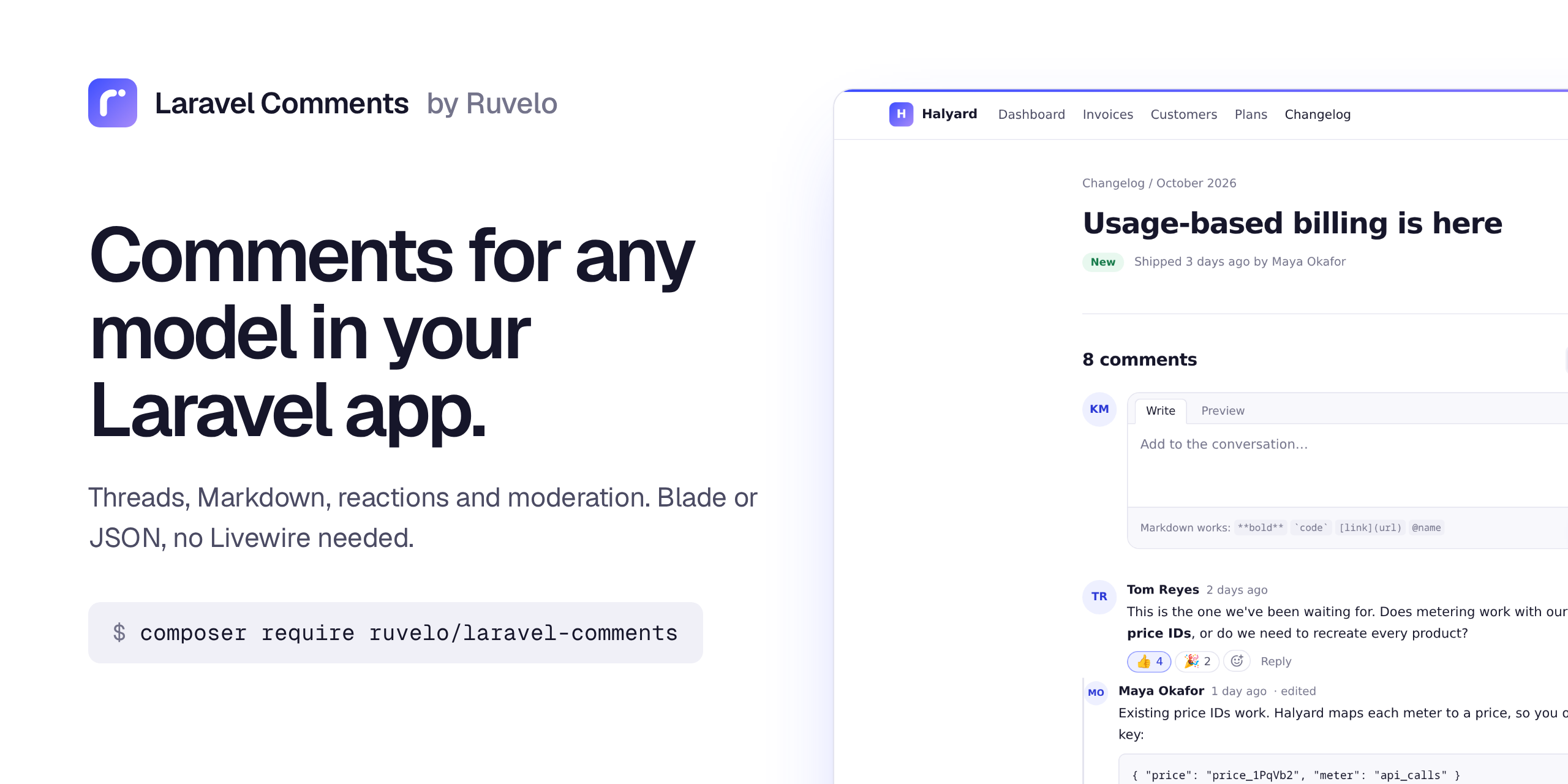
Free, polished comments for any Eloquent model. Threaded replies, Markdown, reactions, @mentions and an optional moderation queue. One Blade component for server-rendered apps, JSON on every route for Inertia, React and Vue. No Livewire required, no frontend build step, no extra services.
composer require ruvelo/laravel-comments
php artisan migrate
Add use HasComments; to a model, register it in config/comments.php, and drop <x-comments::thread :for="$post" /> into its page. Or click around the live demo first.
A quick tour

Comments where your content is. A thread under a post, an invoice, a ticket or anything else with an Eloquent model. Replies nest to the depth you choose, code blocks and @mentions render properly, and people react with one click.

Write, preview, post. The compose box has a Write/Preview toggle and a Markdown hint. Replies and edits open in place and post without a reload. With JavaScript off, every button is still a plain HTML form that works.

Moderate when you need to. Turn on require_approval and new comments wait in a queue until a moderator approves them. Each item links to where it lives.
 |
 |
| Light and dark, following each reader's system setting. | Mobile first, readable and usable at phone width. |
Features
- Any model, any author: a
HasCommentstrait for what's commented on, and any model as the author (yourUser, aCustomer, aTeam). Both are polymorphic. - Threads: replies nest up to
max_depth(2 by default: comments and replies). A reply to the deepest level joins that level instead of nesting further. - Safe Markdown: GitHub-style, with code blocks, tables and task lists. Raw HTML is escaped,
javascript:links are dropped, outside links getrel="nofollow", and images become links so readers never load a stranger's URL. - Mentions:
@mayalinks to a person and notifies them. Plug in your own resolver, or use the bundled one that looks up ausernamecolumn. - Reactions: a fixed set of emoji (👍 ❤️ 🎉 😄 😮 😢 by default), one of each per person, toggled with a click. Hover a reaction to see who gave it.
- Edits and deletes: edited comments say so. A deleted comment with replies stays as "This comment was deleted", so the conversation still makes sense.
- Moderation: an optional approval queue and a moderation page with waiting, approved and deleted tabs.
- Permissions as gates: sensible defaults, each overridable with one
Gate::define. - Spam and abuse: per-author rate limiting, a honeypot field and a length limit.
- Notifications, off by default: the model's owner hears about new comments, authors hear about replies, mentioned people hear they were mentioned. Standard Laravel notifications whose
toArray()hastitle,bodyandurl, so they show up in ruvelo/laravel-inbox with no setup. - Works without JavaScript, and gets better with it: posting, editing, deleting, reactions and previews happen in place.
- JSON API on the same routes for SPAs, Inertia, Livewire or mobile apps: paginated threads with nested replies, create, update, delete, react and preview.
- Fast: a thread page takes the same handful of queries whether it has 2 comments or 200 (there's a test for that).
- Light and dark, self-contained styles that never leak into your page, and accessible markup: labels, roles,
aria-pressedreactions, keyboard-operable everything.
Requirements
- PHP 8.3+
- Laravel 12 or 13
- Any database Laravel supports (tested on SQLite)
Getting started
1. Make a model commentable and list it under a short name. The name is what URLs and the JSON API use; class names sent by a browser are never trusted.
use Ruvelo\Comments\Concerns\HasComments;

class Post extends Model
{
    use HasComments;

    // Optional: where the post lives, for permalinks, notifications and moderation.
    public function commentUrl(): ?string
    {
        return route('posts.show', $this);
    }
}
// config/comments.php (php artisan vendor:publish --tag=comments-config)
'commentables' => [
    'post' => App\Models\Post::class,
],
Aliases from your Relation::morphMap() work too.
2. Show the thread on the post's page:
<x-comments::thread :for="$post" />
It brings its own styles and script, included once per page. Signed-in users can comment; guests see the thread and a "Sign in to comment" link to your login route (or plain text if you don't have one).
3. Optionally, tell it about your users. Without anything, authors show their name and initials. Implement CommentAuthor to choose a name or add real avatars:
use Ruvelo\Comments\Concerns\IsCommentAuthor;
use Ruvelo\Comments\Contracts\CommentAuthor;

class User extends Authenticatable implements CommentAuthor
{
    use IsCommentAuthor;

    public function commentAuthorAvatarUrl(): ?string
    {
        return $this->profile_photo_url;
    }
}
Hooks on the commentable
All optional; HasComments provides defaults.
| Method | Default | |
|---|---|---|
commentsAreOpen(): bool |
true |
Return false to close the thread. Existing comments stay visible |
commentUrl(): ?string |
null |
Where the model lives. Used by permalinks, notifications and the moderation page |
commentTitle(): string |
its title, name or "Post #12" |
How the model is named in notifications and moderation |
commentNotifiables(): iterable |
[] |
Who hears about new comments when notifications are on, usually the owner |
Who can do what
Every write goes through a gate. Define a gate with the same name to decide yourself, for example in your AppServiceProvider:
| Gate | Arguments | Default |
|---|---|---|
comments-create |
$user, $commentable |
Any signed-in user |
comments-update |
$user, $comment |
The author, within edit_window |
comments-delete |
$user, $comment |
The author, or a moderator |
comments-react |
$user, $comment |
Any signed-in user, on published comments |
comments-moderate |
$user |
Nobody, until you define it |
use Illuminate\Support\Facades\Gate;

Gate::define('comments-moderate', fn ($user) => $user->is_admin);
Gate::define('comments-create', fn ($user, $post) => $user->hasVerifiedEmail());
Moderation
Set require_approval to true and new comments wait until someone who passes comments-moderate approves them. Their author still sees them, marked "Waiting for approval"; moderators' own comments are approved straight away.
Moderators review the queue at /comments/moderation: waiting, approved and deleted tabs, Approve and Reject (which deletes), and a link to where each comment lives.
Configuration
Publish the config file to change the defaults:
php artisan vendor:publish --tag=comments-config
| Key | Default | |
|---|---|---|
commentables |
[] |
Short name ⇒ model class. Only these (and morph map aliases) are accepted from requests |
path |
comments (COMMENTS_PATH) |
URL prefix for every route |
domain |
null |
Serve the routes on another (sub)domain |
middleware |
['web'] |
Applied to every route. The signed-in user is the session's |
routes |
true |
Set to false to register routes yourself (copy routes/web.php) |
max_depth |
2 |
Levels a thread shows: 1 is flat, 2 is comments and replies |
per_page |
20 |
Top-level comments per page; their replies always come along |
sort |
oldest |
Default order, oldest or newest. Readers can switch |
max_length |
5000 |
Characters per comment |
edit_window |
null |
Minutes authors may edit after posting; null for always |
require_approval |
false |
Hold new comments for a moderator |
rate_limit |
5 per 1 minute | Per author, through the routes. max => null turns it off |
honeypot |
website |
Hidden field name; posts that fill it are dropped. null turns it off |
reactions |
👍 ❤️ 🎉 😄 😮 😢 | The emoji people can react with; [] turns reactions off |
mentions.resolver |
null |
A MentionResolver class, e.g. ColumnResolver::class; null turns mentions off |
mentions.model / .column / .route |
users model / username / null |
Used by ColumnResolver: where to look handles up and what to link to |
notifications.enabled |
false (COMMENTS_NOTIFICATIONS) |
Send notifications |
notifications.channels |
['database'] |
Any Laravel channels, e.g. ['database', 'mail'] |
author_name_attribute |
name |
Shown for authors that don't implement CommentAuthor |
markdown.extensions |
[] |
Extra CommonMark extensions |
markdown.options |
[] |
CommonMark options. html_input and allow_unsafe_links can't be loosened |
layout |
null |
Your layout view for the moderation page; null uses the package's |
layout_section |
content |
The section the moderation page fills in your layout |
table_prefix |
ruvelo_ |
Tables are ruvelo_comments and ruvelo_comment_reactions, clear of any comments table your app already has |
run_migrations |
true |
Set to false if you publish and run the migration yourself |
Making it look like your app
The thread's styles are scoped to .comments and driven by CSS variables. Override any of them on .comments to re-theme:
.comments { --comments-accent: #0f766e; --comments-radius: 4px; --comments-sans: Inter, sans-serif; }
The thread follows the reader's light or dark setting. If your app is light-only, pin it: <x-comments::thread :for="$post" data-theme="light" /> (or dark).
For deeper changes, publish the views:
php artisan vendor:publish --tag=comments-views
They land in resources/views/vendor/comments: components/thread.blade.php, the partials/ it's built from (one comment, the form, reactions, styles and script), and moderation.blade.php. To put the moderation page inside your app's chrome, set layout to your layout view; the page fills the layout_section section.
For developers
PHP API
Ruvelo\Comments\Comments is the one write path: the routes use it too.
use Ruvelo\Comments\Comments;

$comment = Comments::post($post, $user, 'Ship **it**');           // or a reply:
Comments::post($post, $other, 'Thanks @maya', parent: $comment);
Comments::update($comment, 'Ship **it** on Friday');               // marks it edited
Comments::delete($comment, by: $user);                             // soft: replies stay
Comments::react($comment, $user, '🎉');                            // true when added, false when removed
Comments::approve($comment);

Comments::for($post)->latest()->limit(5)->get();   // published comments, authors and reactions loaded
Comments::thread($post, viewer: $user, sort: 'newest');  // a page as $user sees it, replies nested
Comments::countFor($post);
Post::withCommentsCount()->get();                  // adds comments_count, no N+1
Comments::render('**Markdown**');                  // the same safe HTML comments get
Comments::allows('comments-update', $user, $comment);
The PHP API doesn't check permissions or rate limits, so imports and seeders aren't slowed down. Call Comments::allows() (or authorize(), which throws NotAllowed) when acting for a user.
JSON API
Every route answers JSON when the request sends Accept: application/json, so the same endpoints serve the Blade component, Inertia pages and SPAs. They use the session (the web middleware) by default; set middleware to suit your app, e.g. ['web', 'auth:sanctum']. The {type} is the short name from commentables.
| Request | Does |
|---|---|
GET /comments/threads/{type}/{id}?sort=&page=&per_page= |
A page of top-level comments, each with nested replies. meta adds comments_count, can_comment, reactions and max_depth |
POST /comments/threads/{type}/{id} |
Create {body, parent_id?}. 201 with the comment, comments_count, message and a rendered html fragment |
PATCH /comments/{id} |
Update {body} |
DELETE /comments/{id} |
Delete. The comment comes back with deleted: true |
POST /comments/{id}/reactions |
Toggle {emoji}. Returns added and the new reactions |
POST /comments/preview |
{body} in, {html} out |
GET /comments/moderation/{status?} |
The queue (pending, approved, deleted) for moderators, with meta.counts |
POST /comments/{id}/approve |
Approve a waiting comment |
GET /comments/{id} |
Permalink: redirects to the model's commentUrl() at the comment |
A comment looks like this:
{
  "id": 12, "parent_id": 9, "depth": 1,
  "author": { "name": "Maya Okafor", "initials": "MO", "avatar_url": null },
  "body": "Existing price IDs work.", "html": "<p>Existing price IDs work.</p>\n",
  "created_at": "2026-10-08T09:12:00+00:00", "edited_at": null,
  "approved": true, "deleted": false, "url": "https://app.test/comments/12",
  "reactions": [{ "emoji": "❤️", "count": 3, "reacted": true, "names": ["Tom Reyes", "Inès Laurent", "Kenji Mori"] }],
  "can": { "reply": true, "update": false, "delete": false, "react": true },
  "replies": []
}
Errors are JSON too: 401 for guests, 403 when a gate or a closed thread says no, 404 for unknown types or comments, 422 with errors.body for validation, and 429 when rate limited.
Events
All in Ruvelo\Comments\Events, each with the $comment:
| Event | When |
|---|---|
CommentPosted |
A comment or reply is posted, approved or not (check $comment->isApproved()) |
CommentUpdated |
Its author edits it |
CommentDeleted |
It's deleted; $by is who did it, when known |
CommentApproved |
A moderator approves it |
ReactionToggled |
Someone adds or removes a reaction: $reactor, $emoji, $added |
Exceptions
All extend CommentsException, and render themselves as the right HTTP response when thrown in a request: CommentingClosed, NotAllowed, NotCommentable, InvalidParent, InvalidComment, InvalidReaction and TooManyComments.
Notifications
Ruvelo\Comments\Notifications\CommentPosted and MentionedInComment are regular notifications. toArray() returns title, body, url and comment_id; toMail() is there for the mail channel. Nobody is notified twice for one comment, or about their own.
Mentions
Bundled: Ruvelo\Comments\Mentions\ColumnResolver matches @handle against one column of your user model, ignoring case. For anything else, implement MentionResolver:
class TeamMentions implements MentionResolver
{
    public function resolve(array $handles): array   // lower-cased handle => model
    {
        return User::whereIn('slug', $handles)->get()->keyBy('slug')->all();
    }

    public function url(Model $person): ?string
    {
        return route('people.show', $person);
    }
}
In your tests
Comment::factory()->on($post)->by($user)->create();
Comment::factory()->replyTo($comment)->by($other)->pending()->create();
Comment::factory()->on($post)->by($user)->body('**Hi**')->edited()->create();
Using an AI coding agent?
The package ships Laravel Boost guidelines in resources/boost/guidelines/core.blade.php. With Boost installed (composer require laravel/boost --dev), run php artisan boost:install and pick ruvelo/laravel-comments from the third-party packages (or php artisan boost:update --discover if Boost is already set up). Your agent then knows how to make models commentable, show the thread, register commentable types, define the gates, and use the JSON API, and what not to do.
Contributing
Pull requests are welcome. Clone, composer install, then composer check runs code style (Pint), static analysis (PHPStan level 8) and the tests, exactly as CI does. See CONTRIBUTING.md and the changelog.
The demo and screenshots are built from the package itself: composer demo writes the static demo into build/, and demo/screenshots.sh regenerates art/.
Credits
Built by François Bultez at Ruvelo, and everyone who contributes.
License
MIT. See LICENSE.