
rankbeam / laravel-seo-filament

Laravel SEO package for Filament 4 and 5 - a complete editor with Google and social previews, canonical controls, and fallback-source indicators.
Requires
- php: ^8.2
- filament/filament: ^4.0|^5.0
- rankbeam/laravel-seo: ^3.17
Requires (Dev)
- laravel/pint: ^1.0
- orchestra/testbench: ^9.0|^10.0|^11.0
- pestphp/pest: ^3.0
Suggests
None
Provides
None
Conflicts
None
Replaces
None
This package is auto-updated.
Last update: 2026-09-27 17:18:07 UTC
README

rankbeam/laravel-seo-filament is the free Laravel SEO package for Filament 4 and 5.
Add its complete SEO editor to any resource in two lines. Editors get live Google and
social previews, focus keywords, canonical and robots controls, social-image validation,
and clear indicators showing whether each value is manual or inherited from Rankbeam's
fallback chain.
Multilingual SEO is included. Edit each content language in its own tab, with separate metadata, previews and script-aware counters. The editor's interface ships in 17 languages and can stay in English while you edit Italian or Japanese. See multilingual editing and interface translations.
Free and MIT licensed. Values are stored through
rankbeam/laravel-seo, with no extra columns
on your resource tables.
Filament guide · Full documentation · Packagist
Installation
composer require rankbeam/laravel-seo-filament
Installing this package pulls in the core (rankbeam/laravel-seo). If you have
not set the core up yet:
php artisan vendor:publish --tag=seo-config
php artisan migrate
What you get
- Live Google and social previews while editors type.
- Per-language SEO tabs, or integration with your page's locale switcher through the Lara Zeus / Spatie adapters.
- Translated interface labels in 17 languages, independent of the content language.
- Title, description, focus keywords, canonical, robots, and social-image fields.
- Manual-versus-fallback source indicators for every effective value.
- Optional schema.org fields for breadcrumbs, FAQs, and products.
- Filament 4 and 5 support, tested in CI.
Requirements
| Dependency | Version |
|---|---|
| PHP | ^8.2 (Laravel 13 requires PHP 8.3+; PHP 8.5 requires Laravel 12 or 13) |
| Filament | 4.x or 5.x (both tested in CI; the test suite passes unchanged on both) |
| Core package | rankbeam/laravel-seo ^3.17 |
These are the constraints for the current release. Upgrade older core installs to a compatible 3.x version before upgrading the editor. See the installation guide for runtime coverage and optional dependencies.
Contributing / local development
This repository consumes the core through a sibling path repository
(../laravel-seo); CI checks out both repositories side by side.
Usage
The model behind your resource must use the core HasSEO trait:
use Rankbeam\Seo\Traits\HasSEO;

class Post extends Model
{
    use HasSEO;
}
Then add the section to the resource — two lines:
use Rankbeam\Seo\Filament\Concerns\HasSEOFields;

class PostResource extends Resource
{
    use HasSEOFields;                       // 1

    public static function form(Schema $schema): Schema
    {
        return $schema->components([
            TextInput::make('title'),
            // ...
            static::seoSection(),           // 2
        ]);
    }
}
static::seoSection(['title', 'description']) limits the section to a subset of fields
(title, description, focus_keywords, canonical, robots, og_image).
The tabbed Google/social preview is shown by default. Pass showPreview: false to omit it
(the source-indicators panel is unaffected):
static::seoSection(showPreview: false); // or SEOFields::make(showPreview: false)
Without the trait, SEOFields::make() returns the same section directly.
Several languages
The core keeps one seo_meta row per (model, locale). Pass the locales a page is published in
and the section renders one tab per language — each editing its own row, with counters for
that language's script (an empty Japanese title shows 0 / 30, an English one 0 / 60), its
own preview and its own fallback indicators, badged with the number of fields set:
static::seoSection(locales: ['en', 'it', 'ja']); // or SEOFields::make(locales: [...])
Or once for every resource, in the published config:
php artisan vendor:publish --tag=seo-filament-config
// config/seo-filament.php
'locales' => ['en', 'it', 'ja'],
Untouched languages never get a placeholder row. When the page runs a translatable plugin
(Filament's getActiveSchemaLocale() — the spatie translatable plugins implement it), the
section follows the page's own locale switcher instead of showing tabs. With neither, it edits
the app locale's row, as before.
Upgrading: the preview view was replaced by the tabbed editor. If you published the package views, refresh or remove the stale copy — see
UPGRADING.md.
Lara Zeus / Spatie page switcher
With lara-zeus/spatie-translatable 1.x on Filament 4 or 2.x on
Filament 5, use Rankbeam's page adapters for Edit and Create. Replace only
the page trait imports; keep the plugin's resource/list traits, panel plugin
and LocaleSwitcher action:
// In your EditPost page:
use Rankbeam\Seo\Filament\Resources\Pages\EditRecord\Concerns\Translatable;

// In your CreatePost page (a separate file):
use Rankbeam\Seo\Filament\Resources\Pages\CreateRecord\Concerns\Translatable;
Each page still declares use Translatable; inside its class. The plugin
remains an optional application dependency. Use its latest patched version;
the integration fixture covers plugin 1.0.4 / Filament 4.13.1 and plugin
2.0.1 / Filament 5.8.1.
Switching keeps unsaved parent content, SEO metadata and structured-data drafts in the editor. Save validates every visited language and saves them together in a database transaction. A validation error opens the language that needs attention. Uploads are stored on Save; leaving or reloading the page discards unsaved drafts. Saving a draft does not translate missing content for you.
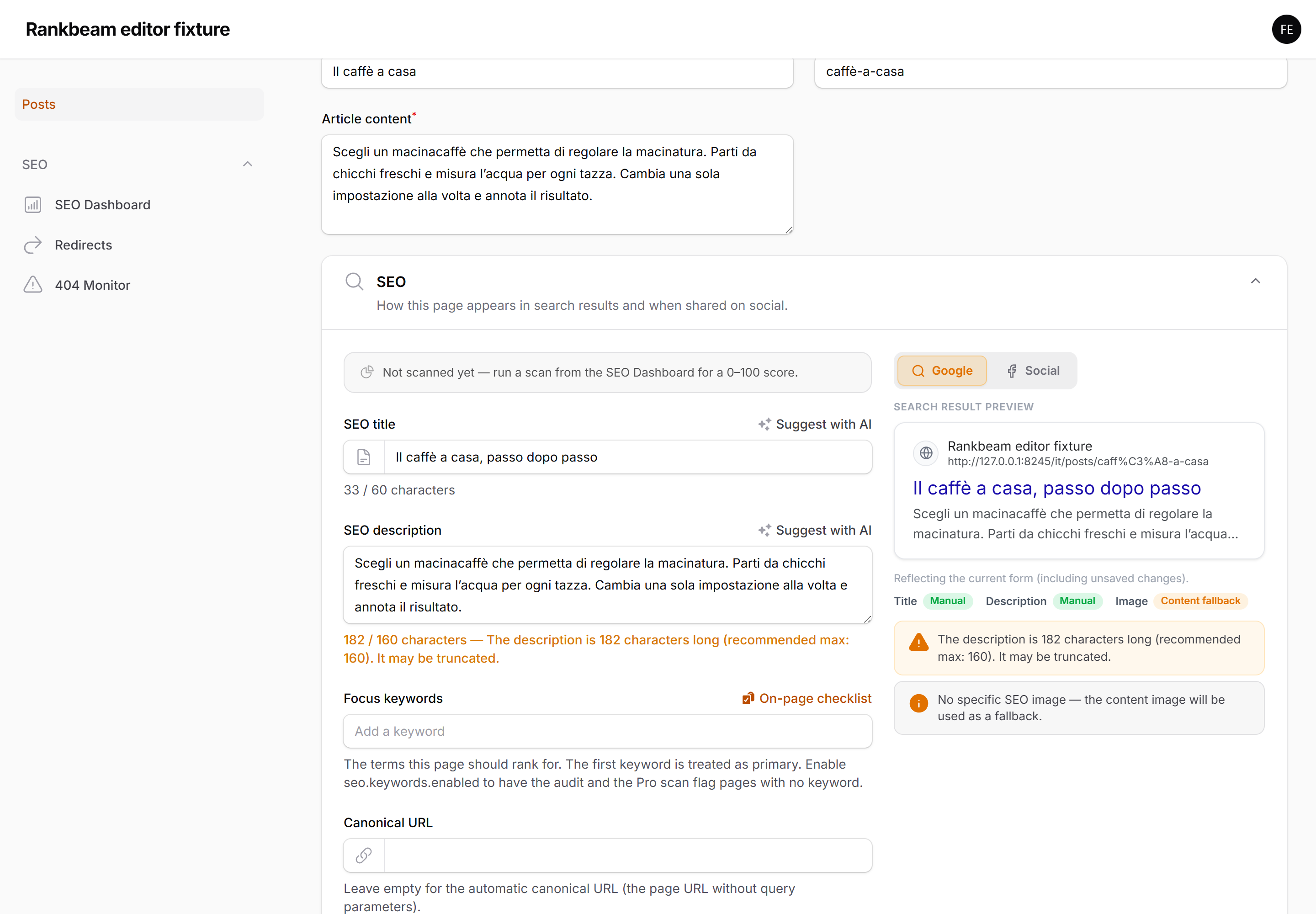
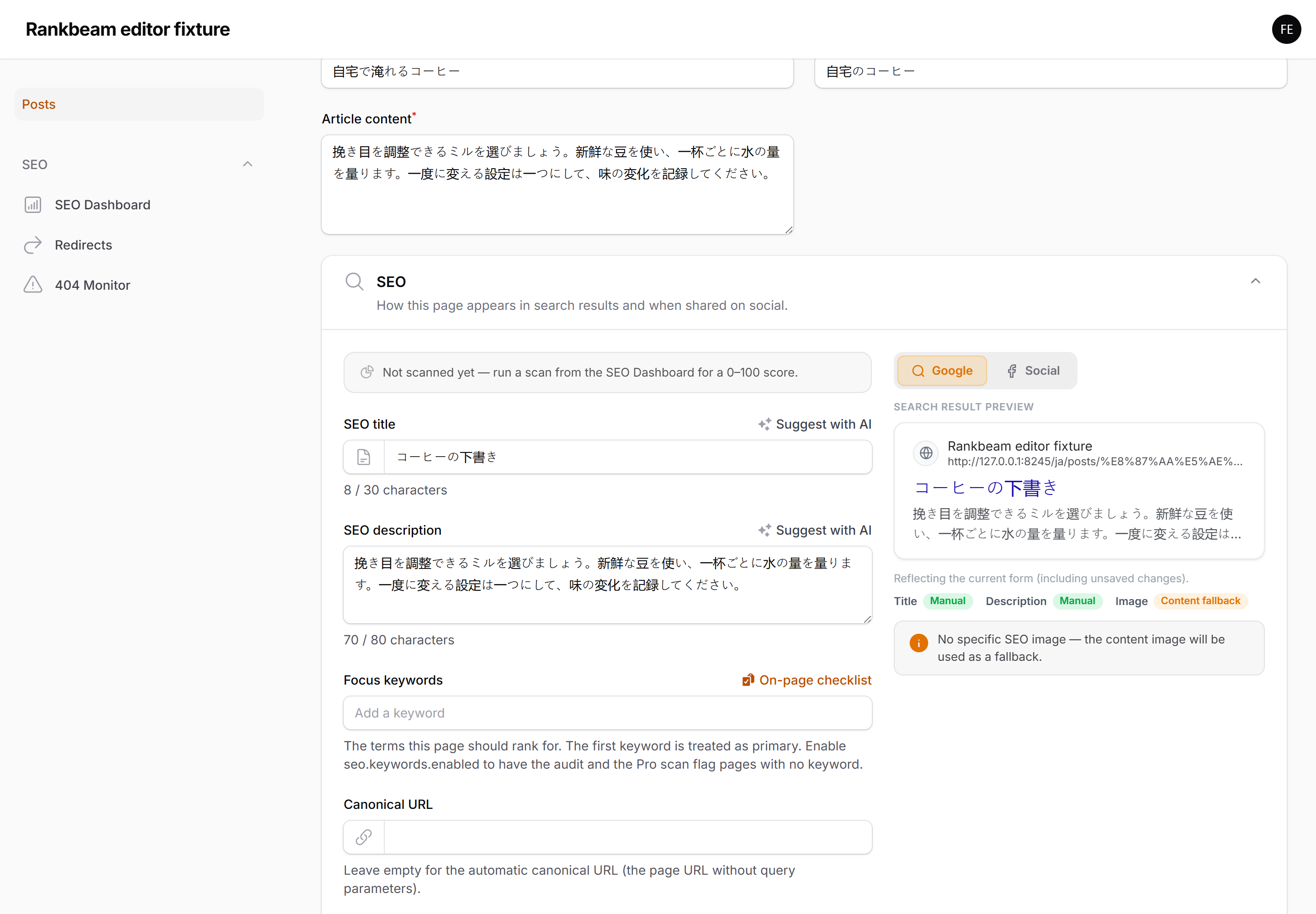
These lossless 2× captures show the same local test application's English operator interface editing Italian and Japanese content. The screenshots use Filament 5.8.1, Lara Zeus 2.0.1 and Rankbeam Filament 1.12.0. They demonstrate content-locale previews and counters, not native-language quality approval. The captures also show optional Pro 2.40.1 controls: AI suggestions and scan scores require Pro and are not included in the free editor.
The adapters preserve the normal before/after hooks and form-data mutators.
If your page overrides handleRecordCreation(), handleRecordUpdate(),
callHook() or transaction methods, integrate the adapter behavior in that
customization and test its save flow. Database transactions do not roll back
filesystem writes; applications should retain their usual orphan-file cleanup.
For custom live text fields on Livewire 3, prefer ->live() or
->live(onBlur: true) over an explicit debounce: the latter delays local model
state and can lose the last keystrokes during a quick locale switch. Rankbeam's
title and description fields use the default request debounce.
The upstream page traits alone refill forms during a switch. Rankbeam guards
against their accidental metadata writes, but those traits do not preserve SEO
drafts; migrate Edit/Create pages to the adapters. Explicit locales: tabs
remain a shared editor and take precedence over the page switcher.
Structured data (optional)
Add a second, optional section so editors can attach schema.org JSON-LD without code:
static::seoSchemaSection(), // or SEOSchemaFields::make()
It writes into the core seo_meta.schema_jsonld column and is pure UI binding over the
core schema builders — a one-toggle automatic breadcrumb
(BreadcrumbSchema::fromModelAncestors()) plus a repeater of FAQ (FAQSchema) and
Product (ProductSchema) blocks. Every built document is validated by the core
SchemaValidator; a malformed block (e.g. a Product with no offer) is rejected on save.
Schema it can't represent (a hand-authored @graph, an exotic @type, richer Product
fields) is preserved verbatim. See the
Filament guide for details.
Testing
composer update --with "filament/filament:~4.0" && vendor/bin/pest   # Filament 4 leg
composer update --with "filament/filament:~5.0" && vendor/bin/pest   # Filament 5 leg
The suite covers render, live counter states, create + edit save round-trips
(including og:image upload), field clearing, URL validation, source-indicator
attribution for every resolver layer, focus-keyword round-trips, the editorial
preview (SERP + social tabs, the showPreview opt-out, the server-side preview
payload — manual-vs-fallback image source, known-local dimension measurement,
remote-image deferral, and shared-threshold warnings), and the structured-data
editor (FAQ / Product build + round-trip, automatic breadcrumb, validation
rejection, optimistic-concurrency reconciliation, and custom-schema preservation).
Testbench note (provider order)
If you boot Filament in orchestra/testbench yourself, register Filament's
SupportServiceProvider before LivewireServiceProvider. Filament rebinds Livewire's
DataStore (which drops Livewire's registered instance); only Livewire's later mechanism
registration pins the resolved override as the shared instance. Package discovery produces
this order naturally in a real app — a hand-rolled provider list might not. The symptom of
getting it wrong is ViewErrorBag::put(): Argument #2 ($bag) must be of type MessageBag, null given on every Livewire test.
Translations
The editor's labels follow app()->getLocale(). These 17 interface locales ship
with the free package:
English (en), Italian (it), German (de), French (fr), Spanish (es),
Brazilian Portuguese (pt_BR), Dutch (nl), Turkish (tr), Russian (ru), Polish (pl),
Japanese (ja), Simplified Chinese (zh_CN), Traditional Chinese (zh_TW), Korean (ko),
Greek (el), Ukrainian (uk) and Czech (cs).
The interface language and the content languages you edit are independent. The list above describes bundled labels; it does not limit your site's content locales. Your application supplies the translated content. The free editor does not translate it automatically.
To override a label, publish the translation files:
php artisan vendor:publish --tag=seo-filament-lang
To contribute a language, follow the rules and glossary in the core repository's TRANSLATING.md.
Guides
- Laravel Filament SEO: previews, canonicals and fallback sources
- Laravel SEO: the complete guide
- Best Laravel SEO packages compared
License
MIT — see LICENSE.md.