
privacy-ci / laravel

Find where personal data lives in your Laravel app, classify it in policy-as-code, and fail CI when new user-linked storage has no policy.
Requires
- php: ^8.2
- illuminate/console: ^12.0|^13.0
- illuminate/support: ^12.0|^13.0
- nikic/php-parser: ^5.0
Requires (Dev)
- illuminate/database: ^12.0|^13.0
- orchestra/testbench: ^10.0|^11.0
- phpunit/phpunit: ^11.0
Suggests
None
Provides
None
Conflicts
None
Replaces
None
This package is auto-updated.
Last update: 2026-09-26 16:22:47 UTC
README
Map the personal data in your Laravel application, write your GDPR policy as code,
execute it end to end, and fail CI the day new storage appears unclassified.


Every backend team can delete a user from their primary database. Almost none can prove the user is gone from Redis, S3, the search index, the warehouse and six SaaS vendors. Almost none have a data map that is still true a year after somebody wrote it.
Five commands, and most teams need all five:
Map it. privacy:discover reads migrations, models, config and composer.lock and
reports every place personal data can reach: columns, the Redis keys and S3 paths written
from application code, and the third-party services it found in your dependencies. No
database connection, no credentials.
Decide it. privacy:make-policy scaffolds your GDPR rules as PHP, one line per
finding, every one commented out. Delete, anonymise, retain with a documented reason. It
lives in the repository, so it is reviewed in pull requests and deployed with the code
that created the data.
Execute it. The policy is not a document, it runs. privacy:make-handler turns it
into the deletion code, and privacy:forget drives the grace period, the reactivation
link, the reminders and the audit row.
Prove it. privacy:verify inspects the real stores after an erasure and reports
PASS, FAIL or RETAINED per address. What it could not reach is UNCHECKED, never
quietly passed.
Keep it true. privacy:check fails the build the day somebody adds user-linked
storage nobody classified. A map nobody enforces is a map that was accurate once.
The whole package is free. No account, no limits, no telemetry.
Quick start
composer require privacy-ci/laravel && php artisan privacy:discover
That reports the whole map. No database connection, no .env, no credentials: discovery
reads from the checkout and never touches a row.
The rest of the sequence, once you have looked at the report:
php artisan privacy:make-policy      # scaffold the rules, every one commented out
php artisan privacy:make-handler     # turn the policy you edited into deletion code
php artisan privacy:forget 42        # suspend now, erase when the grace period closes
php artisan privacy:verify 42        # prove it landed, and say what could not be checked

php artisan privacy:check            # in CI: exit 1 on new storage with no policy
Contents
- Why bother before you have to
- How it works
- 1. Discover: where does personal data live?
- 2. Classify: your GDPR policy as code
- 3. Gate: fail CI on new unclassified storage
- 4. Generate the deletion handler
- 5. Erasure lifecycle: suspend, then delete
- 6. Verify: did the erasure actually land?
- Command reference
- Configuration
- Certain findings versus likely ones
- The findings manifest
- What this is not
- Development
- License
Why bother before you have to
Under the GDPR, failing to honour an erasure request sits in the higher penalty tier: up to 20 million euros or 4% of worldwide annual turnover, whichever is larger. The UK and most other regimes mirror that shape.
The fine is rarely the expensive part. What costs money is the scramble: a regulator or a customer gives you 30 days, and an engineering team spends them reconstructing a data map nobody wrote down, hunting through Redis keys and S3 prefixes by hand, under a deadline, on work that ships nothing.
Building the map while nobody is asking takes an afternoon. Building it during the clock takes a sprint, and you still cannot prove the deletion worked.
How it works
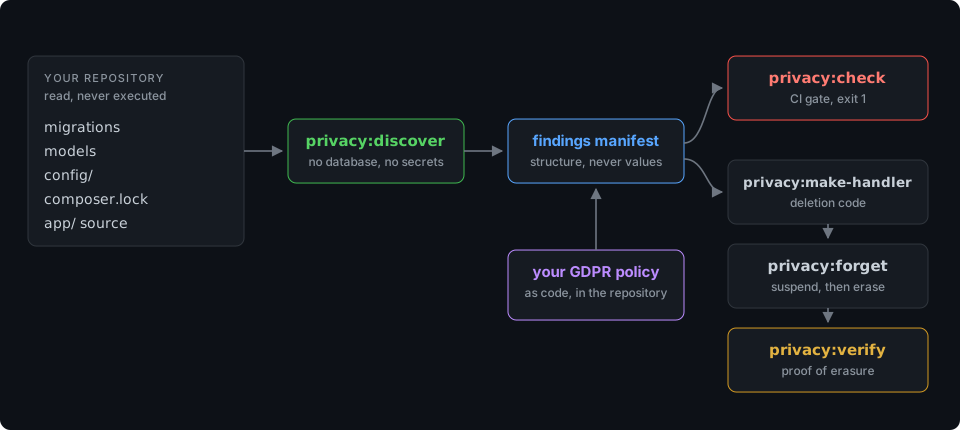
Discovery and the policy meet in one document, the findings manifest. Everything downstream is an operation on that document: the gate diffs it, the generator compiles it, the verifier walks it against the real stores.
1. Discover: where does personal data live?
php artisan privacy:discover          # the report above
php artisan privacy:discover --json   # the findings manifest
Or without booting Laravel at all, which is what you want in CI:
vendor/bin/privacy-ci --path=. --no-ansi
The full report, as text
PERSONAL DATA: HIGH CONFIDENCE

  location                         store    linkage         confidence      classification
  audit_entries.actor_id           primary  relationship    1.00 certain    DELETE
  comments.author_ip               primary  name match      0.99            ANONYMIZE
  comments.user_id                 primary  foreign key     1.00 certain    ANONYMIZE
  orders.buyer_id                  primary  foreign key     1.00 certain    RETAIN
  orders.shipping_address          primary  name match      0.95            RETAIN
  recommendation_events.device_id  primary  name match      0.98            UNCLASSIFIED
  recommendation_events.user_id    primary  foreign key     1.00 certain    UNCLASSIFIED
  sessions.ip_address              primary  name match      0.99            ANONYMIZE
  sessions.user_id                 primary  foreign key     1.00 certain    ANONYMIZE
  subscribers.email                primary  name match      0.99            UNCLASSIFIED
  users.email                      primary  name match      0.99            DELETE
  users.id                         primary  subject root    1.00 certain    DELETE
  users.password                   primary  name match      0.99            DELETE
  users.phone                      primary  name match      0.99            DELETE
  profile:{id}                     default  declared        1.00 certain    DELETE
  comments_index?user_id={id}      scout    foreign key     1.00 certain    DELETE
  users/{id}                       scout    subject root    1.00 certain    DELETE
  avatars/{id}.jpg                 s3       declared        1.00 certain    DELETE

PERSONAL DATA: POSSIBLE (review required)

  location                         store    linkage         confidence      classification
  sessions.user_agent              primary  name match      0.70            UNCLASSIFIED
  users.name                       primary  name match      0.65            DELETE

LOW CONFIDENCE (may embed personal data)

  location                         store    linkage         confidence      classification
  comments.body                    primary  name match      0.40            UNCLASSIFIED
  recommendation_events.payload    primary  name match      0.38            UNCLASSIFIED

STORES AND SERVICES DETECTED

  Intercom            config/services.php           not yet scannable
  Laravel Scout       laravel/scout                 scannable
  Redis               predis/predis                 scannable
  S3                  config/filesystems.php        scannable
  Snowflake           config/services.php           not yet scannable
  Stripe              stripe/stripe-php             not yet scannable

  3 stores detected that this version cannot scan: Intercom, Snowflake, Stripe
  Personal data may be flowing there unmapped.

22 locations found · 16 classified · 6 unclassified · 1 would fail CI
It never touches your database
Discovery reads migrations, config and composer.lock from source. It opens no
database connection and never reads a row, so it runs safely in CI against a bare
checkout with no credentials present.
Migrations are replayed as a history, not unioned: a column added in 2021 and dropped in 2023 does not appear in the results.
Raw SQL migrations are read too. Long-lived applications often never used the
Blueprint builder, their schema arrived as a dump wrapped in DB::statement(), and the
table it defines is usually the oldest and most important one:
DB::statement("CREATE TABLE `legacy_members` (
  `member_id` int(10) unsigned NOT NULL AUTO_INCREMENT,
  `email` varchar(255) NOT NULL,
  `state` enum('Active','Suspended','Pending Close') NOT NULL,
  PRIMARY KEY (`member_id`),
  CONSTRAINT `fk` FOREIGN KEY (`owner_id`) REFERENCES `legacy_members` (`member_id`)
) ENGINE=InnoDB;");
Columns, nullability and inline FOREIGN KEY constraints are all extracted, and
enum('Active','Pending Close') does not shred the column list the way a naive comma
split would.
If your subject table is not users.id, say so:
'subjects' => ['user' => 'legacy_members.member_id'],
Models are read too
The model scanner catches associations the database does not know about. Plenty of
production schemas declare belongsTo(User::class) with no matching foreign key: the
link is real, the migration scanner cannot see it, and it is still deterministic enough
to fail a build on.
It also reads $hidden and encrypted casts. A developer marking a column sensitive in
the framework's own vocabulary is weak evidence on its own, but it usefully raises
confidence on a column a name heuristic was unsure about.
Search indexes are followed into Elasticsearch and OpenSearch
A Searchable model copies personal columns out of the database. An erasure written
against rows alone leaves that copy behind, and the copy is the one with a public search
box in front of it.
Scout's trait is read as a deterministic finding, not a guess:
class User extends Authenticatable
{
    use Searchable;

    public function toSearchableArray(): array
    {
        return ['name' => $this->name, 'email' => $this->email];
    }
}
  location                     store       linkage         confidence      classification
  comments_index?user_id={id}  opensearch  foreign key     1.00 certain    UNCLASSIFIED
  users/{id}                   opensearch  subject root    1.00 certain    UNCLASSIFIED
Those two shapes are the whole of it, and the difference matters:
users/{id} |
The subject is the document; its id is the document id |
comments_index?user_id={id} |
The subject is a field; documents are keyed by something else |
A comment's document id is the comment's id, so nothing can address it by the subject's
id alone. Reporting it as comments_index/{id} would generate a delete against whichever
comment happened to share the user's id, which is data loss wearing a passing test.
A model further than one hop from the subject is reported as an index with no addressable
subject inside it, and says so, rather than guessing a column that is not a user id.
Most applications never touch Scout. Elasticsearch has not been a first-party engine since Scout 3, so a cluster is usually reached through the SDK directly, wrapped in a repository nobody thought to call a privacy boundary. Matching on the call does not find those, because real code splits the request from the send:
// one method builds it
$params['index'] = $index;
$params['id'] = $user->user_id;
$params['body']['username'] = $user->username;

// a different method, usually a different file, sends it
$this->client->index($params);
Following $params across that needs interprocedural dataflow. So discovery matches the
request shape instead — an array carrying both an index and an id, where the id
names the subject — which is the part that cannot be avoided whether the array is a
literal in the call or built a key at a time:
  location      store       linkage         confidence      classification
  {index}/{id}  opensearch  inferred        0.60            UNCLASSIFIED
The index name is usually a variable or a facade call rather than a literal, which leaves
a placeholder and makes the location honestly unverifiable. It is still the finding worth
having: an index of users nobody has classified, whether or not we can name the cluster.
Like everything from static analysis it is inferred, so it warns and never fails CI.
This only sees code inside discovery.source_paths, which defaults to app_path(). If
your repositories live in src/, widen it — an unscanned path reports as an absence of
findings, not as an absence of scanning. When a cluster is configured and nothing was
mapped in it, the report says so rather than staying quiet.
Scout is an abstraction over engines, not an engine. It ships Algolia, Meilisearch,
Typesense, database and collection; Elasticsearch has not been first-party since Scout 3,
so applications reach it through a community driver or the SDK directly. Discovery reads
use Searchable to find which models are indexed whatever the engine, and reads the
driver in your composer.lock to work out which cluster that is:
The store column is how that shows up in the report: primary for the database,
opensearch or elasticsearch for a detected cluster, scout when nothing said which.
| Installed | Recorded store |
|---|---|
matchish/laravel-scout-elasticsearch, babenkoivan/elastic-scout-driver, jeroen-g/explorer, elasticsearch/elasticsearch |
elasticsearch |
opensearch-project/opensearch-php |
opensearch |
| Scout alone, or both clients at once | scout, left for your policy to name |
On Algolia or Meilisearch the indexes are still discovered and still classified; only
verification is engine-specific, and it reports UNCHECKED rather than guessing.
Static analysis finds what the schema cannot
Plenty of personal data never reaches a column. Stage B reads your application code for identifiers written to cache, object storage and Redis:
Cache::put("user:{$user->id}", $payload);
Storage::disk('s3')->put("avatars/{$user->id}.jpg", $file);
Redis::set('profile:' . $user->id, $json);
  location               store    linkage         confidence      classification
  user:{user.id}         cache    inferred        0.80            UNCLASSIFIED
  avatars/{user.id}.jpg  s3       inferred        0.80            UNCLASSIFIED
Patterns keep the interpolated expression, user:{user.id} and not user:*, because a
developer reading the report can judge the first at a glance and cannot judge the second
at all. Concatenation and interpolation both work, and Storage::disk('s3') attributes
the write to that disk rather than the default.
Precision here is inherently poor, and the design admits it. PHP interpolates
dynamically, applications wrap everything in repositories and helpers, and a key is only
recognisable as personal by how it is named: user:{$userId} and report:{$reportId}
are identical in shape. So every Stage B finding is inferred, which means it can only
ever warn:
report:{reportId} |
Ignored, names something other than the subject |
app:config |
Ignored, wholly literal, cannot key on a person |
Cache::get(...) |
Ignored, a read is not a write |
| Same key, three files | One finding, not three |
| Any finding at all | inferred · warns · never fails CI |
Set discovery.source_paths to [], or pass --no-static, to switch it off.
2. Classify: your GDPR policy as code
Rules live in your repository, so they are versioned, reviewed in pull requests, and
deployed with the code that created the data. Changing a table from RETAIN to DELETE
becomes a code review with a named approver.
namespace App\Privacy;

use App\Models\{Comment, Order, User};
use PrivacyCI\Policy\PrivacyPolicy;

class UserPrivacyPolicy extends PrivacyPolicy
{
    public function configure(): void
    {
        $this->subject(User::class);

        $this->delete(User::class);
        $this->anonymize(Comment::class, ['user_id' => null, 'author_ip' => null]);
        $this->retain(Order::class)->reason('statutory accounting retention, 7y');

        $this->deleteRedis('profile:{id}');
        $this->deleteStorage('avatars/{id}.jpg', disk: 's3');
    }
}
Register it in config/privacy.php, and every finding gains a classification: the
DELETE / ANONYMIZE / RETAIN column in the report above.
A rule naming specific columns narrows one covering the whole table. RETAIN without a
reason and CUSTOM without a handler are rejected outright: an undocumented retention is
the thing an auditor asks about first.
Rules for Redis, object storage, search indexes and third-party services add locations to the map. The developer is describing somewhere the scanner cannot reach, and a declared location belongs on the map just as much as a found one.
A search rule names the index, and names the field when the documents are keyed by something other than the subject:
$this->deleteSearch('users');                                   // users/{id}
$this->deleteSearch('comments_index', by: 'user_id');           // delete by query
$this->deleteSearch('posts', 'opensearch', by: 'author_id');    // on a named cluster
A rule naming a connection re-homes an index discovery found, so scout becomes
opensearch and both the generated handler and the probe go to the right cluster. Leaving
it out is not the same as naming the default: discovery already read the cluster off your
installed driver, and an argument nobody filled in does not overrule that.
Suppression needs a reason
IGNORE is the escape hatch, so it is not free:
$this->ignore(FeatureFlag::class)->reason('internal flag, no subject link');
RETAIN and IGNORE both require a written reason, enforced at policy load. An
unexplained suppression is indistinguishable from an oversight when someone reads the
diff two years later.
Scaffold it instead of writing it
Discovery on a mature codebase finds dozens of locations. Generate a policy to edit:
php artisan privacy:make-policy
php artisan privacy:make-policy --only-blocking   # just what fails CI today
final class UserPrivacyPolicy extends PrivacyPolicy
{
    public function configure(): void
    {
        $this->subject(User::class);

        // ── recommendation_events ───────────────────── linked by user_id
        //    user_id                       1.00  recommendation_events.user_id -> users.id

        // $this->anonymize('recommendation_events', ['user_id' => null]);
        // $this->delete('recommendation_events');
    }
}
Every rule arrives commented out, and there is a test that fails if one ever does not.
Discovery suggests; you decide. An uncommented delete() here would become real deletion
code the moment somebody ran privacy:make-handler.
Findings are grouped by table with evidence inline, the most plausible rule is written on
the line below, and tables that fail CI today sort first. A table with no key to the
subject gets no delete() or anonymize() suggestion, neither could address the
rows, so offering one would be a lie.
3. Gate: fail CI on new unclassified storage
php artisan privacy:baseline   # once, when adopting: forgive existing debt
php artisan privacy:check      # in CI: fail only on what is new

Two rules decide it, and neither is configurable:
- Only deterministic findings can fail, a foreign key or a declared relationship. A name match warns and nothing more. One false positive that blocks a deploy costs more trust than a missed column ever will.
- Only new findings can fail. Anything in
privacy-baseline.jsonpre-dates adoption. Without that, dropping this into a mature codebase means three hundred failures on day one and a deleted workflow by the afternoon.
privacy:baseline refuses to overwrite an existing file without confirmation:
re-baselining is how a team accidentally forgives everything it meant to fix. Stale
entries (a baselined column that no longer exists) are reported, because leaving them
in silently grandfathers a future column that reuses the name.
For gradual adoption, --warn-only reports everything and always exits 0.
Running it anywhere
The gate is one command and an exit code, so any runner works. GitLab, Jenkins, Buildkite and a git pre-push hook all behave the same way.
./vendor/bin/privacy-ci --path=. --check --no-ansi # 0 = pass, 1 = fail
Prefer the binary over php artisan privacy:check in CI. Artisan has to boot the
application, so it wants an .env and an APP_KEY; the binary reads the checkout and
nothing else. Neither needs a database.
A complete GitHub Actions workflow:
name: privacy

on: pull_request

jobs:
  privacy:
    runs-on: ubuntu-latest
    steps:
      - uses: actions/checkout@v4

      - uses: shivammathur/setup-php@v2
        with:
          php-version: '8.3'
          coverage: none

      - name: Cache Composer
        uses: actions/cache@v4
        with:
          path: ~/.composer/cache/files
          key: composer-${{ hashFiles('composer.lock') }}

      - run: composer install --prefer-dist --no-interaction --no-progress

      - name: Privacy check
        run: ./vendor/bin/privacy-ci --path=. --check --no-ansi
No database service, no .env, no secrets. Verified from a clean clone with neither file
present.
While a team is adopting the check, swap the last step for one that reports without blocking anyone:
      - name: Privacy check (reporting only)
        run: ./vendor/bin/privacy-ci --path=. --check --no-ansi || true
privacy-baseline.json has to be committed. Without it every run reports the whole of
your existing debt and fails from the first day.
What it does not do
It does not comment on the pull request. You get a red check and the reason in the job log. Inline comments need a GitHub App holding a token, which is a hosted piece rather than something this package can do from inside a job.
4. Generate the deletion handler
Policy-as-code only describes the world. privacy:make-handler makes it produce
something, at zero runtime risk, because it emits code, not effects.
php artisan privacy:make-handler
php artisan privacy:make-handler --print    # see it without writing
final class DeleteUser implements SubjectDeleter
{
    public function delete(DeletionRequest $request): void
    {
        $subjectId = $request->subjectId;

        Storage::disk('s3')->delete("avatars/{$subjectId}.jpg");

        app(SearchIndex::class)->deleteByQuery('comments_index', 'user_id', (string) $subjectId);

        Redis::del("profile:{$subjectId}");

        app(SearchIndex::class)->deleteDocument('users', (string) $subjectId);

        do {
            $deleted = \App\Models\AuditEntry::query()
                ->where('actor_id', $subjectId)
                ->limit(1000)
                ->delete();
        } while ($deleted > 0);

        // Terminates because user_id is among the columns being nulled,
        // so the next pass matches nothing. Keep it that way if you edit this.
        do {
            $affected = \App\Models\Comment::query()
                ->where('user_id', $subjectId)
                ->limit(1000)
                ->update([
                    'author_ip' => null,
                    'user_id' => null,
                ]);
        } while ($affected > 0);

        // retained: statutory accounting retention, 7y

        // Terminates because user_id is among the columns being nulled,
        // so the next pass matches nothing. Keep it that way if you edit this.
        do {
            $affected = DB::table('sessions')
                ->where('user_id', $subjectId)
                ->limit(1000)
                ->update([
                    'ip_address' => null,
                    'user_id' => null,
                ]);
        } while ($affected > 0);

        \App\Models\User::query()->whereKey($subjectId)->delete();

        // TODO: these locations have no policy and are therefore untouched.
        // Classify them in your privacy policy and regenerate.
        //   - comments.body
        //   - recommendation_events.device_id
        //   - recommendation_events.payload
        //   - recommendation_events.user_id
        //   - sessions.user_agent
        //   - subscribers.email
    }
}
It lands in your repository, you review it as a diff and you own it afterwards. It
implements SubjectDeleter, so pointing privacy.lifecycle.deleter at it wires the
whole erasure lifecycle together.
Ordering is the hard part, and it is handled. Non-database stores are cleared first, once the subject's row is gone, a key pattern built from it can no longer be resolved. Then rows furthest from the subject, then the subject's own row last, so foreign keys stay satisfied throughout.
| Unclassified locations | Loud TODOs, never silently omitted |
RETAIN |
A comment carrying the documented reason, no action |
IGNORE |
Absent entirely |
CUSTOM |
Calls your handler class |
| A table with no model | Falls back to DB::table() |
| PII with no foreign key | TODO, we know it is there, you supply the lookup |
| An existing file | Refuses to overwrite without --force |
| Unchanged policy | Byte-identical output |
Use --class and --namespace to place it. Generated files follow the application's
own PSR-4 map, read from composer.json, so --namespace="Acme\Shop\Domain\Privacy"
writes to src/Domain/Privacy/ rather than somewhere the autoloader will never look.
Deleting or masking the subject
Neither is a default. For the subject's own row privacy:make-policy offers both, because
neither is obviously right:
// $this->delete(User::class);
// $this->anonymize(User::class, ['email' => 'deleted@example.invalid', 'name' => 'Deleted user']);
Deleting forces every foreign key pointing at the row to be nullable or cascading, or the delete is refused. Masking keeps orders, comments and audit rows attributable to somebody, just not to a person. Mixing is fine and usual: mask the subject, delete the sessions, anonymise the comments, keep the orders.
Mask to placeholders, not to null. On most subject tables the identifying columns are
NOT NULL, so an update to null fails at erasure time. If you try, privacy:make-handler
says so before you ship it:
Anonymising sets these to null, but the schema declares them NOT NULL, so the erasure will fail: users.email, users.name. Make the columns nullable, or delete the rows instead of anonymising them.
Three things behave differently for the subject's own row:
| It is found by its own key | Not by a foreign key it does not have |
| The update is not chunked | One row, and the key must survive, so a loop would never end |
| Verification asks a different question | Not "is the row gone" but "did anything identifying survive" |
That last one matters. A masked subject that still held its old email would pass an absence check, since the row is meant to be there. Verification compares each masked column against the value the policy declared:
users where id = 1, masked    PASS
users where id = 1, masked    FAIL    data still present
The second line is a real run after putting the original email back.
If your email column is unique, give each erased subject a distinct placeholder, or the second erasure collides with the first.
5. Erasure lifecycle: suspend, then delete
There is no undo. So a deletion request does not erase anything. It stops processing immediately and starts a 14-day clock; only when the clock runs out does anything become irreversible.
use PrivacyCI\Lifecycle\Laravel\RequestsDeletion;

class User extends Authenticatable
{
    use RequestsDeletion;
}
$user->requestDeletion(via: 'account settings');  // suspended now, erased in 14 days
$user->deletionPending();                         // true
$user->daysUntilDeletion();                       // 14
$user->reactivate();                              // "actually, keep my account"
php artisan privacy:forget 123              # suspend now, erase in 14 days
php artisan privacy:forget 123 --cancel     # reactivate and call it off
php artisan privacy:process-deletions --dry-run
GDPR separates storing data from processing it. Suspending on day zero means the request is substantively honoured within hours, and the window becomes a recovery period for the data rather than a month of doing nothing.
| Day 0 | Day 14 | Posture | |
|---|---|---|---|
mode: suspend (default) |
processing stops | deleted | Acted immediately, recovery preserved |
mode: hold |
nothing changes | deleted | Simpler; a long window means continued processing |
grace_days: 0 |
deleted | . | No recovery at all. Set it knowingly |
Suspending and deleting are two interfaces your application implements, and neither has a working default: until they are bound, requests fail loudly, because an app must never be able to tell someone their account is closed while it stays fully active. The package owns the timing, the reactivation link, the reminder schedule and the audit row.
The full erasure lifecycle covers binding those two
interfaces, the signed reactivation link and why it is POST-only, reminder scheduling,
the audit trail and its limits, and the guarantees each of those is tested against.
6. Verify: did the erasure actually land?
php artisan privacy:verify 42

recommendation_events.user_id on that FAIL line is the same column the gate flagged
further up. Nobody classified it, so the generated handler left it alone, and
verification found the rows still there.
UNCHECKED is not PASS
The distinction is the entire point. A report that silently passed what it never looked at would be worse than no report.
| Situation | Outcome |
|---|---|
| Probe looked, found nothing | PASS |
| Probe looked, data remains | FAIL, exit 1 |
| Kept on purpose | RETAINED, with the documented reason |
| No probe for that store | UNCHECKED |
| Probe threw (store unreachable) | UNCHECKED, with the error |
| PII with no key to the subject | UNCHECKED, we know it is there, we cannot address it |
A run with any gaps reports VERIFIED WITH GAPS, never VERIFIED, and exits
non-zero. Each result carries a stable sha256 fingerprint that excludes the timestamp,
so the same evidence hashes identically whenever it is re-rendered.
Probes ship for database, object storage, Redis and search; register them in
verification.probes. Removing one does not weaken the report, the addresses it covered
simply show as unchecked, which is the honest outcome.
SearchProbe speaks to Elasticsearch and OpenSearch, and neither SDK is a dependency of
this package: the client is duck-typed, so bind whichever one you already have.
'search' => [
    'clients' => [
        'default' => \Elastic\Elasticsearch\Client::class,
        // 'opensearch' => \OpenSearch\Client::class,
    ],
],
The generated handler and the probe go through the same client, so what erasure
removed and what verification looks for cannot drift apart. Deletes are issued with
refresh, because an index is near-real-time and a check moments later would otherwise
report the subject still present. A cluster that cannot be reached is UNCHECKED, never
PASS; an index that does not exist holds nobody and passes.
The snapshot has to come first
Once the subject's row is gone, the Redis keys, storage paths and dependent rows that were
reachable from it can no longer be derived. So the footprint, every address resolved
for that one person, is captured immediately before deletion and checked immediately
after. privacy:process-deletions does both automatically and attaches them to the
request, so one row carries the whole story: what was there, what ran and what remained.
Verifying without a captured footprint still works, and says what it is:
No footprint was captured for this subject, so addresses are being derived from policy now. That confirms policy coverage; it cannot prove what was removed.
Command reference
| Command | What it does |
|---|---|
privacy:discover |
Report every location personal data can live in. --json emits the manifest |
privacy:baseline |
Record today's findings as pre-existing, so only new ones fail |
privacy:check |
Fail (exit 1) on new deterministic, unclassified user-linked storage |
privacy:make-policy |
Scaffold a policy from what discovery found, every rule commented out |
privacy:make-handler |
Generate a SubjectDeleter from your policy |
privacy:forget {id} |
Start a subject's grace period, or --cancel it |
privacy:process-deletions |
Send reminders, then erase subjects whose window closed |
privacy:verify {id} |
Check that a subject was really erased everywhere |
The standalone binary covers discovery and the gate with no Laravel boot:
vendor/bin/privacy-ci --help
  --path      Application root to scan (default: current directory)
  --subject   Name of the data subject (default: user)
  --root      Column identifying the subject (default: users.id)
  --policies  Directory of privacy policies (default: app/Privacy)
  --check     Fail (exit 1) on new unclassified user-linked storage
  --baseline  Baseline file (default: <path>/privacy-baseline.json)
  --source    Code to scan for data flows (default: <path>/app)
  --no-static Skip static analysis of application code
  --min-confidence  Hide findings below this score (default: 0.25)
  --write-baseline  Record current findings as pre-existing, then exit
  --json      Emit the findings manifest instead of a report
  --no-ansi   Disable colour
Configuration
php artisan vendor:publish --tag=privacy-config
To use the erasure lifecycle as well:
php artisan vendor:publish --tag=privacy-migrations
php artisan migrate
In suspend mode (the default) privacy:forget will tell you to bind a
SubjectSuspender first. It refuses to report an account closed while it is still fully
active.
Models anywhere, not just app/Models
Point model_paths wherever your models actually live, any namespace, any depth. The
scanner reads the namespace from the file rather than assuming one:
'discovery' => [
    'model_paths' => [base_path('src/Domain/Models')],
],
Relationships resolve across namespaces, and a policy can still name a model by its short
name ($this->delete(Member::class) or 'Member').
Model detection follows ancestry, so Invoice extends BaseModel extends Model works as
long as the base class is inside a scanned path. When it lives in a package and is not
named *Model, declare it:
'model_base_classes' => [
    \Acme\Support\Database\Entity::class,
],
Confidence thresholds
'confidence' => [
    'high' => 0.85,     // presented as likely personal data
    'report' => 0.25,   // below this, omitted entirely
],
Words that are only personal in context, name, description, reason, message,
payload, city, are damped on tables with no route to the subject, which usually
drops them below report. Lower it to see them: on a lookup table of countries, name
is "Germany", but a free-text note on a table you own might genuinely be personal.
Certain findings versus likely ones
Every finding carries a confidence and a linkage explaining why we believe it.
| Linkage | Example | Can fail CI |
|---|---|---|
subject_root |
users.id |
yes |
foreign_key |
comments.user_id → users.id |
yes |
relationship |
belongsTo(User::class) with no constraint |
yes |
declared |
named in a privacy policy | yes |
heuristic |
orders.shipping_address |
no, warns only |
inferred |
Cache::put("user:{$user->id}", …) |
no, warns only |
Only deterministic findings may ever fail a build. A false positive that blocks a deploy costs more trust than a missed column, so this is not configurable.
The findings manifest
Everything is an operation on one document. Diff it across commits and you have the CI check; sign and retain it and you have audit evidence; join several and you have a cross-service map.
{
  "schema_version": "1.0",
  "project": "acme/api",
  "subjects": [{ "type": "user", "root": "users.id" }],
  "locations": [
    {
      "id": "db:primary:comments.author_ip",
      "kind": "database_column",
      "store": "primary",
      "path": "comments.author_ip",
      "subject": "user",
      "linkage": "heuristic",
      "confidence": 0.99,
      "classification": "ANONYMIZE",
      "policy_source": "UserPrivacyPolicy.php:17",
      "replacements": { "author_ip": null },
      "evidence": [
        "reachable from users in 1 hop(s)",
        "column name matches IP address",
        "defined in 2019_02_01_000000_create_comments_table.php"
      ]
    }
  ]
}
It carries structure and identifiers, never values. Serialisation is deterministic, so two scans of unchanged code produce byte-identical output, without which diffing would be meaningless.
What this is not
The output is engineering evidence, not legal certification.
privacy:check passing means no deterministic, newly introduced user-linked storage
lacks a policy. It does not mean the application is compliant with the GDPR, the CCPA or
anything else. VERIFIED means every address in a captured footprint was inspected and
found clear; it says nothing about data in stores that were never mapped, addresses
reported UNCHECKED, or personal data the heuristics did not recognise.
Three limits worth stating plainly:
- Discovery is incomplete by construction. It finds what migrations, models, config and code reveal. Data written by a service you do not own, by raw SQL the parser could not read, or by a key built dynamically at runtime is not in the map, and a location that is not in the map is never verified.
- Heuristic findings are guesses. A column matching a name pattern may hold nothing personal; a column matching nothing may hold a great deal. That is why they only ever warn.
- Verification proves absence at known addresses. It cannot prove that the set of known addresses was complete.
Deciding what counts as personal data, what must be erased and what may be retained is a legal judgement this tool does not make. It gives an engineering team a map, a gate and a record; take those to whoever owns that judgement.
Provided under the MIT licence, without warranty of any kind.
Development
While the version is 0.x the policy DSL and the command names can still change in a
minor release.
composer install
vendor/bin/phpunit --testdox            # unit + feature
vendor/bin/phpunit --testsuite Unit     # no Laravel boot required
./bin/privacy-ci --path=tests/fixtures/demo-app --no-ansi
The demo app under tests/fixtures/demo-app wires migrations, models and a policy into
the conventional Laravel locations, so it exercises the whole path.
Regenerating the screenshots
The GIFs under docs/media are recordings of real runs, never mockups, and the sample
output in the text is captured from the same runs. .demo/record-discover.sh re-records
discover.gif against tests/fixtures/demo-app — the same data the text block above
comes from, so the page cannot contradict itself.
Run it from a real terminal window. Laravel only colours its output when it believes
it is writing to a TTY, and that belief does not survive being driven from a CI shell or
an agent: the recording comes out correct and entirely grey, which looks broken beside
the other two. --ansi does not override it.
check.gif and verify.gif show commands whose output this tooling does not affect;
re-record them only when privacy:check or privacy:verify itself changes.
Working against a real application
To develop against an app on the same machine, point Composer at the checkout rather than the repository. Composer symlinks it, so edits take effect with no reinstall:
"repositories": [
    { "type": "path", "url": "../privacy-ci", "options": { "symlink": true } }
],
composer require privacy-ci/laravel:@dev
A path repository resolves to dev-main from the branch name, which is why the @dev
constraint and minimum-stability: dev are needed. Neither applies to a normal install,
which resolves a tagged version from Packagist.
License
MIT. See LICENSE.