
mscode-pl / vocative

Address people by first name in their language: vocative case, gender and salutation. For Polish, Ukrainian, Czech, Serbian and Croatian.
Requires
- php: ^8.2
- ext-mbstring: *
Requires (Dev)
- pestphp/pest: ^2.0 || ^3.0 || ^4.0 || ^5.0
Suggests
None
Provides
None
Conflicts
None
Replaces
None
This package is auto-updated.
Last update: 2026-11-29 01:14:04 UTC
README
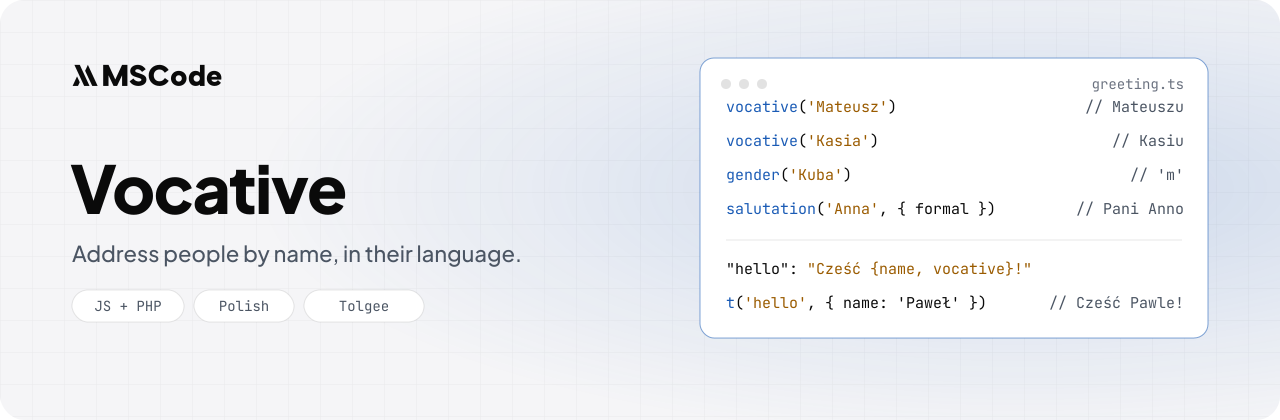
In Polish you greet Anna with "Cześć Anno" and Mateusz with "Cześć Mateuszu". Most apps print "Cześć Anna" because the name comes straight from a form. Vocative turns a first name into the form you address someone with, tells you whether it is a man's or a woman's name, and builds the formal greeting. It covers Polish, Ukrainian, Czech, Serbian and Croatian. The same rules ship for JavaScript and PHP, and a Tolgee plugin does it inside your translations.
Install · JavaScript · PHP · Tolgee · How it works · Languages
Install
The same rules ship as an npm package and a Composer package. Install the one for your stack, not both.
JavaScript or TypeScript (browser, Node, React Native):
npm install @mscode-pl/vocative
PHP 8.2+ (Laravel or plain PHP):
composer require mscode-pl/vocative
No dependencies. The Polish data adds about 2.4 kB gzipped to a bundle, each other language about 1 kB.
JavaScript
import { vocative, gender, salutation } from '@mscode-pl/vocative/pl';

vocative('Anna');                      // 'Anno'
vocative('Paweł');                     // 'Pawle'
vocative('Maciek');                    // 'Maćku'
vocative('Anna Maria');                // 'Anno Mario'
vocative('Jan K.');                    // 'Janie K.'

gender('Kuba');                        // 'm'
gender('Andrea');                      // null, used by both men and women

salutation('Anna');                    // 'Anno'
salutation('Anna', { formal: true });  // 'Pani Anno'
salutation('Jan', { formal: true });   // 'Panie Janie'
- Each language has its own entry point, so a bundle only carries the data for the languages you import.
- Casing follows the input:
ANNAgivesANNO,annagivesanno. - Account names are cleaned first, so a Google or Apple sign-in name works as it comes:
Kasia9632andKasiaDy12653giveKasiu,ania.kgivesaniu. Digits, symbols and a camelCase tail are dropped; when nothing usable is left (123), the result is an empty string, so you can fall back to a generic greeting. - Unknown names never throw. They go through the rules and come back inflected as well as the rules allow.
genderreturnsnullwhen a name is common for both sexes. A formal salutation then falls back to the plain vocative instead of guessing "Pan" or "Pani".
The language object is there when the language is chosen at runtime:
import { polish } from '@mscode-pl/vocative/pl';
import { ukrainian } from '@mscode-pl/vocative/uk';
import type { Language } from '@mscode-pl/vocative';

const languages: Record<string, Language> = { pl: polish, uk: ukrainian };
languages[user.locale]?.vocative(user.firstName) ?? user.firstName;
PHP
use MSCode\Vocative\Vocative;

Vocative::pl()->vocative('Anna');                   // 'Anno'
Vocative::pl()->gender('Kuba');                     // 'm'
Vocative::pl()->salutation('Anna', formal: true);   // 'Pani Anno'

Vocative::uk()->vocative('Олександр');             // 'Олександре'
Vocative::for($user->locale)->vocative($user->first_name);
Vocative::for() accepts regional codes (pl-PL, sr_Latn) and throws an InvalidArgumentException for a language without rules, and Vocative::languages() lists the ones there are. In a Blade template or a laravel-react-email mailable:
Cześć {{ \MSCode\Vocative\Vocative::pl()->vocative($user->first_name) }}!
PHP 8.2 or newer with mbstring. The JavaScript and PHP versions are tested against the same fixtures and give the same result for every one of the 3,649 Polish first names in the data.
Tolgee
Translators write {name, vocative} in Tolgee, and the plugin fills in the vocative for the language being shown:
import { Tolgee } from '@tolgee/web';
import { FormatIcu } from '@tolgee/format-icu';
import { VocativePlugin } from '@mscode-pl/vocative/tolgee';
import { polish } from '@mscode-pl/vocative/pl';

const tolgee = Tolgee()
  .use(FormatIcu())
  .use(VocativePlugin({ languages: [polish] }))
  .init({ language: 'pl' /* ... */ });
{ "hello": "Cześć {name, vocative}!" }
t('hello', { name: 'Mateusz' }); // 'Cześć Mateuszu!'
pl-PLand other regional codes fall back topl.- In a language without rules,
{name, vocative}prints the name unchanged. - Words that depend on gender use a normal ICU
select, with the gender passed as a parameter:
{ "dear": "{gender, select, f {Droga} m {Drogi} other {Witaj}} {name, vocative}" }
t('dear', { name, gender: gender(name) ?? 'other' }); // 'Droga Anno'
The plugin registers a formatter on Tolgee's core, which @tolgee/web, @tolgee/react and the other integrations share. It is tested with @tolgee/core and @tolgee/format-icu 7.3, and it does not import Tolgee itself.
How it works
Polish vocatives follow the end of the name: -a becomes -o (Anna, Anno), a fleeting -ek becomes -ku (Marek, Marku), a hard consonant takes -e with a sound change (Piotr, Piotrze; Robert, Robercie), and a soft one takes -u (Tomasz, Tomaszu). Diminutives such as Kasia and Ola take -u.
The rules were checked against PoliMorf, the morphological dictionary of the Polish Academy of Sciences, on every first name carried by at least 100 people in the PESEL register:
| First names checked | 3,649 (dane.gov.pl, January 2026) |
| With a vocative in the dictionary | 1,281 |
| Rules alone give the dictionary form | 1,249 (97.5%) |
| Stored exceptions | 32 vocatives, 512 genders |
The 32 names where the rules miss, such as Lew (Lwie) or Wawrzyniec (Wawrzyńcu), are stored as exceptions. Gender comes from the PESEL lists: a name counts as male or female when at least 90% of the people who carry it are one sex, and as null otherwise.
What it does not do:
- Surnames in Polish. In practice Poles say "Panie Kowalski", so the surname stays in the nominative.
- Nicknames that are not registered first names. They go through the rules, which handle the common patterns (Kasia, Bartek, Zosia) but can miss rarer ones.
Other languages
| Language | Example | Formal |
|---|---|---|
| Ukrainian | Олександр, Олександре; Марія, Маріє; Наталя, Наталю | Пане / Пані |
| Czech | Petr, Petře; Zdeněk, Zdeňku; Jana, Jano | Pane / Paní |
| Serbian | Petar, Petre; Miloš, Milošu; Milica, Milice (Cyrillic and Latin) | Gospodine / Gospođo |
| Croatian | Ivan, Ivane; Josip, Josipe; Ana, Ana | Gospodine / Gospođo |
These rules are newer than the Polish ones. They are checked against a hand-made list of about 50 common names per language (tests/fixtures/<code>.json), not yet against a full dictionary, so rarer names can come out wrong. Ukrainian works on Cyrillic and returns Latin spellings such as Oleksandr unchanged, with null gender. Serbian answers in the script it was given. Serbian and Croatian leave most female names unchanged, since their vocative there depends on stress that the spelling does not show; only -ica takes -ice.
Languages
| Language | Code | JavaScript | PHP | Tolgee |
|---|---|---|---|---|
| Polish | pl |
@mscode-pl/vocative/pl |
Vocative::pl() |
yes |
| Ukrainian | uk |
@mscode-pl/vocative/uk |
Vocative::uk() |
yes |
| Czech | cs |
@mscode-pl/vocative/cs |
Vocative::cs() |
yes |
| Serbian | sr |
@mscode-pl/vocative/sr |
Vocative::sr() |
yes |
| Croatian | hr |
@mscode-pl/vocative/hr |
Vocative::hr() |
yes |
Greek, Lithuanian and Romanian also have a vocative. Each language is a folder of rules and a fixture file of real names, so adding one does not touch the others. CONTRIBUTING.md walks through it.
Development
pnpm install && composer install
pnpm test && vendor/bin/pest
pnpm data:pl    # rebuild the Polish exceptions and fixtures from PESEL and PoliMorf
License
MIT. The Polish data is built from the PESEL first-name lists (CC0 1.0) and PoliMorf (2-clause BSD), see data/pl/NOTICE.md.

Built and maintained by MSCode, a Polish software house that makes websites and web and mobile apps.