
jayik / laravel

Laravel client for the Jayik Merchant API v2: orders, warehouses, categories, reference data, API keys and signed webhooks.
Requires
- php: ^7.4|^8.0
- guzzlehttp/guzzle: ^7.0.1
- illuminate/contracts: ^8.0|^9.0|^10.0|^11.0|^12.0|^13.0
- illuminate/http: ^8.0|^9.0|^10.0|^11.0|^12.0|^13.0
- illuminate/routing: ^8.0|^9.0|^10.0|^11.0|^12.0|^13.0
- illuminate/support: ^8.0|^9.0|^10.0|^11.0|^12.0|^13.0
Requires (Dev)
- orchestra/testbench: ^6.0|^7.0|^8.0|^9.0|^10.0|^11.0
- phpunit/phpunit: ^9.5|^10.5|^11.0|^12.0
Suggests
None
Provides
None
Conflicts
None
Replaces
None
README
jayik/laravel
Laravel client for the Jayik Merchant API v2: create and track delivery orders, manage warehouses and categories, and receive signed webhooks.
- Laravel 8 – 13, PHP 7.4+
- Every endpoint of the Merchant API (39) is covered
- Official package, maintained by Jayik
Contents
- Installation
- Configuration
- Quick start
- How responses work
- Orders
- Warehouses
- Order categories
- Reference data
- Account
- API keys
- Marketplaces
- Webhooks
- Error handling
- Rate limits
- Constants
- Testing your app
- Method reference
Installation
composer require jayik/laravel
Configuration
Create an API key in the Tajr dashboard (https://tajr.jayik.app/api-keys) and add it to .env. A key acts as the merchant account that owns it, so keep it on the server.
JAYIK_API_KEY=jk_live_...
JAYIK_WEBHOOK_SECRET=whsec_...
| Variable | Default | Purpose |
|---|---|---|
JAYIK_API_KEY |
– | Sent as the X-API-KEY header |
JAYIK_BASE_URL |
https://api.jayik.app/api/merchant |
API root |
JAYIK_TIMEOUT |
30 |
Request timeout, seconds |
JAYIK_CONNECT_TIMEOUT |
10 |
Connection timeout, seconds |
JAYIK_RATE_LIMIT_RETRIES |
2 |
Retries after a 429 (0 disables) |
JAYIK_RATE_LIMIT_MAX_WAIT |
30 |
Longest wait per retry, seconds |
JAYIK_WEBHOOK_SECRET |
– | Secret used to verify incoming webhooks |
JAYIK_WEBHOOK_TOLERANCE |
300 |
Maximum webhook age, seconds (0 disables) |
JAYIK_WEBHOOK_ROUTE_ENABLED |
true |
Register the package's webhook route |
JAYIK_WEBHOOK_PATH |
jayik/webhook |
Path of that route |
To edit the config file (for example the webhook route's middleware), publish it:
php artisan vendor:publish --tag=jayik-config
Quick start
use Jayik\Laravel\Facades\Jayik;

// 1. Create the order (it starts as Pending)
$order = Jayik::orders()->create([
    'customer_name'     => 'Ali Hassan',
    'customer_phone'    => '07809876543',
    'customer_address'  => 'Baghdad, Karrada, near the bridge',
    'amount'            => 25000,          // IQD; 0 when already paid
    'governorate_id'    => 1,              // UUID or governorate number
    'order_category_id' => $categoryId,
]);

// 2. Tell Jayik it is ready for the driver
Jayik::orders()->readyToPickup($order['tr']);

// 3. Later: look it up by tracking number
$order = Jayik::orders()->findByTr($order['tr'], ['status']);
echo $order['status']['name']; // "AwaitingPickup"
You can also inject the class instead of using the facade:
public function store(\Jayik\Laravel\Jayik $jayik) { $jayik->orders()->create([...]); }
How responses work
-
Methods return plain arrays exactly as the API sends them. The
{status, message, data}wrapper is removed, so you getdatadirectly. -
List methods return a
PaginatedResponse:$page = Jayik::orders()->list(['take' => 50]); $page->items(); // array of orders $page->collect(); // Illuminate Collection $page->total(); // int, or null when requested with simple => true $page->currentPage(); $page->perPage(); $page->lastPage(); $page->hasMorePages(); $page->toArray(); // raw page object foreach ($page as $order) { ... }
-
lazy()methods return aLazyCollectionthat fetches page after page as you iterate. -
Amounts are Iraqi dinars.
takeis capped at 500 by the API. -
Failed calls throw exceptions; see Error handling.
Orders
Create an order
$order = Jayik::orders()->create([...]);
| Field | Type | Required | Notes |
|---|---|---|---|
customer_phone |
string | yes | e.g. 07809876543 |
customer_address |
string | yes | |
amount |
number | yes | IQD to collect; 0 for prepaid |
order_category_id |
uuid | yes | One of your categories |
governorate_id |
uuid | int | yes | Governorate UUID or its number |
customer_name |
string | no | |
tr |
string | no | Your own tracking number; generated when omitted |
warehouse_id |
uuid | no | Pickup point; must be yours |
district_id |
uuid | no | Needed for fawri when the account has a fawri price list |
delivery_type |
int | no | 0 normal (default), 1 fawri / express |
notes |
string | no | |
business_name |
string | no | |
destination_coordinate |
string | no | "lat,lng", e.g. "33.312805,44.361488" |
total_products |
int | no | |
scheduled_delivery_date_from |
datetime | no | DateTime/Carbon objects are formatted for you |
scheduled_delivery_date_to |
datetime | no | Must be after _from |
invoice_url |
string | no | |
order_items |
array | no | Each: attribute_id, name, weight, unit, count |
use Jayik\Laravel\Support\DeliveryType;

Jayik::orders()->create([
    'customer_phone'    => '07809876543',
    'customer_address'  => 'Erbil, 100m Street',
    'amount'            => 0,
    'governorate_id'    => $governorateUuid,
    'order_category_id' => $categoryId,
    'delivery_type'     => DeliveryType::FAWRI,
    'district_id'       => $districtId,
    'order_items'       => [
        ['attribute_id' => $attributeId, 'name' => 'T-shirt', 'weight' => 1, 'unit' => 'kg', 'count' => 2],
    ],
]);
Create many orders
1 to 300 orders in one request. All are created or none are. The API returns no order data, so look them up by tr afterwards.
Jayik::orders()->createBatch([
    ['tr' => 'A-1001', 'customer_name' => 'Ali',  'customer_phone' => '0780...', 'customer_address' => '...', 'amount' => 15000, 'order_category_id' => $cat, 'governorate_id' => $govUuid],
    ['tr' => 'A-1002', 'customer_name' => 'Sara', 'customer_phone' => '0770...', 'customer_address' => '...', 'amount' => 9000,  'order_category_id' => $cat, 'governorate_id' => $govUuid],
]);
Differences from single create: tr and customer_name are required, and governorate_id must be the UUID (the number is not accepted).
List and search
$page = Jayik::orders()->list([
    'take'    => 50,                    // default 15
    'page'    => 1,
    'sort'    => '-created_at',         // "-" = descending
    'from'    => '2026-11-01',          // last-update range; send both
    'to'      => '2026-11-30',
    'simple'  => true,                  // skip the total count (faster)
    'include' => ['status', 'customer', 'warehouse'],
    'filter'  => [
        'status_id'      => [$pendingId, $awaitingId],  // arrays become CSV
        'warehouse_id'   => $warehouseId,
        'customer.phone' => '07809876543',
    ],
]);
| Filter | Matches |
|---|---|
tr, uuid |
Exact order |
status_id, not_status_id |
One or more status ids |
governorate_id, warehouse_id, order_category_id |
By relation |
delivery_type |
0 or 1 |
customer.phone |
Phone |
customer.name, customer.address |
Search |
amount |
Amount |
Allowed include values: status, customer, governorate, district, warehouse, orderCategory, orderItems, orderItems.attribute, merchant, history.merchant, driverRate, amountChanges, financial. Nested objects only appear when included.
Walk through every match without handling pages yourself:
Jayik::orders()->lazy(['filter' => ['warehouse_id' => $id]])
    ->each(fn ($order) => SyncOrder::dispatch($order));
Get one order
Jayik::orders()->get(123, ['status', 'history.merchant']); // by numeric id
Jayik::orders()->findByTr('100006537', ['status']);         // by tracking number, null if none
An order has three identifiers: tr (tracking number, used by most actions), id (integer, used by get and delete) and uuid.
Change an order
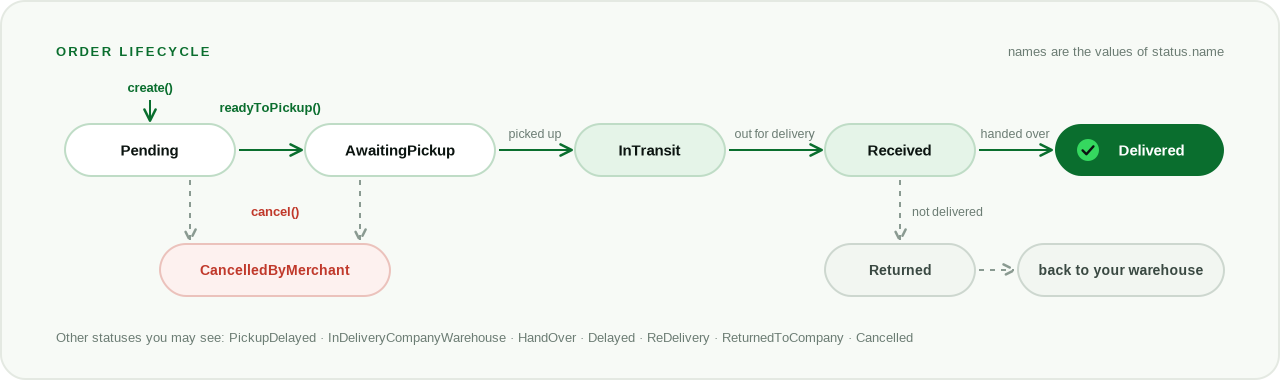
Jayik::orders()->readyToPickup($tr); // Pending -> AwaitingPickup
Jayik::orders()->cancel($tr);        // while Pending, AwaitingPickup or PickupDelayed
Jayik::orders()->delete($id);        // permanent; only while Pending
Tracking numbers
$tr = Jayik::orders()->generateTr();  // "100006537"
Jayik::orders()->trExists('A-1001');  // bool
Warehouses
Warehouses are your pickup points. Pass a warehouse's id as warehouse_id when creating an order.
$warehouse = Jayik::warehouses()->create([
    'name'                    => 'Main store',     // required
    'address'                 => 'Baghdad, Mansour', // required
    'governorate_id'          => 1,                // UUID or number
    'lat'                     => 33.3128,
    'long'                    => 44.3615,
    'phone'                   => '07801234567',
    'secondary_phone'         => null,
    'availability_times_from' => '09:00',
    'availability_times_to'   => '18:00',
    'site_id'                 => 'vendor-42',      // your own reference
]);

Jayik::warehouses()->list($take = 15, $page = 1);
Jayik::warehouses()->lazy();
Jayik::warehouses()->get($id);
Jayik::warehouses()->update($id, ['name' => 'New name', 'governorate_id' => 1]);
Jayik::warehouses()->delete($id);
Jayik::warehouses()->setDefault($id); // used when an order has no warehouse_id
Always send
governorate_idwhen updating. Leaving it out clears the warehouse's governorate.
Business hours
Jayik::warehouses()->businessHours($id);
// [['day' => 'sunday', 'opens_at' => '09:00', 'closes_at' => '17:00', 'is_closed' => false], ...]

Jayik::warehouses()->updateBusinessHours($id, [
    'sunday' => ['is_closed' => false, 'opens_at' => '09:00', 'closes_at' => '17:00'],
    'friday' => ['is_closed' => true],
]); // days you leave out stay as they are
Order categories
Every order needs one of your categories.
$category = Jayik::orderCategories()->create('Clothes');

Jayik::orderCategories()->list($take = 10, $page = 1);
Jayik::orderCategories()->lazy();
Jayik::orderCategories()->get($id);
Jayik::orderCategories()->update($id, 'Fashion');
Jayik::orderCategories()->delete($id);
Jayik::orderCategories()->setDefault($id);
Reference data
These rarely change, so cache them.
$governorates = Cache::remember('jayik.governorates', now()->addDay(), fn () => Jayik::governorates()->all());
// [['id' => '...', 'name' => 'بغداد', 'number' => 1], ...]

Jayik::statuses()->all();     // id, name (stable code), ar_name, en_name, kr_name, color, ...
Jayik::attributes()->all();   // product types for order_items[].attribute_id

// Paged and single lookups
Jayik::governorates()->list($take = 10, $page = 1);
Jayik::governorates()->get($id);
Jayik::statuses()->list();
Jayik::statuses()->get($id);
Jayik::attributes()->list();
Status ids are UUIDs. To filter orders by status, map the stable name to its id once:
use Jayik\Laravel\Support\OrderStatus;

$statusIds = collect(Jayik::statuses()->all())->pluck('id', 'name');

Jayik::orders()->list(['filter' => ['status_id' => $statusIds[OrderStatus::DELIVERED]]]);
Account
$details = Jayik::account()->details();
// ['user' => [...], 'roles' => [...], 'permissions' => [...]]

Jayik::account()->permissions(); // ['merchant-get-order', 'merchant-store-order', ...]
Keys that belong to an employee only have that employee's permissions; a missing permission results in a PermissionDeniedException.
API keys
$key = Jayik::apiKeys()->create('Production server');
$key['key']; // shown only this once — store it now

Jayik::apiKeys()->list();
Jayik::apiKeys()->get($id);                         // never includes the value
Jayik::apiKeys()->update($id, $active = false);     // switch off
Jayik::apiKeys()->update($id, true, 'New label');
Jayik::apiKeys()->regenerate($id);                  // old value stops working immediately
Jayik::apiKeys()->delete($id);
Marketplaces
One Jayik account, many vendors. Create a warehouse per vendor and keep its id:
$warehouse = Jayik::warehouses()->create([
    'name'    => $vendor->name,
    'address' => $vendor->address,
    'site_id' => (string) $vendor->id,
]);

$vendor->update(['jayik_warehouse_id' => $warehouse['id']]);
An order has one pickup point, so a basket with products from several vendors becomes one order per vendor:
foreach ($cart->items->groupBy('vendor_id') as $vendorId => $items) {
    Jayik::orders()->create([
        'warehouse_id'     => $vendors[$vendorId]->jayik_warehouse_id,
        'amount'           => $items->sum('total'),
        'total_products'   => $items->sum('quantity'),
        // customer and destination fields...
    ]);
}
Then list a vendor's orders with 'filter' => ['warehouse_id' => $id].
Each vendor has their own Jayik account. Switch keys per call; the default key is untouched:
Jayik::withKey($vendor->jayik_api_key)->orders()->create([...]);
Webhooks
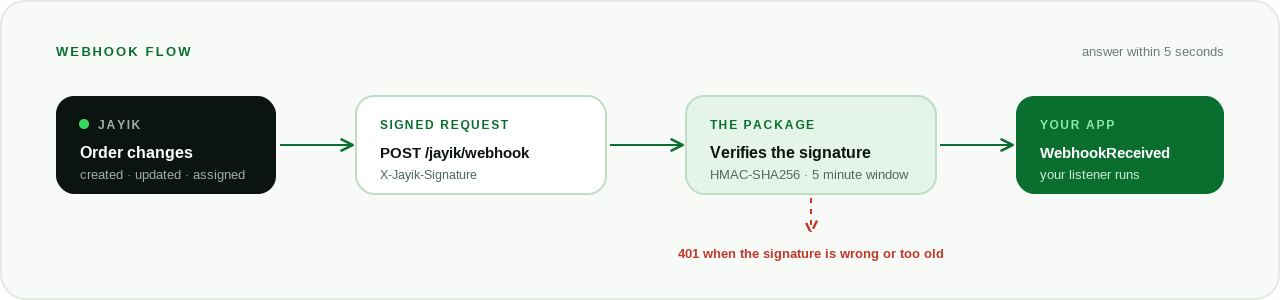
Jayik sends a POST to your URL whenever one of your orders is created or changes. The package registers the route, verifies the signature and dispatches a Laravel event.
1. Register your URL
Jayik::webhook()->set('https://your-app.com/jayik/webhook'); // must be https
Jayik::webhook()->secret(); // "whsec_..." -> put it in JAYIK_WEBHOOK_SECRET
2. Listen
use Illuminate\Support\Facades\Event;
use Jayik\Laravel\Support\OrderStatus;
use Jayik\Laravel\Webhooks\WebhookReceived;

Event::listen(function (WebhookReceived $event) {
    $webhook = $event->webhook;

    if ($webhook->status() === OrderStatus::DELIVERED) {
        Order::where('tracking_number', $webhook->tr())->update(['delivered_at' => now()]);
    }
});
On $event->webhook |
|
|---|---|
->operation |
created, updated, assigned, deleted, restored, forceDeleted |
->order |
The order record as an array (includes driver) |
->payload |
The full decoded body |
->tr() |
Tracking number |
->status() |
Status code, e.g. Delivered |
->driver() |
id, name, phone (null unless enabled for your account) |
->isCreated(), ->isUpdated(), ->isAssigned(), ->isDeleted() |
Shortcuts |
Jayik expects a 2xx answer within 5 seconds. Make slow listeners queued (implements ShouldQueue).
3. Test it
Jayik::webhook()->test();                    // sample data, operation "created"
Jayik::webhook()->test($tr, 'updated');      // a real order's data
Jayik::webhook()->redeliver($tr);            // re-send "created" for an order
Jayik::webhook()->get();                     // current URL, secret and signature scheme
Jayik::webhook()->remove();                  // stop receiving events
How verification works
Each request carries X-Jayik-Timestamp (Unix seconds) and X-Jayik-Signature (sha256= + hex digest). The signature is HMAC-SHA256 of {timestamp}.{raw body} with your webhook secret. Requests with a wrong signature, missing headers, or a timestamp older than the tolerance get a 401, and no event is dispatched.
Using your own route
Turn the built-in route off and protect your own with the jayik.webhook middleware:
JAYIK_WEBHOOK_ROUTE_ENABLED=false
use Jayik\Laravel\Webhooks\WebhookEvent;

Route::post('/hooks/jayik', function (Request $request) {
    $webhook = WebhookEvent::fromRequest($request);
    // ...
    return response()->noContent();
})->middleware('jayik.webhook');
Keep this route out of CSRF protection (routes in routes/api.php already are).
Or verify by hand anywhere:
use Jayik\Laravel\Webhooks\SignatureVerifier;

$valid = app(SignatureVerifier::class)->isValid(
    $request->getContent(),
    $request->header('X-Jayik-Signature'),
    $request->header('X-Jayik-Timestamp')
);
Error handling
Every failed call throws a subclass of Jayik\Laravel\Exceptions\RequestException, which itself extends JayikException.
| Status | Exception | Meaning |
|---|---|---|
| 400 | ValidationException |
Invalid or refused input |
| 401 | AuthenticationException |
Missing or invalid key |
| 403 | PermissionDeniedException |
Inactive account, missing permission, or action not allowed |
| 404 | NotFoundException |
Nothing with that id on your account |
| 409 | ConflictException |
Not possible in the order's current state |
| 422 | UnprocessableException |
Valid request that cannot be carried out |
| 429 | RateLimitException |
Too many requests |
| other | RequestException |
Anything else, e.g. 5xx |
use Jayik\Laravel\Exceptions\RequestException;
use Jayik\Laravel\Exceptions\ValidationException;

try {
    Jayik::orders()->create($data);
} catch (ValidationException $e) {
    $e->errors();     // ['customer_phone' => ['The customer phone field is required.']]
    $e->getMessage(); // first message
} catch (RequestException $e) {
    $e->status();     // HTTP status
    $e->response;     // Illuminate\Http\Client\Response
}
A missing API key throws a JayikException before any request is sent. Network failures surface as Laravel's own Illuminate\Http\Client\ConnectionException.
Rate limits
The API allows 120 requests per minute per account. When it answers 429, the client waits the number of seconds in Retry-After and tries again, up to JAYIK_RATE_LIMIT_RETRIES times. If the wait would be longer than JAYIK_RATE_LIMIT_MAX_WAIT, or retries run out, you get a RateLimitException:
catch (RateLimitException $e) {
    $job->release($e->retryAfter() ?? 60);
}
For bulk work, prefer createBatch() and a larger take over many small calls.
Constants
use Jayik\Laravel\Support\DeliveryType;     // NORMAL (0), FAWRI (1)
use Jayik\Laravel\Support\OrderStatus;
use Jayik\Laravel\Support\WebhookOperation; // CREATED, UPDATED, ASSIGNED, DELETED, RESTORED, FORCE_DELETED
OrderStatus |
Value | Meaning |
|---|---|---|
PENDING |
Pending |
Created, waiting for you to mark it ready |
AWAITING_PICKUP |
AwaitingPickup |
Ready for the driver |
PICKUP_DELAYED |
PickupDelayed |
|
CANCELLED_BY_MERCHANT |
CancelledByMerchant |
|
IN_TRANSIT |
InTransit |
|
IN_DELIVERY_COMPANY_WAREHOUSE |
InDeliveryCompanyWarehouse |
|
RECEIVED |
Received |
With the driver, out for delivery |
HAND_OVER |
HandOver |
|
DELAYED |
Delayed |
|
RE_DELIVERY |
ReDelivery |
|
DELIVERED |
Delivered |
|
RETURNED |
Returned |
|
RETURNED_TO_COMPANY |
ReturnedToCompany |
|
ON_THE_WAY_TO_MERCHANT_WAREHOUSE |
OnTheWayToMerchantWarehouse |
|
RETURNED_TO_MAIN_WAREHOUSE |
ReturnedToMainWarehouse |
|
CANCELLED |
Cancelled |
OrderStatus::CANCELLABLE lists the statuses in which cancel() is allowed.
Testing your app
The package uses Laravel's HTTP client, so Http::fake() works as usual:
use Illuminate\Support\Facades\Http;

Http::fake([
    'api.jayik.app/*' => Http::response([
        'status' => true, 'message' => 'Order Created Successfully',
        'data'   => ['id' => 1, 'tr' => '100006537'],
    ]),
]);

$this->post('/checkout', [...])->assertOk();

Http::assertSent(fn ($request) => $request->url() === 'https://api.jayik.app/api/merchant/v2/orders'
    && $request['amount'] === 25000);
To fake an incoming webhook in a feature test, sign it with the verifier:
$body = json_encode(['opration' => 'updated', 'data' => ['tr' => '100', 'status' => ['name' => 'Delivered']]]);
$time = time();

$this->call('POST', '/jayik/webhook', [], [], [], [
    'CONTENT_TYPE'           => 'application/json',
    'HTTP_X_JAYIK_TIMESTAMP' => (string) $time,
    'HTTP_X_JAYIK_SIGNATURE' => app(\Jayik\Laravel\Webhooks\SignatureVerifier::class)->sign($body, $time),
], $body)->assertOk();
Run the package's own tests with composer test.
Method reference
| Call | Endpoint | Permission |
|---|---|---|
account()->details() |
GET /auth/details |
– |
orders()->list($query) / lazy($query) |
GET /v2/orders |
merchant-get-order |
orders()->get($id, $include) |
GET /v2/orders/{id} |
merchant-show-order |
orders()->findByTr($tr, $include) |
GET /v2/orders?filter[tr]= |
merchant-get-order |
orders()->create($order) |
POST /v2/orders |
merchant-store-order |
orders()->createBatch($orders) |
POST /v2/orders/batch |
merchant-store-order |
orders()->generateTr() |
GET /v2/orders/generate-tr |
– |
orders()->trExists($tr) |
GET /v2/orders/tr-exists/{tr} |
– |
orders()->cancel($tr) |
PUT /v2/orders/cancel |
merchant-cancel-order |
orders()->readyToPickup($tr) |
PUT /v2/orders/ready-to-pickup |
merchant-update-order |
orders()->delete($id) |
DELETE /v2/orders/{id} |
merchant-delete-order |
warehouses()->list() / lazy() |
GET /v2/warehouses |
merchant-get-warehouse |
warehouses()->get($id) |
GET /v2/warehouses/{id} |
merchant-show-warehouse |
warehouses()->create($data) |
POST /v2/warehouses |
merchant-store-warehouse |
warehouses()->update($id, $data) |
PUT /v2/warehouses/{id} |
merchant-update-warehouse |
warehouses()->delete($id) |
DELETE /v2/warehouses/{id} |
merchant-delete-warehouse |
warehouses()->setDefault($id) |
PUT /v2/warehouses/default |
merchant-update-DefaultWarehouse |
warehouses()->businessHours($id) |
GET /v2/warehouses/{id}/business-hours |
– |
warehouses()->updateBusinessHours($id, $hours) |
PUT /v2/warehouses/{id}/business-hours |
merchant-update-warehouse |
orderCategories()->list() / lazy() |
GET /v2/order-categories |
merchant-get-orderCategory |
orderCategories()->get($id) |
GET /v2/order-categories/{id} |
merchant-show-orderCategory |
orderCategories()->create($name) |
POST /v2/order-categories |
merchant-store-orderCategory |
orderCategories()->update($id, $name) |
PUT /v2/order-categories/{id} |
merchant-update-orderCategory |
orderCategories()->delete($id) |
DELETE /v2/order-categories/{id} |
merchant-delete-orderCategory |
orderCategories()->setDefault($id) |
PUT /v2/order-categories/default |
merchant-update-DefaultCategory |
governorates()->list() / all() |
GET /v2/governorates |
– |
governorates()->get($id) |
GET /v2/governorates/{id} |
– |
statuses()->list() / all() |
GET /v2/statuses |
– |
statuses()->get($id) |
GET /v2/statuses/{id} |
– |
attributes()->list() / all() |
GET /v2/attributes |
– |
webhook()->get() / secret() |
GET /v2/webhook |
merchant-get-webhook |
webhook()->set($url) / remove() |
PUT /v2/webhook |
merchant-store-webhook |
webhook()->test($tr, $operation) |
POST /v2/webhook/test |
merchant-send-webhook |
webhook()->redeliver($tr) |
POST /v2/webhook/deliveries/{tr} |
merchant-send-webhook |
apiKeys()->list() |
GET /v2/api-keys |
merchant-get-apiKey |
apiKeys()->get($id) |
GET /v2/api-keys/{id} |
merchant-show-apiKey |
apiKeys()->create($description) |
POST /v2/api-keys |
merchant-store-apiKey |
apiKeys()->regenerate($id) |
POST /v2/api-keys/regenerate |
merchant-re-generate-apiKey |
apiKeys()->update($id, $active, $description) |
PUT /v2/api-keys/{id} |
merchant-update-apiKey |
apiKeys()->delete($id) |
DELETE /v2/api-keys/{id} |
merchant-delete-apiKey |
For an endpoint the package does not wrap yet, use the client directly:
Jayik::client()->get('v2/something', ['take' => 10]);
Jayik::client()->post('v2/something', ['field' => 'value']);
License
MIT. See LICENSE.