
idct / php-rapid-cache-client

High-performance Redis/Valkey-backed PSR-16 cache client for PHP, extended with tag-based invalidation, queues, sets, sorted sets, and atomic counters.
Requires
- php: ^8.2
- ext-igbinary: *
- ext-redis: *
- psr/simple-cache: ^3.0
Requires (Dev)
- behat/behat: ^3.31
- friendsofphp/php-cs-fixer: ^3.95
- infection/infection: ^0.32
- php-mock/php-mock: ^2.7
- php-mock/php-mock-phpunit: ^2.15
- phpstan/phpstan: ^2.0
- phpstan/phpstan-phpunit: ^2.0
- phpstan/phpstan-strict-rules: ^2.0
- phpunit/phpunit: ^11.5
Suggests
None
Provides
Conflicts
None
Replaces
None
README

IDCT Rapid Cache Client is a high-performance Redis-backed caching library
for PHP. At its core it is a clean PSR-16 (SimpleCache)
implementation, so it drops straight into any framework or library that speaks
the standard cache contract. On top of that baseline it adds the features real
applications keep reaching for but PSR-16 leaves out: tag-based grouping and
invalidation, FIFO queues, sets, sorted sets, and atomic counters - all
exposed through the CacheServiceInterface contract.
The package ships two clients that share the same PSR-16 + tagging surface but differ in how values land in Redis:
RapidCacheClient— the general-purpose client. Stores any serializable PHP value (objects, nested arrays,DateTime, …) as a single Redis STRING using the compact binaryext-igbinaryserializer. Adds queues, sets, sorted sets, and whole-value counters on top.HashRapidCacheClient— purpose-built for flat associative arrays of scalars. Each value is stored as a native Redis HASH so individual fields can be read, written, or atomically incremented without round-tripping the whole record (HGET/HSET/HINCRBY). No serializer — the wire format is plain Redis hash fields.
Speed comes from two deliberate choices: both clients talk to Redis (or any
Redis-compatible server such as Valkey) through the
native ext-redis C extension, and the string client serializes values with
ext-igbinary so arbitrary PHP values round-trip losslessly and cheaply.
Bulk operations are pipelined and chunked, connections are established
lazily and re-established transparently, and every Redis-level error is
translated into a PSR-16 exception so your calling code stays
backend-agnostic.
Quick example
<?php

use IDCT\Cache\RapidCacheClient;

// host, port, optional key prefix
$cache = new RapidCacheClient('localhost', 6379, 'myapp:');

// Store any serializable value, optionally with a TTL (seconds or DateInterval)
$cache->set('user.123', ['name' => 'John Doe', 'roles' => ['admin']], 3600);

// Read it back (returns the supplied default on a miss)
$user = $cache->get('user.123', $default = null);

// Group entries under a tag, then invalidate the whole group at once
$cache->setTagged('user.123', $user, 'active-users');
$cache->clearByTag('active-users');
…and the same surface as a Redis HASH when the value is a flat record and you want per-field reads / writes / atomic counters:
use IDCT\Cache\HashRapidCacheClient;

$hash = new HashRapidCacheClient('localhost', 6379, 'myapp:');

// Whole hash in one round-trip
$hash->set('user.123', ['name' => 'John Doe', 'visits' => 0, 'plan' => 'pro'], 3600);

// Single-field operations - no need to fetch the whole record
$plan = $hash->getField('user.123', 'plan');                  // HGET
$hash->setField('user.123', 'last_seen', '2026-05-28');       // HSET
$visits = $hash->incrementField('user.123', 'visits', 1);     // HINCRBY - atomic
Features
Shared by both clients:
- PSR-16 SimpleCache - drop-in compatible with any PSR-16 consumer
(implements
Psr\SimpleCache\CacheInterface). - Core cache operations -
get,set,delete,clear,has, plus the multi-key variantsgetMultiple,setMultiple,deleteMultiple. - Atomic take -
take()reads a key and removes it in one indivisible step, so a value can be claimed exactly once even when several processes go for it together. PSR-16 alone cannot express this. - Flexible TTLs -
intseconds or\DateInterval; a non-positive TTL deletes the entry, per the spec. - Tagging system - associate keys with tags (
setTagged,tag,untag) and read or invalidate them in bulk (getTagged,clearByTag,getTagCardinality). Each client uses its own tag-index namespace so the two can coexist on the same Redis instance without colliding. - Key namespacing - an optional prefix isolates your keys on a shared
Redis instance;
clear()is prefix-scoped and never touches other apps' data. - Resilient connections - lazy connect, transparent reconnect, optional retry-once on transient errors, and PSR-16 exception translation.
- Tunable performance - configurable pipeline batch size, persistent
connections, and finite connect/read timeouts via
RedisConnectionConfig.
Specific to RapidCacheClient:
- Lossless serialization - igbinary handles objects, nested arrays,
DateTime, etc., automatically. - Queues - Redis lists used as FIFO queues:
enqueue,pop,peek,getQueue,getQueueLength. - Sets - unique collections:
createSet,addToSet,removeFromSet,getSet,getCardinality. - Sorted sets - ordered, value-resolving iteration via
getSorted. - Atomic counters -
increase/decreasebacked by RedisINCRBY/DECRBY.
Specific to HashRapidCacheClient:
- Native Redis HASH storage - each value is a flat associative array of scalars stored field-for-field as a Redis HASH; no serializer, no whole-value round-trips for a single-field read.
- Single- and multi-field operations -
getField/setField/hasField/deleteField(HGET/HSET/HEXISTS/HDEL) and the bulk formsgetFields/setFields/deleteFields(HMGET/HMSET/HDEL). - Atomic field counters -
incrementField/decrementFieldbacked by RedisHINCRBY/HINCRBYFLOAToperate in place on individual fields.
Sponsorship ❤️
This project is maintained on the side and looking for sponsors to keep the modernization moving forward. If your team relies on it, please consider chipping in - every contribution helps keep this library alive:
Thank you to everyone who already supports the project! 🙏
Contents
- Quick example
- Features
- Sponsorship ❤️
- Requirements
- Benchmarks
- Installation
- Testing
- Usage
- Contributing
- License
- Thank you
Requirements
- PHP 8.2 or higher
ext-redis(phpredis) - built with igbinary supportext-igbinary- A Redis server (6.0+) or any Redis-compatible server such as Valkey (the test suite runs against Valkey 7.2)
Benchmarks
The package ships with a self-benchmark that measures the throughput of both clients' operations against the same Valkey/Redis instance. There is no cross-library comparison - it answers "how many of each operation does each client sustain per second on this host". Results are grouped into six categories:
RapidCacheClient→ Core, Tagging, CountersHashRapidCacheClient→ Hash Core, Hash Fields, Hash Tagging, Hash Counters
The chart is regenerated by CI and published to the assets branch:
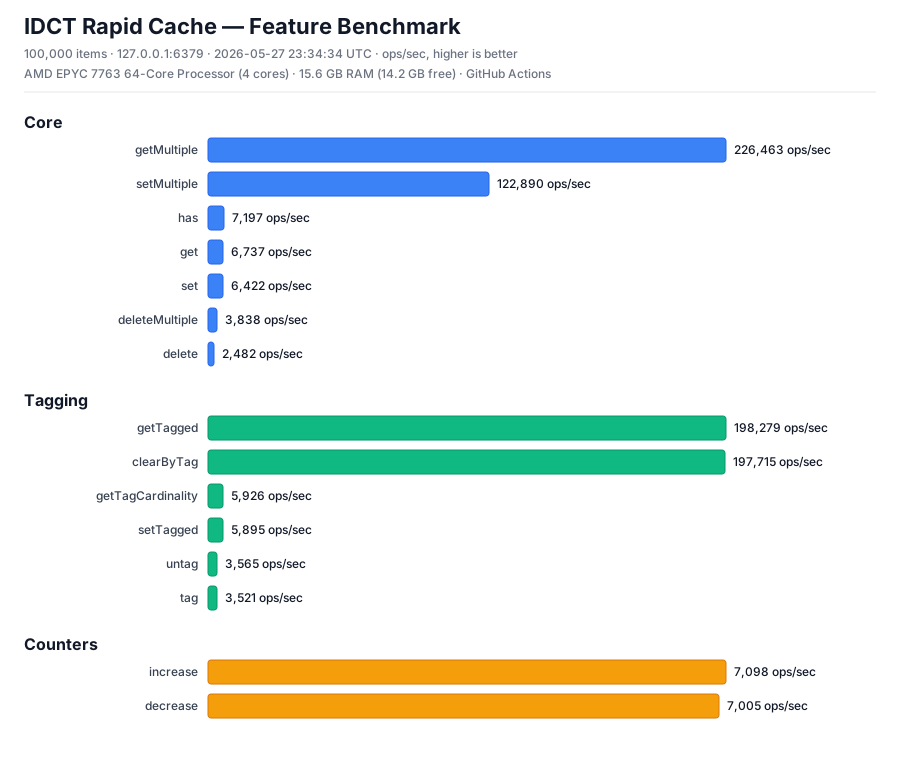
Each bar is one operation, in operations per second (higher is better), on a scale local to its category. The useful signal is the shape, not the absolute height:
- Single-key operations (
set,get,setTagged,increase,getField, …) each cost one network round-trip, so they cluster together - that floor is the round-trip latency to your Redis, not RapidCache's own overhead. - Pipelined / bulk operations are far faster because they amortise
round-trips:
setMultiple/getMultiplechunk many keys per call, andgetTagged/clearByTagresolve an entire tag withSMEMBERS+ a singleMGETor batched delete. This is the throughput path - prefer the multi-key and tag-bulk APIs in hot loops. - The hash client's field-level operations (
getField,setField,incrementField, …) cost the same single round-trip as a whole-valueget/setbut move only the affected field over the wire - the win is bandwidth and contention on big records, not raw ops/sec.
Absolute numbers depend entirely on the runner hardware and the network path to Redis - treat the chart as the relative cost of single round-trips vs. pipelined work, not a guaranteed throughput figure.
Reproduce locally from the benchmark/ directory (see its
README for all options):
cd benchmark
composer install
make benchmark-quick   # 10k items, writes report.html + benchmark.svg
Installation
Install the package with Composer:
composer require idct/php-rapid-cache-client
Make sure the required PHP extensions are present:
# Ubuntu/Debian
sudo apt-get install php-redis php-igbinary

# CentOS/RHEL
sudo yum install php-redis php-igbinary

# Or via PECL (answer "yes" to enable igbinary support when building redis)
pecl install redis igbinary
Verify they are loaded:
php -m | grep -E '(redis|igbinary)'
php --ri redis | grep -i igbinary   # should report igbinary support => enabled
Testing
The library ships with a PHPUnit unit suite (100% line/method coverage) and a Behat functional suite that runs against a real Valkey container. The Composer scripts start and stop the container for you via Docker Compose, so you only need Docker installed - not a local Redis.
composer install

composer test          # full gate: install + unit + functional
composer test:unit     # PHPUnit unit tests (with coverage)
composer test:bdd      # Behat functional tests
composer test:unit-no-coverage   # faster unit run while iterating
Quality tooling:
composer analyse       # PHPStan (level 8)
composer fix           # php-cs-fixer (PSR-12 + Symfony rules)
composer test:mutation # Infection mutation testing
Managing the Valkey container by hand (exposed on host port 6380):
composer redis:start   # docker compose up -d valkey
composer redis:stop    # docker compose down
composer test:connection
composer clean         # down -v + docker system prune
Developing the library itself? See HUMANS.md for a full contributor guide and AGENTS.md for the rules AI agents follow.
Usage
Connecting & configuration
The simplest form takes a host, port, and optional key prefix:
use IDCT\Cache\RapidCacheClient;

$cache = new RapidCacheClient('localhost', 6379);

// A prefix is strongly recommended on a shared Redis instance - it namespaces
// every key and scopes clear() so it never deletes other apps' data.
$cache = new RapidCacheClient('localhost', 6379, 'myapp:');
For full control (authentication, database selection, timeouts, persistent
connections, retry behavior, pipeline batch size) pass a
RedisConnectionConfig. It is an immutable value object whose defaults are
tuned for safe production behavior (a finite 1s connect timeout, non-persistent
connections):
use IDCT\Cache\RapidCacheClient;
use IDCT\Cache\RedisConnectionConfig;

$config = new RedisConnectionConfig(
    host: 'cache.internal',
    port: 6379,
    prefix: 'myapp:',
    password: 's3cr3t',      // null/empty → no AUTH
    database: 1,             // SELECT this DB (0 = none)
    connectTimeout: 1.0,     // seconds; phpredis default of 0 means "wait forever"
    readTimeout: 1.0,        // seconds; only applied when > 0
    persistent: true,        // reuse the connection across requests (pconnect)
    persistentId: 'pool1',   // pool id for persistent connections
    retryOnce: true,         // retry a failed op once on a transient RedisException
    pipelineBatchSize: 1000, // max commands per pipelined/multi-key batch
);

$cache = new RapidCacheClient($config);
No socket is opened during construction - the connection is established lazily on the first cache operation and re-established automatically if it drops.
Basic cache operations (PSR-16)
// Store a value (returns bool)
$cache->set('user.123', ['name' => 'John Doe', 'email' => 'john@example.com']);

// Retrieve a value ($default is returned only on a true miss)
$user = $cache->get('user.123');
$user = $cache->get('user.123', $defaultValue);

// Store with a TTL - int seconds or a DateInterval
$cache->set('session.abc', $sessionData, 3600);
$cache->set('session.abc', $sessionData, new DateInterval('PT1H'));

// Check existence (a fast probe - not a guarantee against a concurrent expiry)
if ($cache->has('user.123')) {
    // ...
}

// Delete a single key / clear the (prefix-scoped) cache
$cache->delete('user.123');
$cache->clear();
take() - claim a value exactly once
get() then delete() leaves a window in which another client reads the same
value, so two callers can both believe they claimed it. take() closes it:
$cache->set('reset.token.abc', ['user_id' => 123]);

$payload = $cache->take('reset.token.abc');   // ['user_id' => 123], key is gone
$payload = $cache->take('reset.token.abc');   // null - nobody else can get it
$payload = $cache->take('missing', 'default');
EXISTS and GETDEL are issued inside one MULTI/EXEC, so the read and the
removal are indivisible. EXISTS rides along purely to tell a stored literal
false from a miss, the same distinction get() makes. Tag associations are
cleaned up exactly as delete() does.
Under eight processes racing for one key, take() produced exactly one winner
where get() plus delete() produced seven.
Use it for anything meant to be consumed once: single-use tokens, job claims, one-shot coupons, idempotency keys.
Requires Redis or Valkey 6.2+, the release that introduced
GETDEL.HashRapidCacheClientoffers the same method, backed byHGETALL+DELin one transaction.
PSR-16 key rules - keys must be non-empty strings; the characters
{}()/\@:are reserved and rejected with aPsr\SimpleCache\InvalidArgumentException. A TTL of0(or negative) deletes the entry immediately, per the spec.
Bulk operations
Multi-key operations are pipelined and automatically chunked by the configured
pipelineBatchSize, keeping request size bounded on large inputs:
// Store many at once (single MSET, or a pipelined SETEX batch when a TTL is given)
$cache->setMultiple(['k1' => 'v1', 'k2' => 'v2'], 60);

// Read many at once (single MGET); missing keys map to the default
$values = $cache->getMultiple(['k1', 'k2', 'k3'], 'fallback');

// Delete many at once (with tag cleanup per key)
$cache->deleteMultiple(['k1', 'k2']);
Tagging
Tags group related entries so you can read or invalidate them as a unit. Since
PSR-16 set() does not take a tag, use setTagged() or call tag() after a
plain set():
// Store and tag in one atomic call (optionally with a TTL)
$cache->setTagged('user.123', $userData, 'active-users');
$cache->setTagged('user.456', $otherUser, 'active-users', 3600);

// Or set first, tag later (the key must already exist)
$cache->set('post.789', $postData);
$cache->tag('post.789', 'posts');

// Iterate every value currently under a tag (key => value)
foreach ($cache->getTagged('active-users') as $key => $value) {
    echo "$key => " . json_encode($value) . PHP_EOL;
}

// Remove a single tag association (the value itself is kept)
$cache->untag('user.123', 'active-users');

// Count, then bulk-invalidate everything under a tag
$count = $cache->getTagCardinality('active-users');
$cache->clearByTag('active-users');
Queues
Redis lists used as FIFO queues:
// Append items to the tail
$cache->enqueue('email-queue', ['to' => 'user@example.com', 'subject' => 'Welcome']);
$cache->enqueue('email-queue', ['to' => 'admin@example.com', 'subject' => 'New user']);

// Pop items from the head (FIFO). Returns null when empty.
while ($email = $cache->pop('email-queue')) {
    echo 'Sending to: ' . $email['to'] . PHP_EOL;
}

// Pop several at once
$batch = $cache->pop('email-queue', 10);   // array of up to 10 items, or null

// Inspect without removing
$next  = $cache->peek('email-queue');       // head item, or null
$firstFive = $cache->peek('email-queue', 5);

// Length, or the full contents (head-first; O(N))
$length = $cache->getQueueLength('email-queue');
$all    = $cache->getQueue('email-queue');
enqueue()rejectsnullvalues: phpredis cannot tell a storednullapart from "queue is empty" on pop.
Sets
Unique, unordered collections:
// Replace the whole set with an exact membership (DEL + SADD)
$cache->createSet('user-roles:123', ['admin', 'editor', 'viewer']);

// Incremental changes
$cache->addToSet('user-roles:123', 'moderator');
$cache->removeFromSet('user-roles:123', 'viewer');

// Read all members (null when the set does not exist)
$roles = $cache->getSet('user-roles:123');

// Member count
$count = $cache->getCardinality('user-roles:123');
Sorted sets
getSorted() treats a Redis sorted set as an ordered index of cache keys: it
reads a window of members and resolves each member's cached value, pruning any
member whose underlying key has expired. Use reversed: true for
highest-score-first ordering.
// Top 10 of a leaderboard (highest score first), as member => cachedValue
foreach ($cache->getSorted('leaderboard', count: 10, offset: 0, reversed: true) as $member => $value) {
    echo "$member => " . json_encode($value) . PHP_EOL;
}

// Count of a sorted set (pass true so ZCARD is used instead of SCARD)
$players = $cache->getCardinality('leaderboard', sortedSet: true);
Atomic counters
Backed by Redis INCRBY / DECRBY (the key is auto-created at 0):
$cache->set('page-views', 0);
$cache->increase('page-views', 1);
$cache->decrease('page-views', 1);

$views = $cache->get('page-views');
Hash storage (HashRapidCacheClient)
Use HashRapidCacheClient when each cached value is a flat associative
array of scalars (a record) and you want to read, write, or atomically
modify individual fields without ever round-tripping the whole record. Each
value lives in Redis as a native HASH, indexed by field name — there is no
serializer involved, so wire payloads are plain Redis hash fields.
use IDCT\Cache\HashRapidCacheClient;

$hash = new HashRapidCacheClient('localhost', 6379, 'myapp:');

// PSR-16 surface works as expected; values must be a non-empty flat
// associative array of string/int/float scalars.
$hash->set('user.123', [
    'name'  => 'John Doe',
    'plan'  => 'pro',
    'score' => 1000,
], 3600);

// Whole-record read returns the hash as a flat array
$user = $hash->get('user.123');           // ['name' => 'John Doe', …]
Single-field operations don't move the rest of the record across the wire:
$plan = $hash->getField('user.123', 'plan');                 // HGET
$hash->setField('user.123', 'last_seen', '2026-05-28');      // HSET
$hash->deleteField('user.123', 'score');                     // HDEL
if ($hash->hasField('user.123', 'plan')) { … }               // HEXISTS
Multi-field reads/writes:
// Read several fields at once
$slice = $hash->getFields('user.123', ['name', 'plan']);     // HMGET
//   ['name' => 'John Doe', 'plan' => 'pro']

// Merge fields into the existing record (does NOT clear unrelated fields)
$hash->setFields('user.123', ['score' => 2000, 'plan' => 'enterprise']);

// Remove several fields at once
$hash->deleteFields('user.123', ['score', 'last_seen']);     // HDEL …
Atomic counters operate in place on a single field, so multiple processes can hit the same counter without a read-modify-write cycle:
$views = $hash->incrementField('page.views', 'count', 1);    // HINCRBY
$saved = $hash->incrementField('account.42', 'balance', 9.99); // HINCRBYFLOAT
$hash->decrementField('inventory.sku-7', 'stock', 1);
Tagging mirrors the string client and uses a separate index namespace
(H_TAG: / H_TAGS:) so both clients can share the same Redis prefix
without colliding:
$hash->setTagged('user.123', $userRecord, 'active-users', 3600);
foreach ($hash->getTagged('active-users') as $key => $record) { … }
$hash->clearByTag('active-users');
What you give up vs. RapidCacheClient:
- No type fidelity beyond scalars.
bool,null, nested arrays, objects, resources are rejected atset()withPsr\SimpleCache\InvalidArgumentException. UseRapidCacheClient(with igbinary) when the cached value isn't a flat record. - No per-field TTL. The whole hash expires as a unit via
PEXPIRE. Set the TTL onset(); subsequentsetField()calls leave the existing TTL in place. - Queues / sets / sorted sets are not exposed — those live on
RapidCacheClientand can be used side-by-side on the same connection.
Error handling
Argument-validation problems are thrown as
IDCT\Cache\Exception\InvalidArgumentException, and storage/transport failures
as IDCT\Cache\Exception\CacheException. Both implement the matching PSR-16
marker interfaces, so PSR-16 consumers can catch them through the standard
contract and stay backend-agnostic:
use Psr\SimpleCache\InvalidArgumentException;
use Psr\SimpleCache\CacheException;

try {
    $cache->get('illegal:key');     // reserved character → InvalidArgumentException
} catch (InvalidArgumentException $e) {
    // bad input on our side
} catch (CacheException $e) {
    // the cache backend failed (the original RedisException is the chained cause)
}
Behavior notes
clear()is prefix-scoped. With a prefix configured it usesSCAN+UNLINKto remove only keys under that prefix; with no prefix it falls back toFLUSHDB(current database only). It never callsFLUSHALL, so it will not destroy unrelated data on a shared Redis instance.get()distinguishes a storedfalsefrom a miss. Because the igbinary serializer makes a stored literalfalseindistinguishable from a missing key at the protocol level,get()adds anEXISTSprobe: it returns the storedfalsewhen the key exists, and the$defaultonly on a true miss.getMultiple()does not disambiguate. For throughput it issues a singleMGETwith no per-keyEXISTSprobe, so both a missing key and a storedfalsemap to the default. Useget()per key when that distinction matters.- Tags read the current value. Tagged-key membership is stored in a Redis
SETatTAG:<tag>; member values are resolved at read time viaMGET, sogetTagged()always returns each key's current value - an overwrite viaset()aftersetTagged()is reflected immediately. - Self-healing reads.
getTagged()andgetSorted()prune entries whose underlying key has expired as a side effect of iteration. Breaking out of the generator early leaves the un-inspected entries for the next call.
Contributing
Contributions are welcome! In short:
- Fork the repository and create a feature branch
(
git checkout -b feature/your-feature). - Make your change with tests and documentation. The project keeps 100% unit-test coverage, passes PHPStan level 8, follows PSR-12 + strict types, and is mutation-tested - new branches need matching tests.
- Run the full gate before opening a PR:
composer test      # unit + functional
composer analyse   # PHPStan
composer fix       # php-cs-fixer
- Open a Pull Request against
mainwith a clear description, and call out any breaking changes explicitly.
When reporting an issue, please include your PHP version, Redis/Valkey version, the library version, a minimal reproduction, and the full error and stack trace.
Full contributor documentation lives in HUMANS.md; the conventions AI agents must follow are in AGENTS.md.
- Issues: GitHub Issues
- Discussions: GitHub Discussions
License
This project is licensed under the MIT License. See the LICENSE file for details.
Thank you
Thank you for using and supporting IDCT Rapid Cache Client - whether by filing issues, opening pull requests, spreading the word, or sponsoring the project. Every bit of help keeps the modernization moving and the library alive. 🙏