
asignua / filament-translation-manager

Database-backed translation manager for Filament 5: edit, search, scan and quick-translate every __() string per locale, with a topbar language switcher. Successor of kenepa/translation-manager, built on spatie/laravel-translation-loader.
Package info
github.com/asignua/filament-translation-manager
pkg:composer/asignua/filament-translation-manager
Requires
- php: ^8.3
- filament/filament: ^5.0
- illuminate/contracts: ^12.0|^13.0
- spatie/laravel-package-tools: ^1.16
- spatie/laravel-translation-loader: ^2.8
- symfony/finder: ^7.0|^8.0
Requires (Dev)
- larastan/larastan: ^3.0
- laravel/pint: ^1.18
- orchestra/testbench: ^10.0|^11.0
- phpunit/phpunit: ^11.5|^12.0
Suggests
None
Provides
None
Conflicts
None
Replaces
None
README

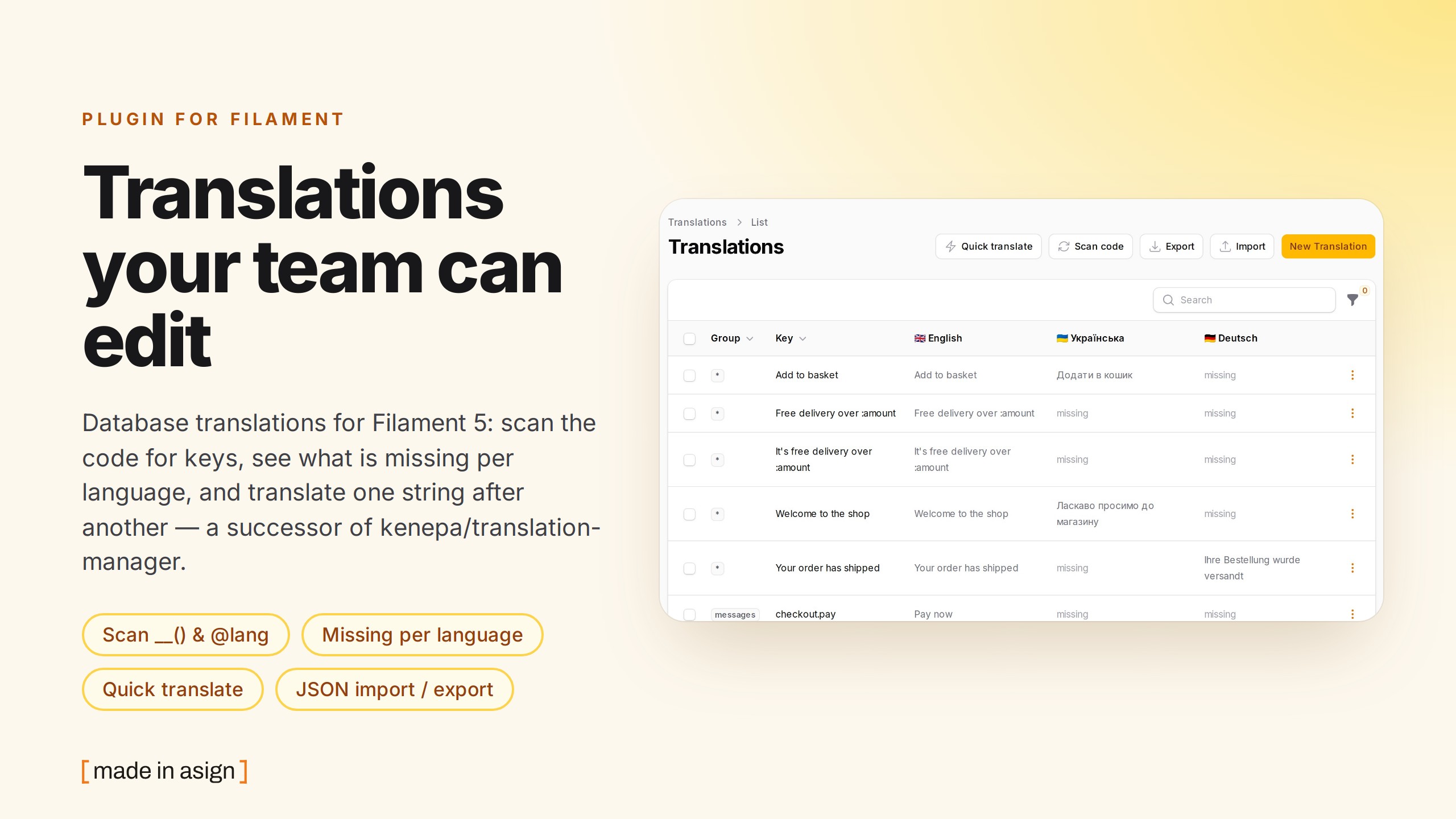
Edit every __('...') string of your Laravel app from the Filament panel, per language, without a deploy. Texts live in the
database (spatie/laravel-translation-loader) and override the lang
files, so the files stay your defaults. A scan finds the strings in your code for you, a filter shows what is still missing in a
language, and a quick-translate page walks you through the gaps one by one.
It is the successor of kenepa/translation-manager, which never shipped Filament 5, on the same storage (language_lines), the
same gate and the same config keys, so an existing project moves over without touching its data (see
Migrating from kenepa/translation-manager).
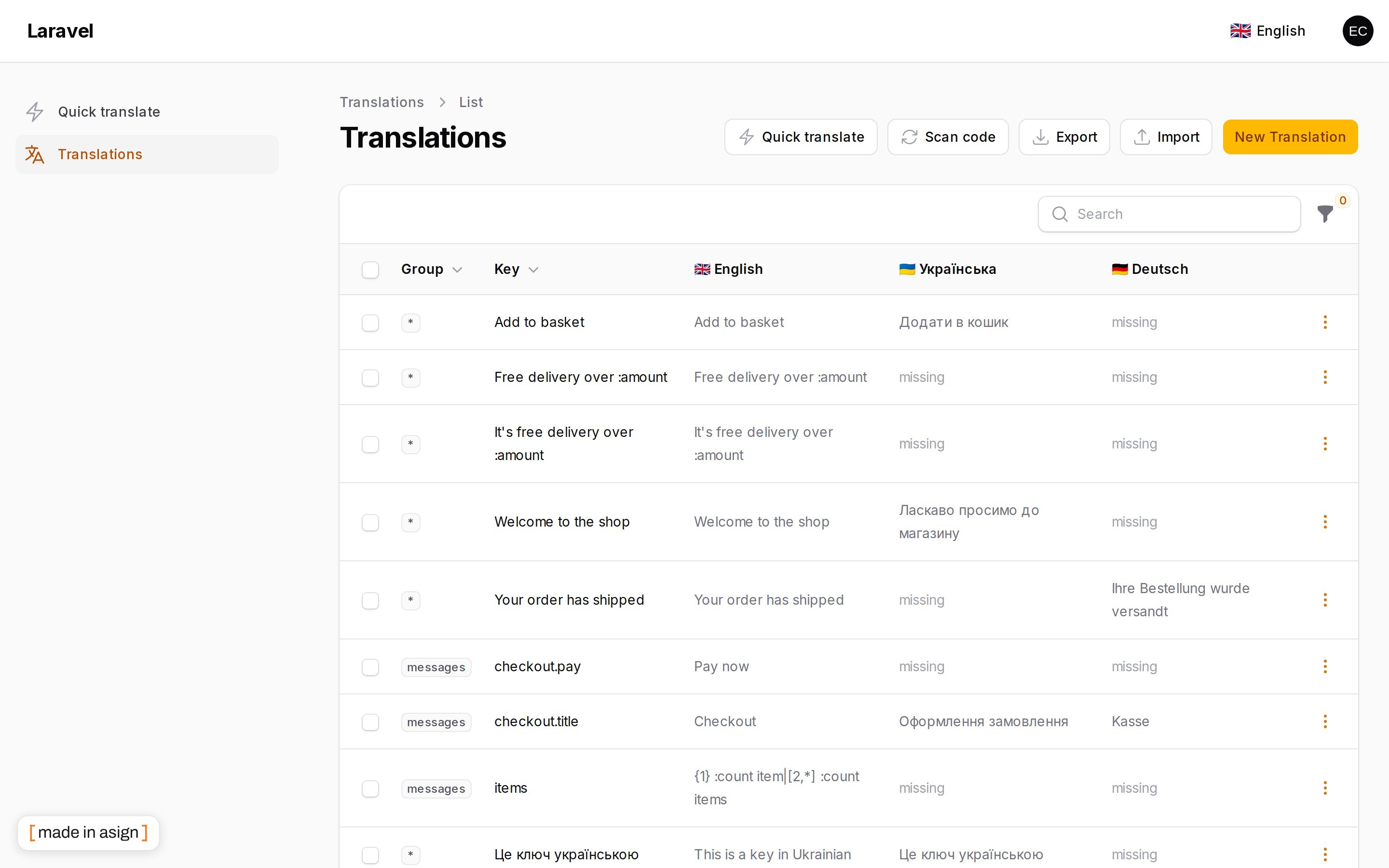
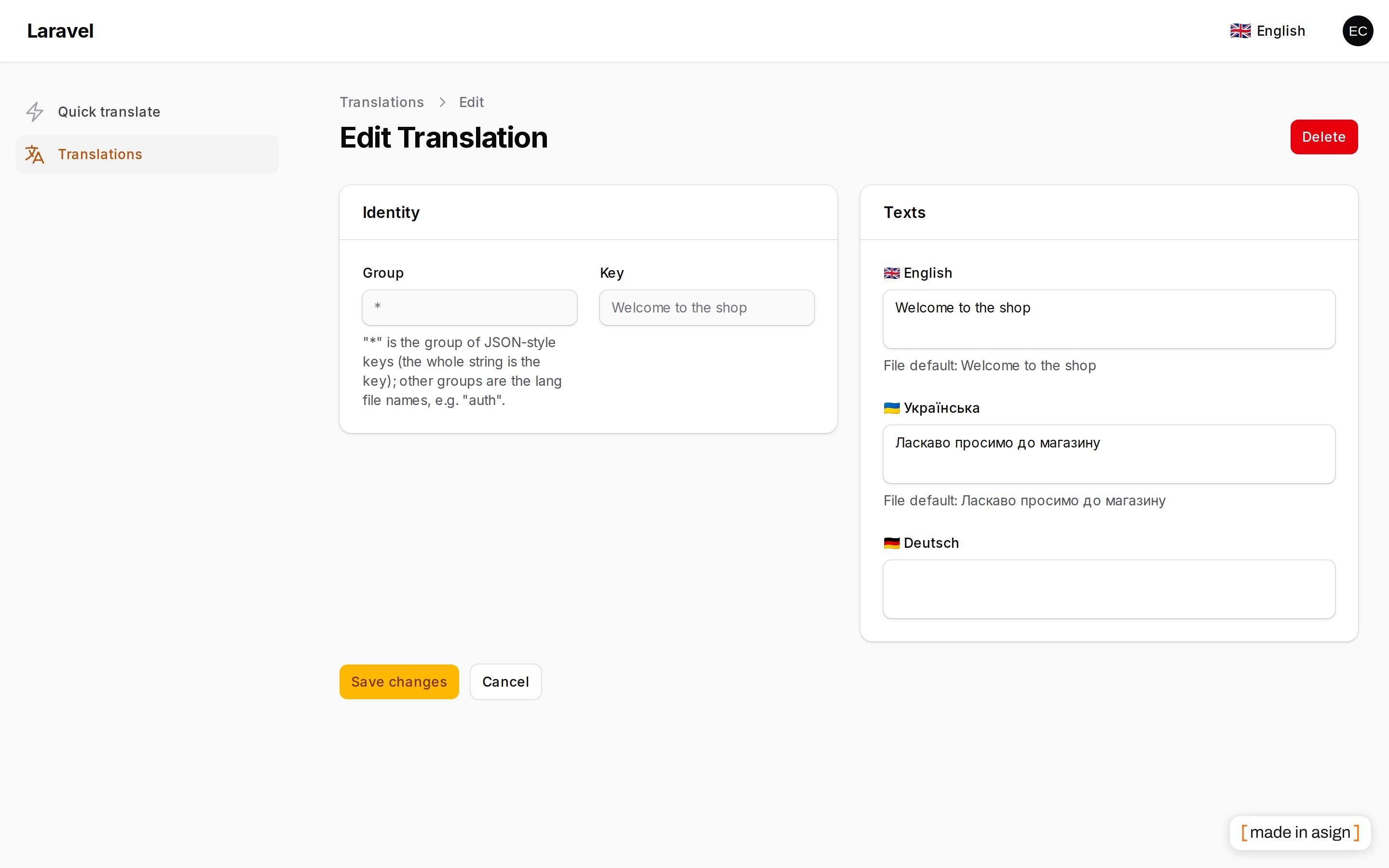
- Searchable table: group, key and one column per language. One search box looks in the key and in every text.
- "Missing in" filter (pick one or several languages) and "Missing in any language".
- Edit form with a field per language; the lang-file value is shown under it as a hint.
- Scan: finds
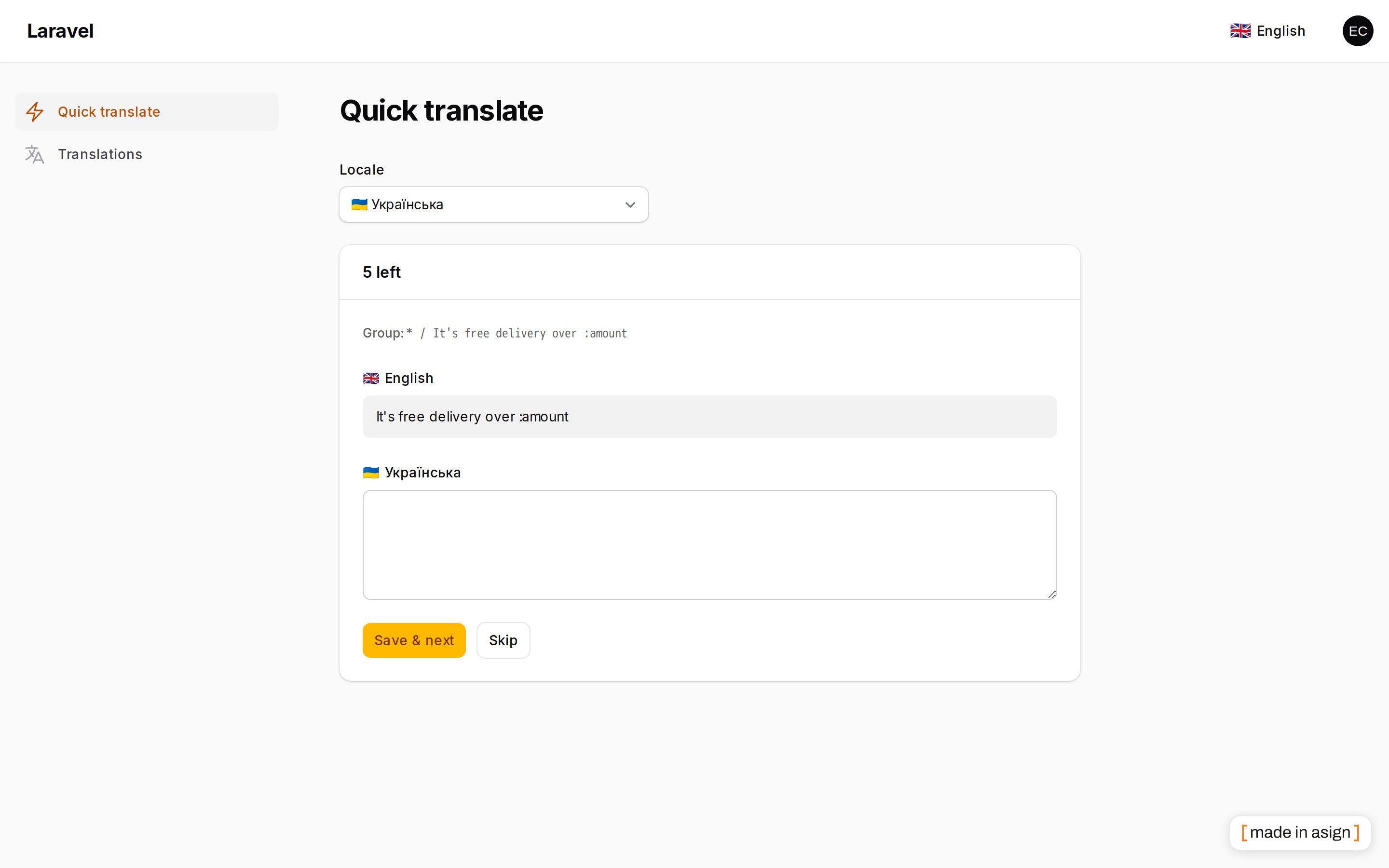
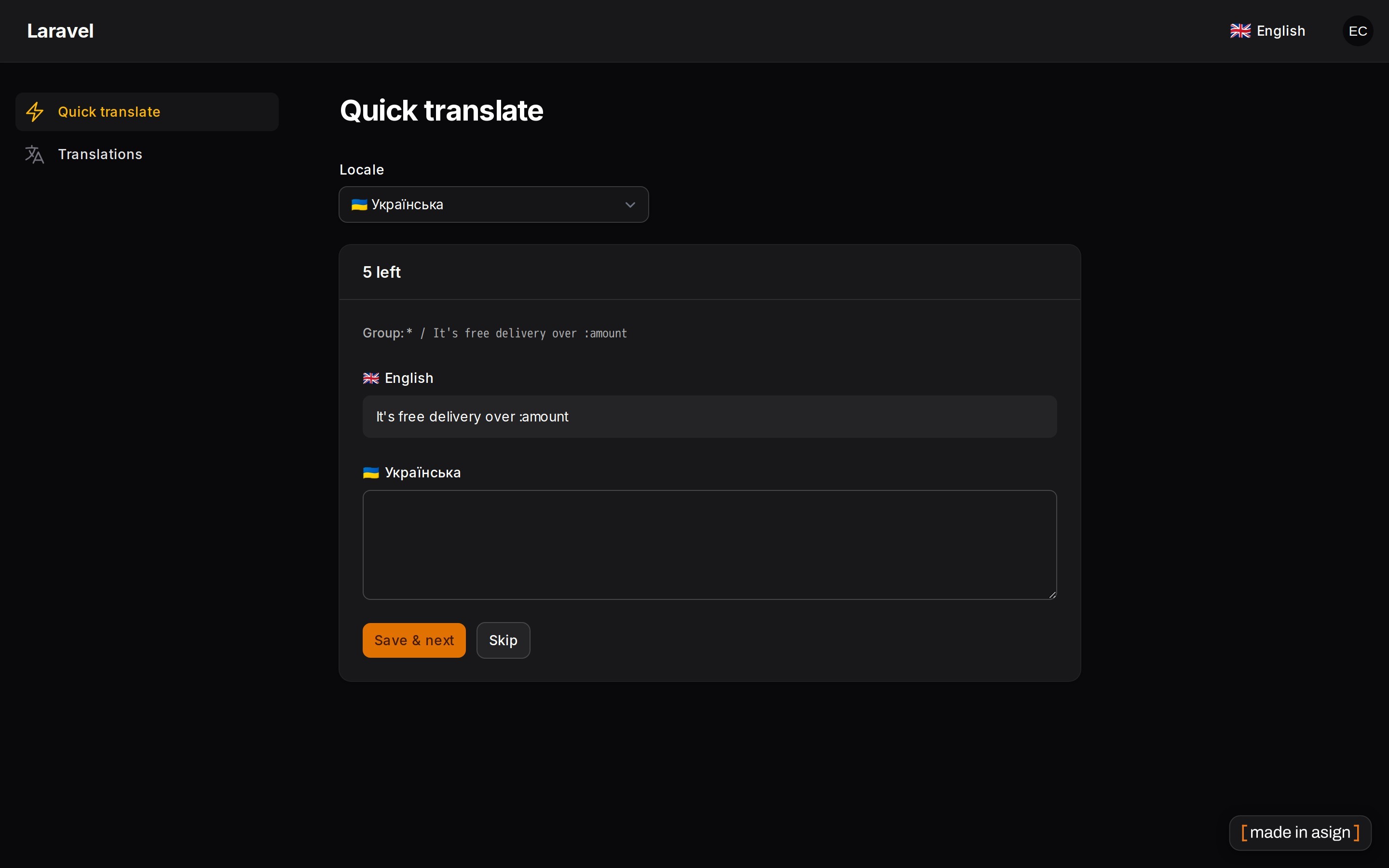
__(),trans(),trans_choice(),@langandLang::get()in your code, plus your lang files (PHP groups and JSON), and adds the missing rows. A text you edited is never overwritten. Also asphp artisan translation-manager:scan. - Quick translate page: the next missing text for a language, the other languages shown as the source, "Save & next".
- JSON export / import per language (the format of
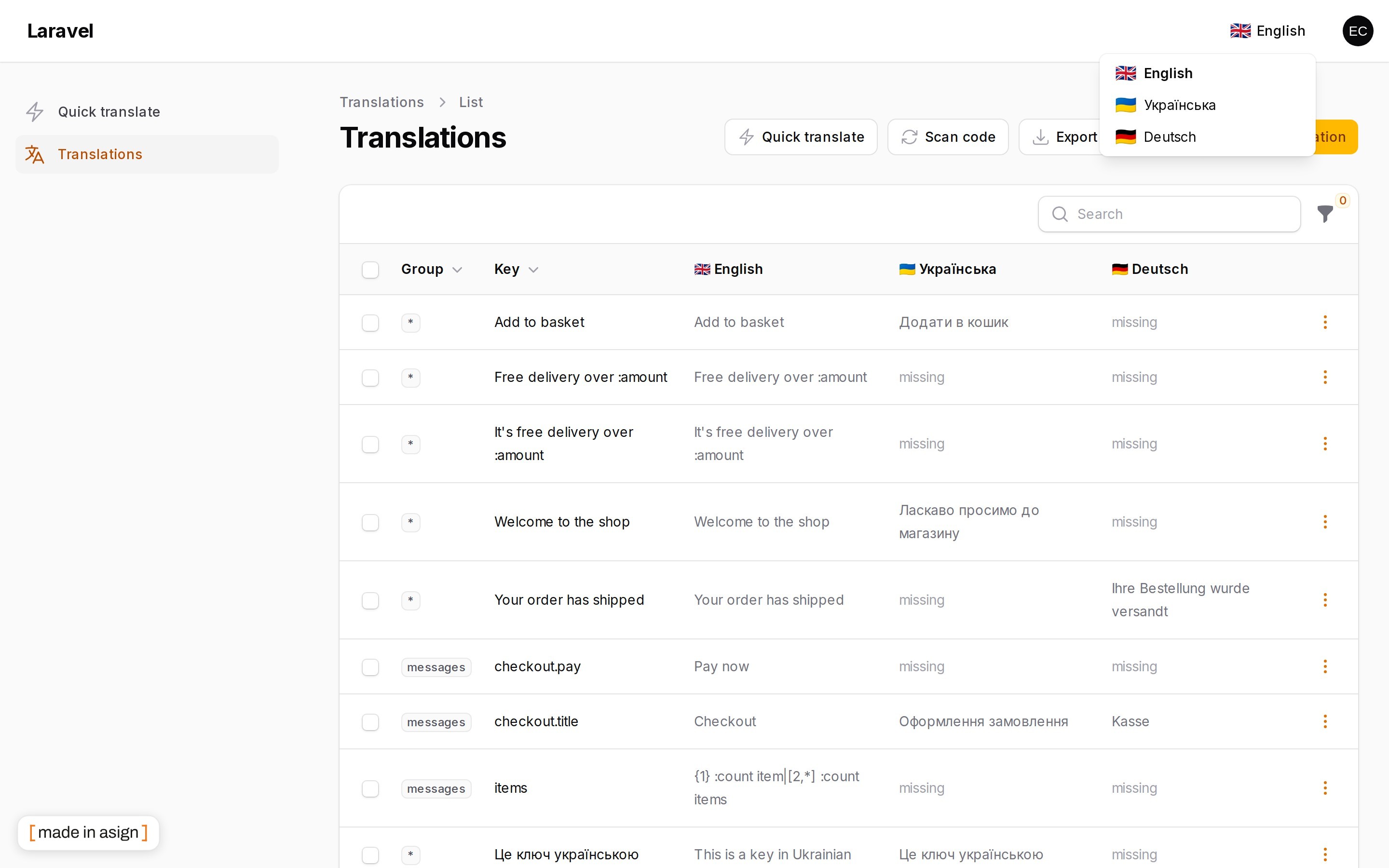
lang/xx.json). - Optional language switcher in the top bar (session, and optionally a user column). Off by default.
- Closed by default: nobody opens it until you define a gate. Deleting has its own, stricter gate.
- Cyrillic and other non-ASCII text is stored readable in the database, not as
До.... - English, Ukrainian, Polish, German, French, Spanish, Italian, Dutch, Brazilian Portuguese and Turkish.
Screenshots
Requirements
- PHP 8.3+
- Laravel 12 or 13
- Filament 5
Installation
composer require asignua/filament-translation-manager
php artisan vendor:publish --tag=filament-translation-manager-migrations
php artisan migrate
The migrations are publishable stubs. The first creates the language_lines table the way spatie's own migration does, and
does nothing when the table already exists, so do not also publish spatie's. The fourth (make_language_lines_keys_binary) makes the key columns case- and space-exact on MySQL/MariaDB for a table that already exists; the second adds the column --prune uses to
tell scanner-created rows from yours, the third the nullable confirmed_at / orphaned_at status columns (skip it and set
status.enabled to false if you do not want the status). Optionally publish the config (--tag=filament-translation-manager-config).
Register the plugin on your panel and tell it the languages:
use Asignua\FilamentTranslationManager\TranslationManagerPlugin;

$panel->plugin(
    TranslationManagerPlugin::make()
        ->locales(['en' => 'English', 'uk' => 'Українська', 'de' => 'Deutsch'])
);
Then open the door. The plugin is closed until a gate exists (an undefined ability means "no"):
use Illuminate\Support\Facades\Gate;

Gate::define('manageTranslations', fn (User $user): bool => $user->isAdmin());
Gate::define('deleteTranslations', fn (User $user): bool => $user->isAdmin()); // single and bulk delete
Open Translations in the navigation and press Scan code once.
Usage
Scan. The header action (or php artisan translation-manager:scan) reads the folders in scan.paths (default app,
resources/views, routes; tests, vendor, node_modules are skipped) and your lang files, and creates a row for every
string it has not seen. For a PHP group (messages.checkout.title) the file text lands in the row; for a JSON-style key
(__('Add to basket')) the key itself becomes the text of the default language. Languages without a text stay missing.
- It is additive: an existing text is never overwritten, a gap in an existing row is filled from the lang files.
--dry-runonly reports.--pruneacts on rows whose key is gone from the code and the lang files. By default (prune.mode=mark) it only marks them (orphaned_at, shown as "Not in code" and filterable); the mark is cleared by the next scan that finds the key again, and nothing is deleted. Withprune.mode=delete(the "Also delete rows no longer found" toggle needs the delete gate) it deletes them, by default only rows the scanner created itself (prune.only_scanned), never ones you typed. Strings built at run time (__($key),__('a'.$b)) cannot be found: review before pruning.- The scan skips what the database loader cannot serve: namespaced keys (
pkg::group.key) and keys over 255 characters. They are counted as "skipped".
Status. Every row has a badge: OK, Missing (a text is absent in a configured language) or Not in code (the last
scan did not find the key). A text that equals the key counts as missing too (missing.value_equal_to_key, on by default):
that is the placeholder a scan leaves for a string nobody translated yet. When such a text is right on purpose (a brand
name, a word that is the same in every language) press Confirm in the row menu; a confirmed row is never missing.
The language the keys are written in (missing.source_locale, default app.fallback_locale) is exempt: there the key
is the text (Collection in English). A key without a single letter (a phone number, a price) has nothing to translate:
the scan confirms it by itself.
Filters: Missing in…, Missing in any locale, Not found in code, Confirmed.
Find the gaps. Filter Missing in and pick a language, or use Missing in any language. The navigation badge
(->navigationBadge()) shows how many rows are incomplete.
Quick translate. The page walks the rows that miss a text in the chosen language, oldest first. The other languages are shown
as the source; type and press Save & next (Ctrl/Cmd+Enter works too), or Skip. ?locale=de opens it on a language.
Export / import. Export one language as xx.json: JSON-style rows by their key, group rows as group.key. Import takes the
same shape; it fills gaps and never overwrites unless you switch Overwrite existing texts on.
Language switcher. ->languageSwitcher() adds a language menu to the top bar. The choice is kept in the session and
applied when the panel boots; set language_switcher_options.user_column to a string column of your user model to remember it there as well.
To apply it on routes outside the panel too, add Asignua\FilamentTranslationManager\Http\Middleware\SetLocale after StartSession.
Configuration
Everything is fluent on the plugin and falls back to config/filament-translation-manager.php:
TranslationManagerPlugin::make()
    ->locales([                                  // or ->availableLocales([...]) as in kenepa
        ['code' => 'en', 'name' => 'English', 'flag' => 'gb'],   // the flag is a country code, shown as an emoji
        ['code' => 'uk', 'name' => 'Українська', 'flag' => 'ua'],
    ])
    ->gate('manageTranslations')                 // kenepa's ability was 'use-translation-manager'
    ->deleteGate('deleteTranslations')
    ->authorize(fn (User $user) => $user->isAdmin())  // replaces both gates (also accepts a bool)
    ->languageSwitcher()
    ->quickTranslate()                           // on by default; ->quickTranslate(false) hides the page
    ->navigationGroup('Settings')->navigationSort(90)->navigationIcon('heroicon-o-language')
    ->navigationBadge();
locales also accepts a list of codes (['en', 'uk']; the name comes from intl) or a code => name map. Without it the
plugin uses app.locale and app.fallback_locale.
Config keys: table, groups, status.enabled, missing.value_equal_to_key, missing.source_locale, locales (alias available_locales), default_locale, model, gate, delete_gate, language_switcher,
language_switcher_options.{user_column,session_key}, quick_translate.enabled, scan.{paths,extensions,exclude,include_lang_files,fill_default_locale_with_key,fill_all_locales_with_key,skip_group_like_keys},
scan.max_key_length, import.max_size, prune.{mode,only_scanned}, navigation.{group,sort,icon,badge}.
Wrapping the plugin in a host
A host with its own table prefix, its own role system or only some of the groups configures, not forks:
config([
    'filament-translation-manager.table' => 'ee_translations',            // default model reads it
    'filament-translation-manager.model' => App\Models\Translation::class, // may extend the plugin model
    'filament-translation-manager.groups' => ['*'],                       // only JSON-style keys: list, scan, quick translate
    'filament-translation-manager.scan.paths' => [base_path('app'), base_path('resources/views')],
    'filament-translation-manager.scan.include_lang_files' => false,
]);

Locales::resolveUsing(fn () => MyLanguages::all());  // read on every call; same shapes as ->locales()

$panel->plugin(TranslationManagerPlugin::make()
    ->resource(MyTranslationResource::class)         // or ->resource(false) when the panel discovers it
    ->authorize(fn () => $user->isAdmin())
    ->navigationGroup(fn () => __('System'))->navigationLabel(fn () => __('Translations')));
MyTranslationResource extends TranslationResource and may override canCreate(), scopeQuery(Builder), extraColumns() and
extraRecordActions(); give it its own pages (small subclasses with $resource set) when you add header actions. The model may
override getTable(); the status and "missing" logic live in scopes (missingIn, missingInAny, orphaned, confirmed,
inManagedGroups) so a host query can reuse them. JSON paths are written as text->uk and compiled by the query builder per
driver, so the same code runs on SQLite, MySQL/MariaDB and PostgreSQL (SqlGrammarTest checks the generated SQL).
The model
Rows are served through Asignua\FilamentTranslationManager\Models\Translation, a subclass of spatie's LanguageLine. The plugin
sets spatie's translation-loader.model to it when you have not chosen another. Two reasons it is not the stock model: the stock
array cast escapes Cyrillic into \uXXXX in the database, and spatie flushes the cache only for the languages left in a row after
an edit, so clearing a language would keep serving the old text. If you use your own model, extend LanguageLine and set model.
Migrating from kenepa/translation-manager
The data does not move: both use spatie's language_lines table. Your existing rows keep working, and rows with escaped Cyrillic
are read as before and become readable the next time they are saved.
| kenepa/translation-manager | this plugin |
|---|---|
Kenepa\TranslationManager\TranslationManagerPlugin::make() |
Asignua\FilamentTranslationManager\TranslationManagerPlugin::make() |
config available_locales (code, name, flag) |
same shape, also ->locales() / ->availableLocales(); the flag is a country code |
config language_switcher |
same key (default false), or ->languageSwitcher() |
gate use-translation-manager |
manageTranslations; to keep the old one: ->gate('use-translation-manager') |
| "Synchronize" / publish translations | Scan code action and translation-manager:scan (plus --prune, --dry-run) |
spatie migration (vendor:publish --provider=Spatie\TranslationLoader...) |
not needed; ours skips an existing table |
composer remove kenepa/translation-manager && composer require asignua/filament-translation-manager- Swap the plugin class in your panel provider; keep your locales.
- Gate: rename the ability or call
->gate('use-translation-manager'). AdddeleteTranslations(or delete stays disabled). php artisan vendor:publish --tag=filament-translation-manager-migrations && php artisan migrate(adds thecreated_by_scancolumn).- Remove the old config file if you published it. This plugin reads
config/filament-translation-manager.php.
This list follows kenepa's README; check it against the version you run. Anything kenepa had that is not here (for example its own languages seeding) is intentionally left out.
Gotchas
- Closed by default. No gate, no access, and no error: the navigation entry just is not there. Define
manageTranslations. - Always write through the model. Spatie caches every group and language forever; only the model's
saved/deletedevents flush it. A rawDB::table('language_lines')->update(...)leaves stale text on the site until the cache is cleared. - Dots are fine,
::is not.__('Mr. Smith')is a JSON-style key and works. Namespaced keys (pkg::group.key) are served by the package that owns them and cannot be overridden from the database loader. - A key that looks like
group.keyis treated as a group row only when a lang filegroup.phpexists (or the group already has rows); otherwise it is a JSON-style key with the whole string. - Dynamic keys are invisible to the scan. Add them by hand or keep them in lang files, and review before
--prune. - Stored text is limited to 255-character keys (the unique index is
group+key). - Two scanners must never disagree. The plugin has one literal parser for everything (
Support\TranslationLiteral), tested with escaped quotes and apostrophes inside double-quoted strings; do not add a second regex. - Already published spatie's migration? Fine. Ours skips an existing table. If you publish spatie's after ours it fails with "table exists": delete that file.
Translations
The interface ships in English, Ukrainian, German, Spanish, French, Italian, Dutch, Polish, Brazilian Portuguese and Turkish
under the filament-translation-manager::filament-translation-manager namespace. A test keeps every language in step with the English keys. Override a
string by publishing the translations (--tag=filament-translation-manager-translations) and editing the copy in
lang/vendor/filament-translation-manager.
AI agents
The package ships Laravel Boost guidelines (resources/boost/guidelines/core.blade.php) so a
coding agent wires it up correctly.
Testing
composer install
vendor/bin/phpunit
vendor/bin/phpstan analyse --memory-limit=1G
vendor/bin/pint --test
Try it by hand with the workbench:
vendor/bin/testbench workbench:build
vendor/bin/testbench filament:assets
vendor/bin/testbench db:seed --class="Workbench\Database\Seeders\DemoSeeder"
vendor/bin/testbench serve --host=0.0.0.0
Log in at /admin as emma@example.com / password.
Changelog
See CHANGELOG.md.
License
The MIT License (MIT). See LICENSE.md.