
yatmo / laravel

Real estate maps, points of interest and neighbourhood data for Laravel: Blade components for the property map, the nearest schools, shops and public transport with travel times, and a cached, server-rendered neighbourhood text for SEO. Laravel 10 to 13. Powered by Yatmo.
Requires
- php: >=8.1
- illuminate/contracts: ^10.0|^11.0|^12.0|^13.0
- illuminate/support: ^10.0|^11.0|^12.0|^13.0
- illuminate/view: ^10.0|^11.0|^12.0|^13.0
- yatmo/yatmo-php: ^1.1
Requires (Dev)
- orchestra/testbench: ^8.0|^9.0|^10.0|^11.0
- phpunit/phpunit: ^10.5|^11.0|^12.0
Suggests
None
Provides
None
Conflicts
None
Replaces
None
This package is not auto-updated.
Last update: 2026-10-16 10:28:33 UTC
README
Add real estate maps, points of interest and neighbourhood data to Laravel applications.
yatmo/laravel is the official Laravel integration of Yatmo: Blade components for the
interactive property map, the nearest schools, nurseries, supermarkets and public transport with real travel
times, and a written neighbourhood text rendered on the server and cached, so search engines index it with the
listing. One .env line per key, a Yatmo facade or an injectable service for the rest of the API (scores,
isochrones, routes, geocoding, static maps), in 25 countries and 23 languages. Laravel 10 to 13.
composer require yatmo/laravel
<x-yatmo-map :latitude="$listing->latitude" :longitude="$listing->longitude" marker="circle" isochrone="right" />
<x-yatmo-pois :latitude="$listing->latitude" :longitude="$listing->longitude" categories="education,transport,shopping" />
<x-yatmo-text :latitude="$listing->latitude" :longitude="$listing->longitude" />
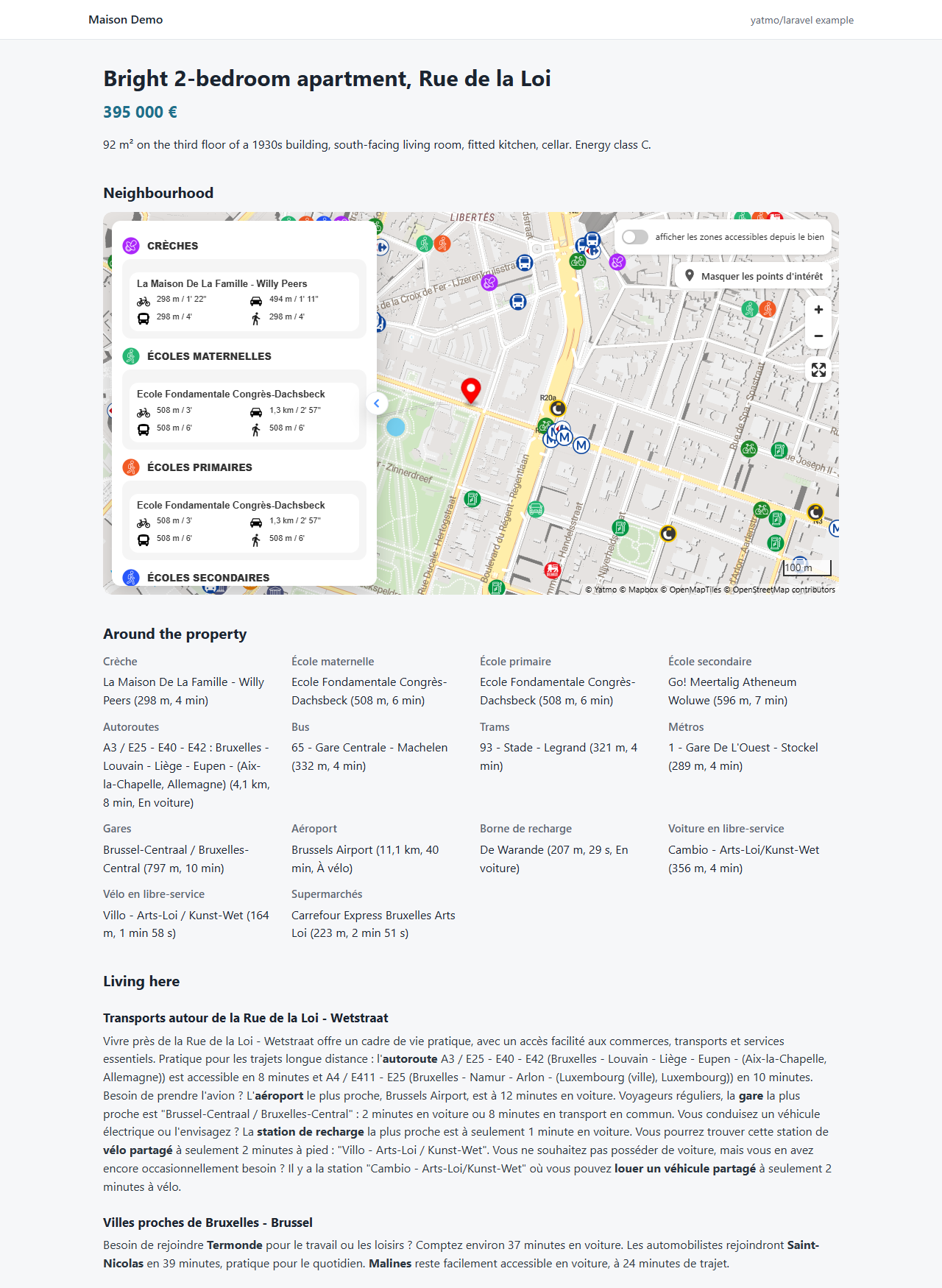
Install in 5 minutes
-
Get a Yatmo licence at yatmo.com: it comes with a backend key (server to server, kept secret) and a frontend key (locked to your domains, embedded in the map) (keys explained).
-
composer require yatmo/laravel. The service provider and theYatmofacade are discovered automatically. -
Add the keys and the country of your properties to
.env:YATMO_KEY=your_backend_key YATMO_FRONTEND_KEY=your_frontend_key YATMO_COUNTRY=BE YATMO_LANGUAGE=FR # optional, follows the application locale when absent
-
Drop the three components into the property view. That is all: the text and the places are fetched once per property and cached for 30 days in your default cache store.
Full example: examples/ holds the routes and the views of the demo app in the screenshot (home grid,
listing page with meta description taken from the neighbourhood text, discreet listing with a circle and city-only
titles); copy them into a fresh laravel new application.
php artisan vendor:publish --tag=yatmo-config copies config/yatmo.php if you want to change the defaults
(cache duration and store, timeout, map defaults).
Blade components
<x-yatmo-map>: the interactive neighbourhood map
The Yatmo iframe plugin: points of interest by category, travel times on foot, by bike, car and public transport, isochrones, a summary panel, 7 map styles. Built with the frontend key, no JavaScript to load.
<x-yatmo-map :latitude="50.8461" :longitude="4.3664"
             mode="overlay" :zoom="15" :map-style="1" accent-color="#1f6f8b"
             marker="circle" :circle-radius="300" isochrone="right" :rounded="12"
             height="520" class="my-map" />
| Attribute | Default | Meaning |
|---|---|---|
latitude, longitude |
required | Position of the property |
mode |
overlay |
overlay, map-top, map-left, map-only... |
zoom |
15 |
Initial zoom |
map-style |
1 Liberty, 2 Basic, 3 Bright, 4 3D, 5 Positron, 6 Dark, 7 Liberty Stonehedge | |
accent-color |
Colour of the interface | |
marker |
pin or circle (discreet listing); circle-radius in metres |
|
isochrone |
right, left... position of the isochrone control |
|
rounded |
Corner radius in pixels | |
route-from |
lat,lng of a place to draw the route to |
|
height |
560px |
CSS height, a bare number is pixels |
language, country, key |
from config | Overrides per component |
:extra |
Array of any other iframe parameter |
Any other attribute (class, id, data-*) goes on the <iframe>. Defaults live in config('yatmo.map').
<x-yatmo-text>: the neighbourhood text, indexable
The written description of the surroundings in the language of the page (shops, schools, transport, leisure,
each as a heading and a paragraph with the key places in <strong>), produced by Yatmo, rendered on the
server by yatmo/yatmo-php and cached. Renders nothing, and logs the exception, when the API cannot be reached:
a listing page never breaks because of it.
<x-yatmo-text :latitude="50.8461" :longitude="4.3664" heading="h3" titles="street-city" paragraphs="shopping,education" />
| Attribute | Default | Meaning |
|---|---|---|
heading |
h3 |
Heading tag, empty for paragraphs only |
titles |
street-city |
First title mentions the street, second the city. city: never the street (discreet listing). generic: neither |
paragraphs |
all | Comma separated icon ids to keep (shopping, education, transport, tourism, health...) |
strong |
true |
Keep the <strong> emphasis |
language |
from config | One text per language is cached from the same API call |
<x-yatmo-pois>: the nearest places with travel times
Nurseries, schools, supermarkets, bus and train stops... grouped by sub-category with the distance and the travel time of the chosen mode, as headings and lists you style with your own CSS.
<x-yatmo-pois :latitude="50.8461" :longitude="4.3664" categories="education,transport,shopping" mode="walking" :limit="2" heading="h4" />
| Attribute | Default | Meaning |
|---|---|---|
categories |
all | education, transport, shopping, tourism |
mode |
walking |
walking, bicycling, driving, transit |
limit |
1 |
Places per sub-category |
heading |
h3 |
Heading tag of each group |
Facade and service
Yatmo\Laravel\Yatmo is a singleton (facade Yatmo, or inject it in a controller). It wraps the configured
Yatmo\Client and caches what a property page needs.
use Yatmo\Laravel\Facades\Yatmo;
use Yatmo\TravelMode;

$text = Yatmo::text($lat, $lng);                        // Yatmo\Model\SummaryText, cached (every language)
$html = Yatmo::textHtml($lat, $lng, ['titles' => 'city']); // ready for {!! !!}
$summary = Yatmo::summary($lat, $lng);                  // nearest places by category, cached
$scores = Yatmo::scores($lat, $lng);                    // 0 to 10 per category, cached
Yatmo::forget($lat, $lng);                              // drop the cache of a position

$client = Yatmo::client();                              // the rest of the API, not cached
$client->isochrones($lat, $lng, TravelMode::Walking);
$client->route($lat, $lng, 50.8503, 4.3517, TravelMode::Transit);
$client->geocode('Rue de la Loi 16, Bruxelles');
$client->enrichment($lat, $lng);                        // ready-made listing attributes
$client->staticMapUrl($lat, $lng, ['width' => 600, 'height' => 400]);
Meta description from the text, in a controller:
$description = Str::limit(Yatmo::text($listing->latitude, $listing->longitude)->paragraphs[0]->text(), 155);
Need another HTTP layer (Guzzle, a proxy)? Bind Yatmo\Transport\TransportInterface in the container and the
client uses it.
Configuration
config/yatmo.php, every value from .env:
| Key | .env |
Default |
|---|---|---|
key |
YATMO_KEY |
backend key, required |
frontend_key |
YATMO_FRONTEND_KEY |
frontend key, for the map |
country |
YATMO_COUNTRY |
BE |
language |
YATMO_LANGUAGE |
the application locale |
cache_days |
YATMO_CACHE_DAYS |
30, 0 disables the cache |
cache_store |
YATMO_CACHE_STORE |
the default store |
timeout |
YATMO_TIMEOUT |
15 seconds |
map |
defaults of <x-yatmo-map> |
Countries: BE, FR, NL, LU, CH, DE, IT, ES, PT, IE, UK, AT, CA, GR, MA, AU, HR, MT, SI, RS, CY, BA, ME, BG, AL.
A multi-country site creates one client per country: new \Yatmo\Client(config('yatmo.key'), 'FR', 'FR').
Why
A listing page that describes the neighbourhood, with real travel times to real places, is more useful to the visitor and brings long-tail search traffic that a map alone never brings. Yatmo computes the text and the places from its own data (official registers, transport feeds, brand networks) and routing engines, and your Laravel app serves them as plain HTML.
Tests
composer test                                   # hermetic, the API is faked
YATMO_LIVE_KEY=your_backend_key composer test:live   # one real call per endpoint
Links
- Yatmo and its documentation
yatmo/yatmo-php, the PHP client this package builds on- WordPress plugin, Odoo module, npm packages (JavaScript, React, Vue, web components), Next.js starter
- More examples
MIT licence. Yatmo is a paid service for real estate portals, agency networks and developers; a licence key is required.