
ruvelo / laravel-translations

A modern translation manager for Laravel: edit your lang files in the browser, see what's missing, edit strings in context on the page, and export the changes back to your repository.
Requires
- php: ^8.3
- laravel/framework: ^12.4.1|^13.0
Requires (Dev)
- larastan/larastan: ^3.13
- laravel/ai: ^1.0
- laravel/pint: ^1.32
- orchestra/testbench: ^10.0|^11.0
- phpunit/phpunit: ^11.5|^12.0
Suggests
- laravel/ai: Drafts translations with the "Suggest" button (^1.0)
Provides
None
Conflicts
None
Replaces
None
README
Live demo Configuration Developer guide Changelog

Laravel Translations
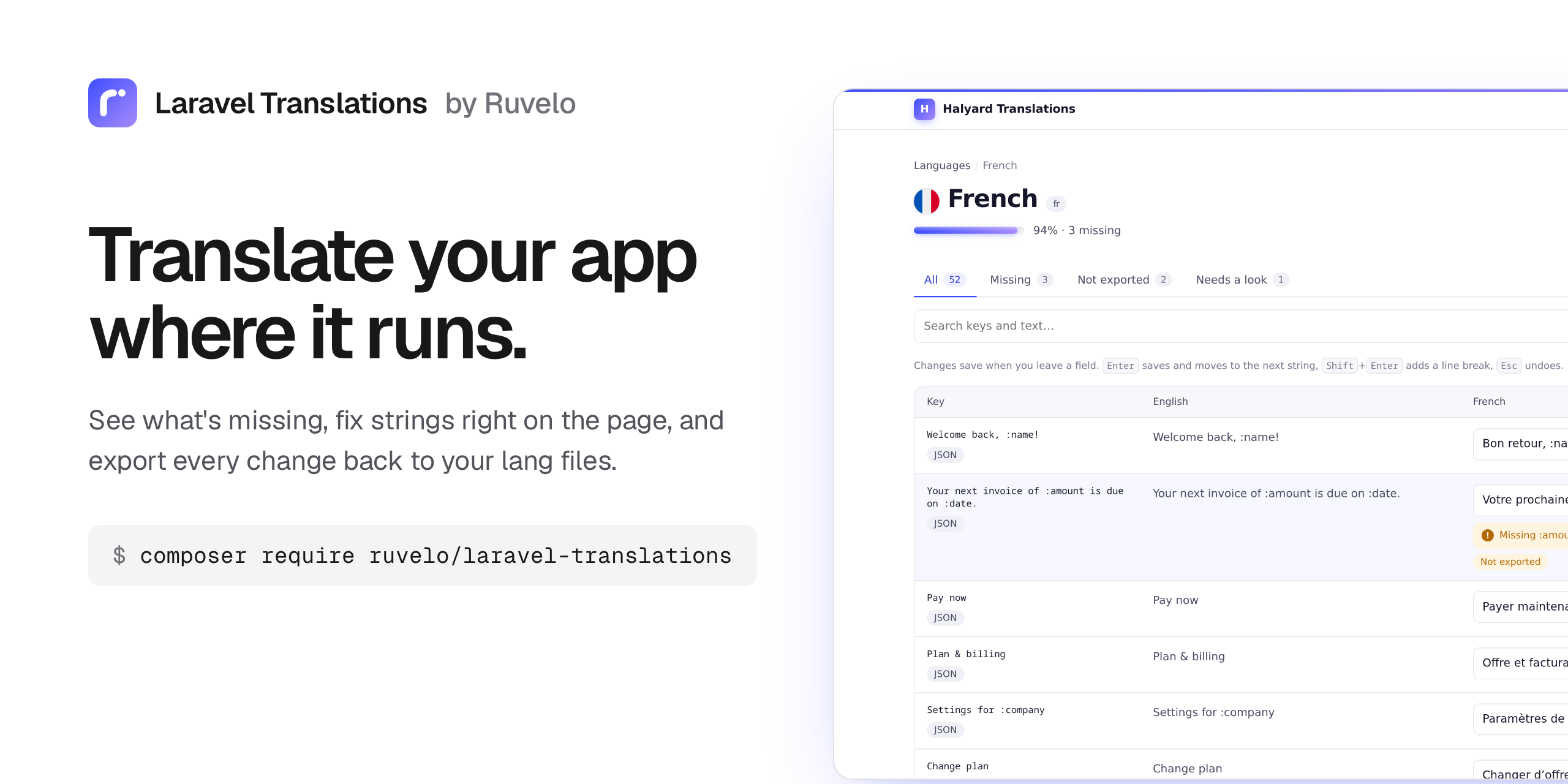
A translation manager for your Laravel app. See how far each language has got, fill in what's missing in a fast editor, or turn on edit mode and fix the strings right on the page where you see them. Your lang/ files stay the source of truth: edits go live at once, and one command writes them back into the files so you can commit them.
composer require ruvelo/laravel-translations
php artisan migrate
Then let someone in, for example in your AppServiceProvider: Gate::define('translations-edit', fn ($user) => $user->is_admin); and open /translations. Or click around the live demo first.
No dependencies beyond laravel/framework. Translation packages run inside every request of your app, and after the 2026 supply-chain attack on laravel-lang release tags, fewer packages in that path is a feature. This one installs nothing else. Machine suggestions use the Laravel AI SDK only if you already have it.
A quick tour

See where every language stands. Each language shows how much is translated, what's missing and what hasn't been exported yet.

Translate in a fast table. Key, source text and translation side by side. Changes save when you leave a field, Enter moves to the next string, and a warning shows the moment a translation drops a placeholder like :amount or a plural form.

Fix text where you see it. Turn on Edit translations on any page of your app. A panel lists every string that page used, missing ones first, each ready to edit. Save, and the page shows the new text.

Review before you commit. Every edit not yet in your lang files, with what the file says, what the site shows, who changed it and when. Revert any of them in a click, then run php artisan translations:export.
 |
 |
| Light and dark, following each editor's system setting. | Works on a phone, panel and all. |
Features
- Your lang files stay in charge. PHP files (nested keys, sub-folders,
lang/vendor/{package}) and JSON files are read as Laravel reads them. Edits are stored as overrides and laid over Laravel's own loader, so they apply instantly in production without writing to the server's filesystem. - Export back to the files.
translations:exportedits the files in place: changed strings are swapped where they stand, new keys slot in next to their neighbour in the source language, and comments, quotes and alignment survive.--dry-runshows the diff. - Edit in context. A small "Edit translations" button for editors only, injected into your pages (or placed with
<x-translations::toolbar />). It records which keys the page used and lists them in a side panel. Nothing is wrapped in markup, so attributes, titles and buttons are covered and nothing breaks. - Placeholder checks.
:name(any case),{count}, plural forms separated by|,{0}/[1,*]ranges and HTML tags. Warnings show as you type and in a "Needs a look" filter. - Locale progress. Percent translated, missing count and pending changes per language. Languages are detected from your lang folder, or set in config; add a new one from the overview.
- Filters and search. Missing, not exported or needs a look; search across keys and text; narrow to one file or package.
- Missing key scanner.
translations:scanfinds keys used with__(),trans(),trans_choice(),@lang,@choiceandLang::get()in PHP and Blade, and$t()/t()/i18n.t()in JS, TS, Vue and JSX when asked. It lists what the source language lacks, adds it with--create, and reports unused keys. - Imports. A file back from a translator, another lang folder, or the database of barryvdh/laravel-translation-manager, all as pending changes to review.
- Suggestions, if you want them. With the Laravel AI SDK installed and configured, a Suggest button drafts a translation that keeps the placeholders. It never saves on its own.
- Fast. Overrides are compiled per language and file, cached, and cleared the moment one changes.
- Safe. Only users who pass the
translations-editgate get in (nobody until you define it), every value is escaped in the UI, and guests get your login page or a 403, never an error. - No build step, no JavaScript required. Plain forms work everywhere; a little inline JavaScript makes them quicker. Light and dark, readable at phone width.
Requirements
- PHP 8.3+
- Laravel 12 or 13
- Any database Laravel supports (tested on SQLite)
- Optional:
laravel/aifor suggestions
How it fits your workflow
- Developers add strings to the source language's lang files, as always.
- Translators and editors fill in the rest at
/translations, or on the page itself. It's live straight away. - Someone with the code runs
php artisan translations:export --dry-run, thentranslations:export, and commits the files. If your editors work in production, run the export there and download the files, or have a script readGET /api/translations/changesand apply them to a checkout. - After that deploy,
php artisan translations:prune(add it to your deploy script) deletes the overrides the files now hold.
If someone changes a string in the code after it was edited in the browser, the review page flags it so nobody's work is silently lost.
Configuration
Publish the config file if you want to change the defaults:
php artisan vendor:publish --tag=translations-config
| Key | Default | |
|---|---|---|
name |
Translations (TRANSLATIONS_NAME) |
Shown in the header and page titles |
enabled |
true (TRANSLATIONS_ENABLED) |
Apply overrides at runtime |
source_locale |
your app.fallback_locale |
The language every other is measured against |
locales |
null |
null detects them from the lang folder; or a list |
names |
[] |
Display names by code, e.g. ['pt_BR' => 'Português (Brasil)'] |
lang_path |
your app's lang path | Where the lang files live |
vendor |
true |
Include lang/vendor/{package} translations |
namespaces |
[] |
Packages with their own translations to include |
ignore_groups |
[] |
Files to hide from the editor, e.g. ['validation'] |
path |
translations (TRANSLATIONS_PATH) |
URL prefix |
domain |
null |
Serve the editor on its own (sub)domain |
middleware |
['web'] |
Applied to every route (the gate is always checked) |
flags |
[] |
Map a locale to another round flag ('en' => 'en-us'), or false to hide flags |
layout |
null |
A view to render inside, e.g. layouts.app |
section |
content |
The section of that layout to fill |
per_page |
50 |
Strings per page in the editor |
in_context.enabled |
true |
Record the keys each page uses; the toolbar |
in_context.inject |
true |
Add the toolbar to every HTML page in the web group |
in_context.max_keys |
300 |
Most keys listed per page |
cache.enabled |
true |
Cache compiled overrides |
cache.store |
null |
Cache store; null for the default |
cache.ttl |
86400 |
Seconds; changes clear it anyway |
scan.paths |
app, resources/views, routes |
Where translations:scan looks |
scan.js |
false |
Also read JS, TS, Vue and JSX files |
scan.js_paths |
resources/js |
Where to find them |
scan.js_functions |
$t, t, $tc, tc, trans, __, wTrans, i18n.t |
Functions that take a key |
scan.framework_groups |
validation, auth, pagination, passwords |
Never reported as unused |
suggestions.enabled |
true (TRANSLATIONS_SUGGESTIONS) |
Show Suggest when the AI SDK is configured |
suggestions.provider / model |
null |
Override the AI SDK's defaults |
suggestions.per_minute |
30 |
Rate limit per editor |
api.enabled |
false (TRANSLATIONS_API) |
Turn on the JSON API |
api.prefix |
api/translations |
Where the JSON API lives |
api.middleware |
['api', 'auth:sanctum'] |
Applied to every API route |
table_prefix |
translations_ |
Tables are {prefix}overrides and {prefix}locales |
run_migrations |
true |
Set to false to publish (--tag=translations-migrations) and run them yourself |
user_model |
your users provider model |
Who edits are attributed to |
user_name_attribute |
name |
Shown in the review |
Who can edit
Nobody, until you define the translations-edit gate:
use Illuminate\Support\Facades\Gate;

Gate::define('translations-edit', fn ($user) => $user->hasRole('translator'));
The editor, the in-context toolbar and the JSON API all use it. Guests go to your login route if you have one, or get a 403.
Editing in context
The toolbar is added to every HTML page your web routes return, for editors only. To place it yourself instead, set in_context.inject to false and put the component last in your layout's <body>, so the page has been rendered by the time it runs:
    <x-translations::toolbar />
</body>
After a save the panel reloads the page. Livewire or Inertia apps can re-render instead:
document.addEventListener('translations:saved', (event) => {
    event.preventDefault();          // no reload
    Livewire.dispatch('$refresh');   // or router.reload() with Inertia
});
The panel shows the strings for the current app()->getLocale(). Keys are recorded by a translator that extends Laravel's; if another package replaces the translator with its own, that one is left alone and the panel has nothing to list (set in_context.enabled to false to turn the toolbar off entirely).
Making it look like your app
The views are plain Blade with scoped styles. Publish them and edit as you like:
php artisan vendor:publish --tag=translations-views
To render the editor inside your own layout, set layout to its view name (e.g. layouts.app) and section to the section it yields (content by default). Extra <head> tags go to a translations-head stack if your layout has one. Colors are CSS variables (--trans-accent and friends) scoped to .trans and .trans-tb, so they never leak into your pages.
For developers
PHP API
use Ruvelo\Translations\Translations;

Translations::set('fr', 'billing.invoice.title', 'Facture :number', $user); // live at once
Translations::set('fr', 'Pay now', 'Payer maintenant');                    // a JSON key
Translations::set('fr', 'courier::messages.sent', 'Envoyé');                // a package key
Translations::get('fr', 'billing.invoice.title');      // the override, or null
Translations::value('fr', 'billing.invoice.title');    // what the app shows
Translations::forget('fr', 'billing.invoice.title');   // back to the lang file

Translations::locales();                 // ['en', 'de', 'fr', …], source first
Translations::addLocale('pt_BR');
Translations::progress('fr')->percent(); // also ->missing(), ->translated, ->pending
Translations::missing('de');             // Collection of Entry
Translations::entries('fr', 'missing', 'invoice', 'billing');
Translations::pending();                 // edits not in the lang files yet
Translations::check('Hi :name', 'Salut'); // ['Missing :name, which the source text uses.']

Translations::export(['fr'], dryRun: true)->files[0]->diff();
Translations::import(storage_path('fr.json'));
Translations::scan()->missing;           // list of Key
Translations::suggest('fr', 'billing.invoice.title');
Keys are written as you'd pass them to __(). To be explicit, pass a Ruvelo\Translations\Key: Key::group('billing', 'invoice.title'), Key::group('messages', 'sent', 'courier') or Key::json('Pay now').
Events: TranslationUpdated (with wasReverted()), TranslationsExported and LocaleAdded.
Exceptions: InvalidKey, InvalidLocale, LocaleAlreadyExists, ExportFailed, ImportFailed and SuggestionsUnavailable, all extending TranslationsException.
JSON API
Off by default. Set TRANSLATIONS_API=true and you get the routes below under /api/translations, protected by Sanctum and the translations-edit gate. Useful for CI, scripts, or a React/Vue/Inertia front end of your own.
| Request | Does |
|---|---|
GET /locales |
Every language with total, translated, missing, percent and pending |
POST /locales |
Add one: {"code": "it"}. 201, or 422 |
GET /locales/{locale}/entries |
Strings, with filter (all, missing, changed, warnings), q, file, per_page (up to 500), page |
PUT /locales/{locale}/entries |
Save: {"key": "billing.cancel", "value": "…"}, or group/namespace/key to be explicit |
DELETE /locales/{locale}/entries |
Revert to the lang file. 204 |
GET /changes |
Pending changes, optionally ?locale=fr |
Each entry looks like {"key", "namespace", "group", "item", "source", "value", "file_value", "status", "pending", "file_changed", "warnings", "updated_at"}. The editor's own forms answer JSON too when asked (Accept: application/json), with the signed-in session.
Commands
php artisan translations:export --dry-run          # the diff, nothing written
php artisan translations:export --locale=fr        # write; --prune to drop the overrides after
php artisan translations:prune                     # after deploying an export
php artisan translations:scan --js --unused        # missing and unused keys
php artisan translations:scan --create             # add the missing keys to the source language
php artisan translations:import ~/Downloads/fr.json
php artisan translations:import --translation-manager   # from barryvdh/laravel-translation-manager
Suggestions
Install the Laravel AI SDK and configure a provider, and editors get a Suggest button. To use another service, bind your own Ruvelo\Translations\Suggestions\Suggester. In tests, fake the agent: TranslationAgent::fake(['Bonjour']).
In your tests
use Ruvelo\Translations\Models\Override;

Override::factory()->locale('fr')->key('billing.title')->value('Facturation')->create();
Override::factory()->json('Pay now')->create();
AI assistants
The package ships Laravel Boost guidelines in resources/boost/guidelines/core.blade.php; php artisan boost:install picks them up.
URLs
/translations |
Languages and their progress |
/translations/{locale} |
The editor (?filter=missing, ?q=, ?file=billing) |
/translations/changes |
Pending changes |
Contributing
Pull requests are welcome. Clone, composer install, then composer check runs code style (Pint), static analysis (PHPStan level 8) and the tests, exactly as CI does. See CONTRIBUTING.md and the changelog.
The demo and screenshots are built from the package itself: composer demo writes the static demo into build/, and demo/screenshots.sh regenerates art/.
Credits
Built by François Bultez at Ruvelo, and everyone who contributes.
Credits for bundled assets
The round language flags are from circle-flags by HatScripts, MIT licensed; their licence is in resources/flags/LICENSE.md. Set translations.flags to false to hide them, or map a locale to another flag, e.g. 'en' => 'en-us'.
License
MIT. See LICENSE.