
martinsoenen / pulse-mcp

Laravel Pulse cards for the tool calls served by a laravel/mcp server.
Requires
- php: ^8.3
- laravel/mcp: ^1.0
- laravel/pulse: ^1.8
- livewire/livewire: ^3.8.3|^4.3.4
Requires (Dev)
- orchestra/testbench: ^10.8|^11.0
- phpunit/phpunit: ^11.5
Suggests
None
Provides
None
Conflicts
None
Replaces
None
This package is auto-updated.
Last update: 2026-09-27 16:39:28 UTC
README
Laravel Pulse cards for the tool calls served by a laravel/mcp server.
Pulse already shows you the HTTP request that carried an MCP call, but it aggregates it by route: every tool call
collapses into a single POST /mcp row. This package breaks that row apart, per tool.
The cards
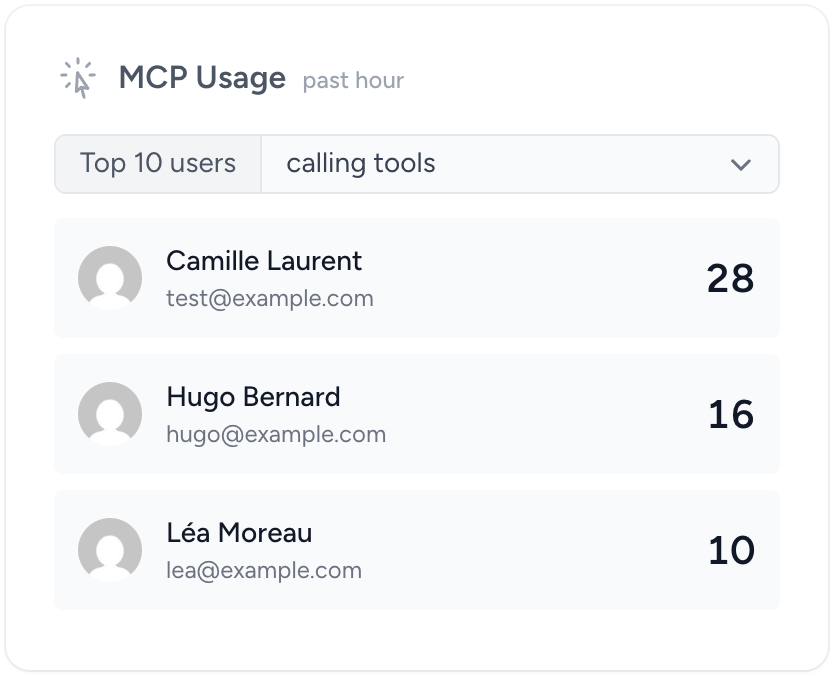
MCP Usage
The users calling the most tools, or experiencing the slowest ones, like Pulse's own Application Usage card.
Slow MCP Tools
The tools that reached the slow threshold, sorted by their slowest call or by how often they were slow.
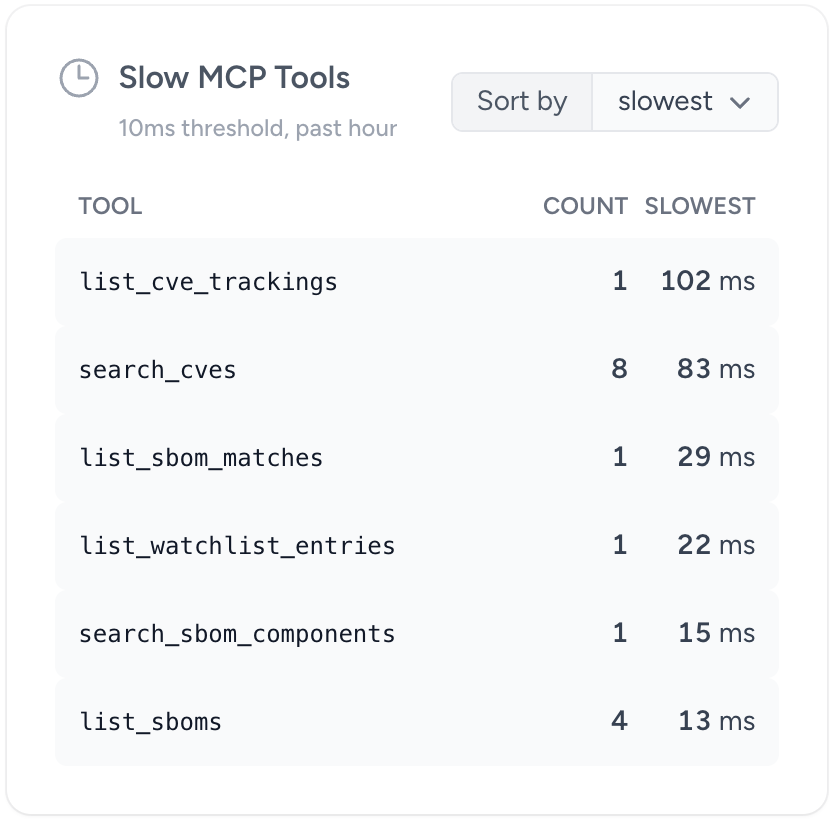
The threshold was lowered to 10 ms for this screenshot.
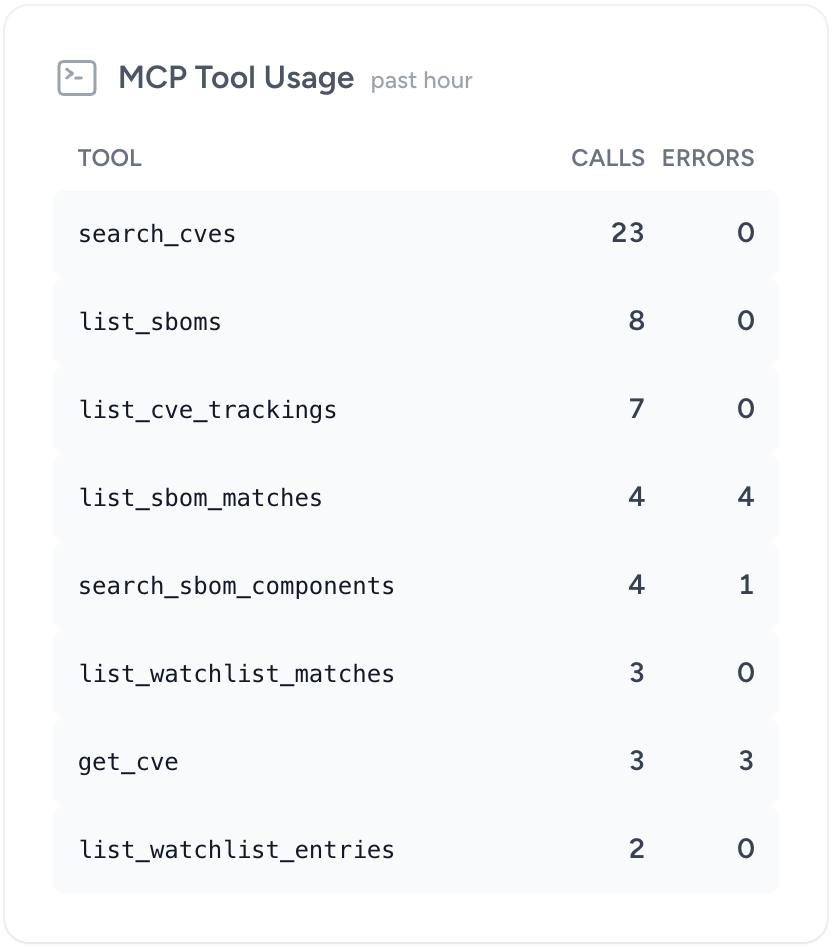
MCP Tool Usage
Every tool, with how many times it was called and how many of those calls failed.
What it records
| Type | Key | Value |
|---|---|---|
mcp_tool_call |
tool name | — |
mcp_tool_error |
tool name | — |
mcp_slow_tool_call |
tool name | duration in milliseconds |
mcp_user_tool_call |
authenticated user id | — |
mcp_slow_user_tool_call |
authenticated user id | — |
A tool call is slow once it reaches the Slow Requests threshold (PULSE_SLOW_REQUESTS_THRESHOLD, 1000 ms by default).
Sharing that setting is deliberate: a slow tool is precisely what makes the POST /mcp request carrying it slow.
A tool counts as failed when it returns Response::error(), when it throws, and when the call itself is rejected
(unknown tool, invalid parameters). The first case is worth stressing: laravel/mcp never reports it to the
exception handler, so without this package a failing tool is completely invisible.
Installation
composer require martinsoenen/pulse-mcp
Then add the cards to your published resources/views/vendor/pulse/dashboard.blade.php:
<livewire:pulse-mcp.usage cols="4" />
<livewire:pulse-mcp.slow-tools cols="4" />
<livewire:pulse-mcp.tool-usage cols="4" />
Like core's Application Usage card, the usage card lets you switch between the users calling tools and the users
experiencing slow tools. Pin it to one of them with type="calls" or type="slow_calls".
Configuration
The recorder is enabled by default. To tune it, add it to the recorders of your config/pulse.php:
\MartinSoenen\PulseMcp\Recorders\McpToolCalls::class => [
    'enabled' => env('PULSE_MCP_ENABLED', true),
    'sample_rate' => env('PULSE_MCP_SAMPLE_RATE', 1),
],
Sampling works as in Pulse's own recorders: a call is kept or dropped as a whole, and the cards scale every count
back up, prefixed with ~, the raw value showing on hover.
How it works, and what that costs
laravel/mcp dispatches no event around tool calls, and CallTool builds its ToolInvoker with new, so there is
no supported way to observe an invocation. What the package does instead is decorate the tools/call handler that
Server::runMethodHandle() resolves from the container.
That works, but it leans on a class the package does not document as an extension point. Two limits follow:
- Tools called through
execute_toolsare not recorded.ToolSearch::execute()bypassesCallTooland drivesToolInvokerdirectly, so those inner calls never reach the decorator. - Streamed tools need care. A tool returning a
Generatoronly runs while the framework iterates it, which happens after the handler returns. The package wraps the generator so the recorded duration covers the whole stream; measuring around the handler alone reports roughly a tenth of the real time.
Both limits disappear if laravel/mcp ever emits events around tool invocations.
Requirements
PHP 8.3+, Laravel 12 or 13, Livewire 3 or 4, laravel/mcp 1.x and laravel/pulse 1.8+.