
jeffersongoncalves / secure-lock-cli

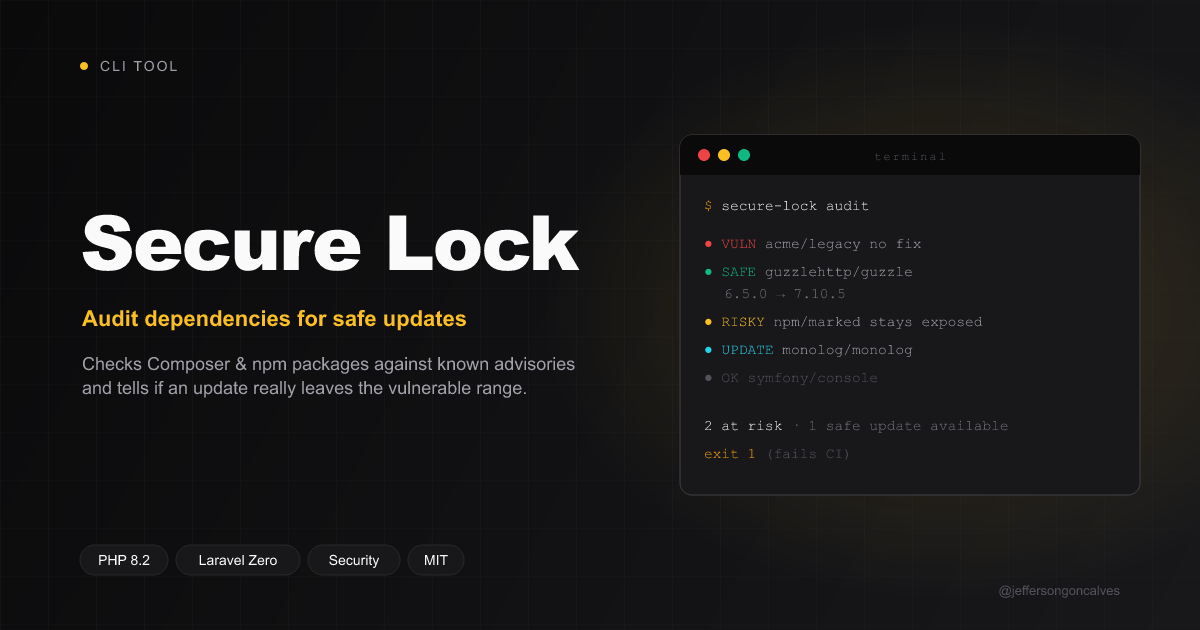
CLI tool to audit project dependencies (Composer & npm) for known vulnerabilities and tell whether an available update actually leaves the vulnerable range.
Package info
github.com/jeffersongoncalves/secure-lock-cli
Type:project
pkg:composer/jeffersongoncalves/secure-lock-cli
Requires
- php: ^8.2
Requires (Dev)
- composer/semver: ^3.4
- guzzlehttp/guzzle: ^7.10
- illuminate/http: ^12.0
- jeffersongoncalves/laravel-zero-self-update: ^1.0
- larastan/larastan: ^3.0
- laravel-zero/framework: ^12.0
- laravel/pint: ^1.25
- mockery/mockery: ^1.6
- pestphp/pest: ^3.8|^4.1
- symfony/yaml: ^7.0
Suggests
None
Provides
None
Conflicts
None
Replaces
None
README
secure-lock-cli
secure-lock audits a project's dependencies and answers three questions
for every package:
- Is there a newer version? (registry lookup)
- Is the installed version vulnerable? (advisory database lookup)
- Is the available update actually safe? — i.e. does the target version really leave the vulnerable range, instead of merely being newer?
Born out of the recent wave of supply-chain attacks (compromised / vulnerable packages on Composer and npm), the tool distinguishes a useful bump that fixes the flaw from a useless bump that stays exposed.
It covers Composer (composer.lock) and the JavaScript managers that
share the npm ecosystem: npm (package-lock.json v1/v2/v3 and
npm-shrinkwrap.json), pnpm (pnpm-lock.yaml lockfileVersion 5/6/9),
bun (bun.lock text lockfile) and yarn (yarn.lock classic v1 and
berry v2+). The ECO column shows the real manager a package came from, while
advisories and the registry are resolved against the shared npm ecosystem.
Built with Laravel Zero and modeled on the other CLIs in this monorepo.
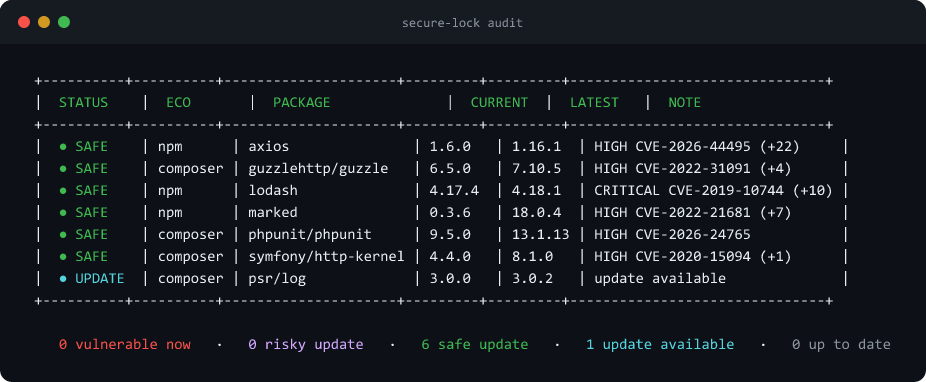
Every package is checked against the registry and the GitHub Advisory
Database, then classified — here six packages have a published fix (SAFE)
and one only has a newer release (UPDATE).

Requirements
- PHP
^8.2 - A
composer.lockand/or apackage-lock.jsonto audit - Optionally a
GITHUB_TOKEN(raises the GitHub Advisory API rate limit from ~60 req/h to 5000 req/h)
Install
Global (recommended)
composer global require jeffersongoncalves/secure-lock-cli
The binary secure-lock will be on your PATH as long as Composer's
global vendor/bin is in it.
From source
git clone https://github.com/jeffersongoncalves/secure-lock-cli.git
cd secure-lock-cli
composer install
Usage
secure-lock                      # audit the current project (default command)
secure-lock --only-vuln          # only show packages at risk
secure-lock --no-dev             # ignore dev dependencies
secure-lock --json > audit.json  # structured output for CI
secure-lock --dir=/path/to/proj  # audit a specific directory
secure-lock --fix                # also print upgrade commands
The JavaScript lockfile is auto-detected in the project directory by priority
(pnpm > bun > yarn > npm); pass --pnpm/--bun/--yarn/--npm to
target one explicitly.
Options
--dir=            Project directory (defaults to the current directory)
--composer=       Explicit path to composer.lock
--npm=            Explicit path to package-lock.json
--pnpm=           Explicit path to pnpm-lock.yaml
--bun=            Explicit path to bun.lock
--yarn=           Explicit path to yarn.lock
--only-vuln           Show only packages at risk
--fix                 Print upgrade commands that leave every vulnerable range
--no-dev              Ignore development dependencies
--ignore=             Advisory id (GHSA or CVE) to suppress; repeatable
--config=             Path to a secure-lock.json (auto-detected otherwise)
--fail-on-unverified  Exit non-zero when an advisory lookup fails
--no-packagist        Disable the Packagist advisory fallback for Composer
--no-npm-audit        Disable the npm audit advisory fallback for JS
--json                Structured JSON output (for CI)
--sarif               SARIF 2.1.0 output (for GitHub code scanning)
--github-token=       GitHub token (or the GITHUB_TOKEN env var)
--cache-ttl=3600      HTTP cache TTL in seconds (0 disables caching)
Verdicts
For each package the tool compares the advisories that hit the current version against those still hitting the latest version:
| Verdict | Badge | Meaning |
|---|---|---|
VULN |
● VULN (red) |
vulnerable now, no published fix |
RISKY_UPDATE |
● RISKY (magenta) |
an update exists but stays exposed |
UNKNOWN |
● UNKNOWN (yellow) |
advisory lookup failed — status not verified |
SAFE_UPDATE |
● SAFE (green) |
the update fixes the vulnerability |
UPDATE |
● UPDATE (cyan) |
newer version, no known vulnerability |
OK |
● OK (gray) |
up to date and clean |
The table is sorted by risk (VULN > RISKY > UNKNOWN > SAFE > UPDATE >
OK) and the NOTE column shows the highest-severity advisory as
SEVERITY CVE-XXXX (+N) (the CVE when present, otherwise the GHSA id).
UNKNOWNmatters. When an advisory lookup fails (most often the GitHub rate limit without a token), the package is reported asUNKNOWN— never asOK. A security tool must not turn a failed request into a false "all clear". Set aGITHUB_TOKENto lift the limit, and add--fail-on-unverifiedto make CI fail when anything could not be checked.
Fixing
Pass --fix to also print, per manager, the upgrade command for each
currently-vulnerable package. The target is the smallest version greater
than the installed one that escapes every vulnerable range (computed from the
advisories' patched versions and the latest release), so the bump is minimal
and verified — not just "the newest":
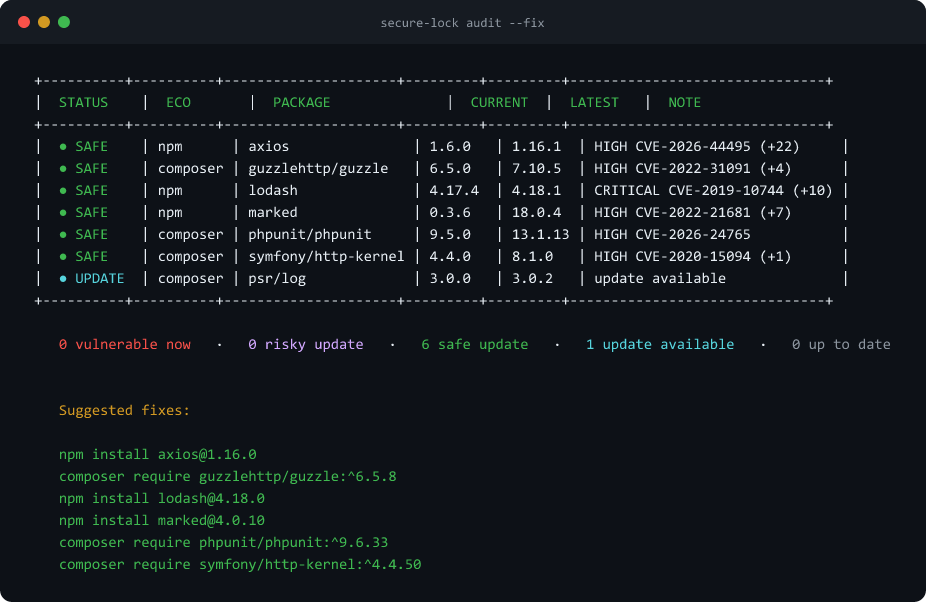
Note how the target is the minimum safe version, not the newest:
guzzlehttp/guzzle goes to 6.5.8 (not 7.10.5) and phpunit to 9.6.33.
Direct vs. transitive. A direct dependency gets a plain
add/require/install. A transitive one can't be pinned that way — an
npm install wouldn't reach the nested version — so the suggestion is the
manager's override mechanism instead: overrides (npm/bun), pnpm.overrides
(pnpm) or resolutions (yarn) in package.json. Composer always uses
composer require, which pins transitive packages too.
Packages with no version that leaves the vulnerable range (VULN) are skipped.
In --json mode each package gains a fix object ({target, command, transitive}) or null.
Suppressing advisories
Accepted or un-patchable risks would otherwise keep failing CI forever. Pass
one or more --ignore flags, or commit a secure-lock.json to the project
root (auto-detected, or point at it with --config):
{
  "ignore": [
    "CVE-2022-31091",
    { "id": "GHSA-xxxx-yyyy-zzzz", "expires": "2026-12-31" }
  ]
}
secure-lock --ignore=GHSA-xxxx-yyyy-zzzz --ignore=CVE-2022-31091
An ignored advisory no longer counts toward the verdict. Entries with an
expires date stop suppressing once that date has passed, so a deferred risk
re-surfaces instead of being forgotten.
GitHub code scanning (SARIF)
--sarif emits SARIF 2.1.0, which GitHub can ingest to show the findings in
the repository's Security › Code scanning tab:
name: secure-lock
on: [push, pull_request]
permissions:
  security-events: write
jobs:
  audit:
    runs-on: ubuntu-latest
    steps:
      - uses: actions/checkout@v6
      - run: composer global require jeffersongoncalves/secure-lock-cli
      - run: secure-lock --no-dev --sarif > results.sarif
        env:
          GITHUB_TOKEN: ${{ secrets.GITHUB_TOKEN }}
        continue-on-error: true
      - uses: github/codeql-action/upload-sarif@v3
        with:
          sarif_file: results.sarif
Exit codes (for CI)
0— no critical risk.1— aVULNorRISKY_UPDATEwas found (fails the pipeline).2— input error (lockfile not found, invalid JSON, etc.).
GitHub Actions
- run: secure-lock --no-dev
  env:
    GITHUB_TOKEN: ${{ secrets.GITHUB_TOKEN }}
How it works
- Registry — Composer:
repo.packagist.org/p2/{name}.json, walking every version and ignoring pre-releases (alpha|beta|rc|dev|next|canary|nightly) to find the highest stable. npm:registry.npmjs.org/{name}(/encoded as%2Ffor scoped packages), usingdist-tags.latest. - Advisories — the GitHub Advisory Database REST API:
GET /advisories?affects={name}&ecosystem={eco}. Theaffectsparameter receives only the package name (e.g.guzzlehttp/guzzle) — the ecosystem goes in its own parameter. Prefixing it (composer:...) returns200with a silently empty list. - Redundant fallbacks — when a package's GitHub lookup fails (e.g. the
rate limit without a token), a second source is queried so the result is
recovered instead of left
UNKNOWN: the Packagist Security Advisories API for Composer, and the npm audit bulk endpoint for npm/pnpm/bun/yarn. Each is one batched request for all failed packages. As a result every ecosystem can be audited with no token at all. Disable with--no-packagist/--no-npm-audit. - Semver — comparisons and range satisfaction use
composer/semver, including GHSA ranges where a comma means logical AND (e.g.>= 7.0.0, < 7.4.5). - Concurrency — every package's registry and advisory lookups are fired
concurrently with
Http::pool(capped), so a large lockfile is audited in a few waves instead of one request at a time. - Cache — registry/advisory responses are cached to disk with a configurable TTL so repeated runs don't hit the API rate limits. Failed lookups are never cached, so a transient error is retried next run.
Keep the CLI up to date
When installed from the released PHAR:
secure-lock self-update          # download and install the latest release
secure-lock self-update --check  # only check, don't install
When installed via Composer:
composer global update jeffersongoncalves/secure-lock-cli
Development
composer install
composer test       # Pint lint + PHPStan + Pest tests
composer lint       # Auto-fix style
composer analyse    # PHPStan (level 6) static analysis
composer build      # Build the PHAR into builds/secure-lock
HTTP calls are mocked in the test suite with Http::fake(). Fixture
lockfiles created during tests live under tests/tmp/ (gitignored).
Release
- Merge changes to
main— CI builds a freshbuilds/secure-lockagainst the latest tag and commits it back. - Create a new GitHub release (tag
X.Y.Z, novprefix). - The
publish-phar.ymlworkflow attachessecure-lock.pharto the release andupdate-changelog.ymlupdatesCHANGELOG.md+version.txt.
Roadmap
The core feature set is complete (multi-ecosystem audit, safe-update
classification, --fix, redundant advisory fallbacks, SARIF). Ideas welcome
via issues.