
vrkansagara / lara-out-press

This is simply compress your final out of Laravel Application and serve to the browser.
Requires
- php: ^8.2|^8.3|^8.4
- ext-pcre: *
- ext-zlib: *
Requires (Dev)
- laminas/laminas-coding-standard: ^2.3
- laravel/framework: 5.5.x || 8.0.x || ^10.00 || ^11.31 || ^12.61
- phpunit/phpunit: ^11.5
Suggests
None
Provides
None
Conflicts
None
Replaces
None
README
LaraOutPress
Compress your Laravel application's HTML/JS output before it hits the wire — zero controller changes required.

LaraOutPress is a single after middleware. It sits at the end of the pipeline, strips
unnecessary whitespace and comments out of your rendered HTML response, does a light
pass of inline JavaScript minification, and hands the browser a smaller payload — with
zero changes to your controllers, views, or routes.
Installation
composer require vrkansagara/lara-out-press
Laravel's package auto-discovery registers the service provider and facade for you.
If your app has auto-discovery disabled, add the provider manually in bootstrap/providers.php
(Laravel 11+) or config/app.php (Laravel ≤10):
Vrkansagara\LaraOutPress\ServiceProvider::class,
Publish the config file so you can override the defaults:
php artisan vendor:publish --provider="Vrkansagara\LaraOutPress\ServiceProvider"
This creates config/laraoutpress.php in your app.
"Unable to locate class or alias" when running
vendor:publish? That means Composer never registered the package in this app. Check, in order:
composer show vrkansagara/lara-out-press— confirms it's actually installed (not just listed incomposer.json).- It's under
require, notrequire-dev, if you runcomposer install --no-devanywhere (CI, production deploys).- Re-run
composer dump-autoloadafter installing — discovery is regenerated at that point.- Clear stale discovery caches:
php artisan package:discover— or deletebootstrap/cache/packages.phpandbootstrap/cache/services.phpand let Laravel rebuild them.
Configuration
Every setting is controlled through environment variables, with config/laraoutpress.php
as the published override point.
| Env variable | Config key | Default | Purpose |
|---|---|---|---|
VRKANSAGARA_COMPRESS_ENABLED |
enabled |
false |
Master on/off switch. Must be a real boolean. |
VRKANSAGARA_COMPRESS_DEBUG |
debug |
false |
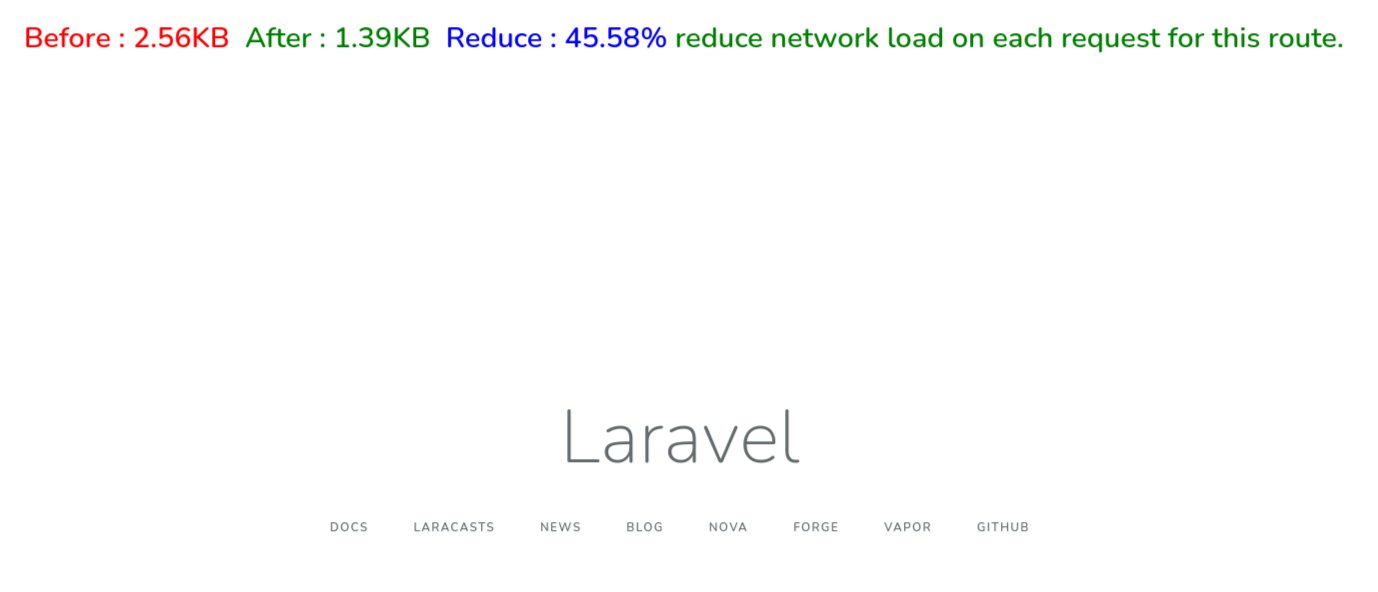
Appends a before/after/percent-saved banner to every page. |
VRKANSAGARA_COMPRESS_ENVIRONMENT |
target_environment |
'' |
Comma-separated list of environments compression runs in. |
| (config only) | exclude_routes |
['api/*'] |
Route patterns (as passed to Request::is()) that are never compressed. |
Enable it
VRKANSAGARA_COMPRESS_ENABLED=true
Only the literal boolean true enables the middleware. Anything else — an empty
string, "1", a stray typo — is treated as false on purpose, so a misconfigured
value fails safe instead of silently compressing (or not compressing) unexpectedly.
Choose which environment(s) it runs in
# Single environment
VRKANSAGARA_COMPRESS_ENVIRONMENT=production

# Multiple environments
VRKANSAGARA_COMPRESS_ENVIRONMENT=production,staging,local
Don't reference
${APP_ENV}in your.envfile. A line likeVRKANSAGARA_COMPRESS_ENVIRONMENT="${APP_ENV}"looks natural (avoid repeating the value), but plain.envfiles are parsed byvlucas/phpdotenv, which does not expand${VAR}references the way a shell or Docker Compose does. You'd get the literal 10-character string${APP_ENV}instead oflocal— and compression would silently never activate. Write the actual environment name.As a safety net, LaraOutPress falls back to the app's current environment whenever
target_environmentis left empty or still contains an unresolved${...}placeholder, so this mistake now fails safe rather than silently.
See the impact on every page
VRKANSAGARA_COMPRESS_DEBUG=true
Appends a fixed banner to the bottom of every compressed page showing the response size before and after compression, and the percentage saved. Turn this off in production — it's a development/staging aid, not a user-facing feature.
Exclude routes
Compression is skipped automatically for JSON responses ($request->expectsJson())
and for any route matching a pattern in exclude_routes (published in
config/laraoutpress.php, matched via Laravel's Request::is()):
// config/laraoutpress.php
'exclude_routes' => [
    'api/*',
    'webhooks/*',
],
Which .env file actually applies?
Laravel only loads one .env file per request by default — the plain .env at
your project root — regardless of how many environment-specific files
(.env.local, .env.production, .env.dusk.local, …) sit next to it. Those extra
files are conventions from other tools (Vite, Dusk, deployment scripts) and are
not read by Laravel/vlucas/phpdotenv automatically unless your app explicitly
opts in via $app->loadEnvironmentFrom(...) or the --env artisan flag.
In practice, that means:
-
If you have both
.envand.env.productionand you deploy without changing how the app boots,.envwins —.env.productionis inert dead weight. -
APP_ENVitself is read from.env, so it can't be used to choose which.envfile loads unless something upstream (your deploy pipeline,php artisan serve --env=, a custom bootstrapper) setsAPP_ENVbefore Laravel boots and points it at a different file. -
When in doubt, dump what Laravel actually resolved instead of guessing from the file list:
php artisan tinker --execute="echo app()->environment();"
If your deployment relies on multiple .env.* files being auto-selected, that
selection logic lives in your own bootstrap/app.php / deployment tooling, not in
Laravel core or in this package — make sure VRKANSAGARA_COMPRESS_* variables are
set in whichever file actually gets loaded for that environment.
What gets touched
- HTML whitespace between tags is collapsed.
- HTML comments (
<!-- ... -->) are stripped. - Inline
<script>content goes through a light JS-comment/whitespace minifier. - JSON responses, excluded routes, and non-matching environments are always passed through untouched.
Development
composer install
composer run-script test      # PHPUnit
composer run-script cs-check  # PHP_CodeSniffer
CI runs the full suite across PHP 8.2, 8.3, and 8.4 on every push and pull request.
Contributing
Issues and pull requests are very welcome — see SECURITY.md for how to report a vulnerability privately.
Made with ❤️ in India 