
everdreamsoft / sandra

Sandra Ontologic Datagraph
Requires
- php: >=8.0
- ext-json: *
Requires (Dev)
- phpunit/phpunit: 8.*
Suggests
None
Provides
None
Conflicts
None
Replaces
None
- dev-master
- v0.1.1
- v0.1
- dev-dev
- dev-fix/numeric-cast-comparison
- dev-mkta_read_me_v2
- dev-sandraxclaude
- dev-datastorage_char_encoding
- dev-adapted_sandra
- dev-sog_api
- dev-sog_api_stable
- dev-sog_apiv2
- dev-sog-apiv2
- dev-feature/logger
- dev-brotherEntityUpdateExisting
- dev-UpdateOnExistingVerb
- dev-backToNoRefId
- dev-unstableRefId
- dev-php8
- dev-prephp8
This package is auto-updated.
Last update: 2026-09-30 21:08:34 UTC
README

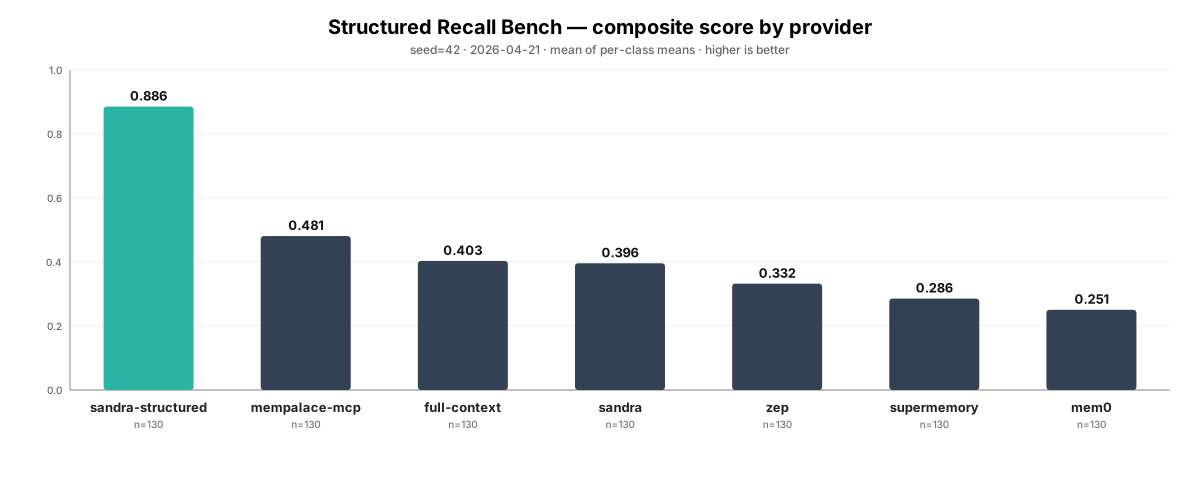
Self-hostable graph + vector memory. Native MCP. 0.89 on Structured Recall Bench, where vector stores cluster between 0.25 and 0.48.
Every AI agent forgets. Vector memory finds similar text but can't enumerate or relate. Classical graph DBs use free-form labels that no LLM can read. SaaS memory ships your data to someone else's servers.
Sandra is a self-hostable graph + vector memory layer where every concept (verb, label, category) has a unique ID and a human-readable name. Your agents read, write, and reason over a shared lexicon. Every relationship is an explicit synapse you can trace. Exposed natively via MCP, so any LLM that can call a tool can use it.
Install
git clone https://github.com/everdreamsoft/sandra && cd sandra
docker compose up -d                                   # MCP on http://127.0.0.1:8090/mcp
claude mcp add sandra --transport http --url http://127.0.0.1:8090/mcp
That's it! your agent now has persistent memory across sessions, projects, machines, and clients (Claude, GPT, Gemini, Llama, Mistral...).
Other clients · semantic search · claude.ai web (HTTPS) · from source
cp .env.example .env                          # set OPENAI_API_KEY for semantic search
docker compose --profile tunnel up -d         # public HTTPS via trycloudflare for claude.ai
docker compose logs tunnel | grep trycloudflare
Cursor, Cline, Continue, Zed, OpenAI Agents SDK, custom clients: point your client's MCP server config at http://127.0.0.1:8090/mcp. From source (PHP 8+, MySQL, composer): see Install Sandra. Set SANDRA_AUTH_TOKEN in .env before exposing the trycloudflare URL, it is public.
Full setup, OAuth 2.1/PKCE, auth tokens: Install Sandra. MCP tool reference: mcp overview. Live quickstart and demos: sandraeds.everdreamsoft.com. Questions? Join the Discord.
What recall feels like
─ Monday, ChatGPT on the web ─
You:    CSV of 100 tweets I wrote this year (text, likes, replies).
        Save them in Sandra and tag each with its emotional register.
Agent:  [sandra_batch → 100 tweet entities; refs: text, engagement,
                       emotion (awe / pride / frustration / joy / ...)]

─ Wednesday, Claude Code on your laptop ─
You:    Design a landing page that resonates with the emotions my
        audience reacts to most.
Agent:  [sandra_search → emotion breakdown, weighted by engagement]
        Your audience peaks on awe and pride. Drafting a hero in that
        register, plus a social-proof block citing your three
        highest-engagement tweets...
Memory lives in your Sandra instance, not in any model's context window. Switch models, switch clients, switch machines: the memory stays.
The next generation of software will be written by agents that need memory like ours.
Why Sandra
Current market solutions are not able to retrieve all the data correctly, so it is impossible to trust agents with precise tasks. Here is how they compare.
| Approach | Example | SRB composite | Trade-off |
|---|---|---|---|
| Vector retrieval | Mem0, Zep, Supermemory | 0.25 to 0.33 | Finds similar text, can't enumerate or relate |
| Verbatim retrieval | MemPalace | 0.48 | A static memory palace, no associative recall |
| Classical graph DB | Neo4j, TigerGraph | (no provider) | Free-form labels, unreadable for LLMs |
| Sandra + planner | this repo | 0.89 | Graph + vector + shared LLM-readable lexicon |
130 deterministic questions, no LLM-judge, raw responses archived. Full design rationale: Sandra memory design.
Sandra is for you if you want your agent to remember across sessions and machines, you want to own the data, you build with multiple LLMs, or you need explicit relationships instead of fuzzy similarity. Skip Sandra if you need a transactional database (use Postgres), pure vector retrieval at massive scale (use a dedicated vector store), or zero infrastructure (use a hosted service).
How memory works
Four primitives, mapped to what neurons do.
- Concept - a stable, named ID; the neuron (
likes,works_at,user). - Triplet - a
(subject, verb, target)link; the synapse. - Entity - a typed cluster of refs grouped by a factory; a named region.
- Factory - the schema for an entity cluster (
person,product,task).
DB analog: concepts are words, entities are rows, factories are tables, triplets are sentences.
─── THE UNIT ─────────────────────────────

   Alice ──── likes ──────▶ strawberry
     │
     └─── works_with ─────▶ Bob

   subject     verb            target
Encounter Alice, Sandra activates that node and follows every synapse outward in one query, spreading activation (Collins & Loftus, 1975), the mechanism behind associative human recall. Because every concept is a stable, named ID, an LLM can call sandra_list_concepts and read the entire vocabulary. No schema file, no documentation needed.
One concept, many implementations
A concept's identity is stable, but the attributes attached to it can vary by source. Concept(user) keeps a single ID across every system that talks about it:
Concept(user)
  ─ in_system → marketing_db    refs: { name: "User",      ltv: 4200, segment: "enterprise" }
  ─ in_system → auth_service    refs: { name: "Principal", email: "alice@acme.com", mfa: true }
  ─ in_system → support_crm     refs: { name: "Customer",  tier: "gold", open_tickets: 2 }
This is what philosophers since Frege have called invariance of reference under variation of sense. What programmers call polymorphism. What your agents need so they can answer "show me everything we know about this user" without lying, conflating, or losing source attribution.
Building a multi-agent system? Every agent is itself an entity in the same graph it reads from. Pattern + comparison with CrewAI / LangGraph / OpenAI Assistants in Guides - multi-agent.
Beyond agent memory
Same primitives also handle:
- Personal knowledge management: Stash articles, strategy notes, ideas as typed entities. Ask: "Give me the 10 most-engaging emotional tweets I posted; suggest an eleventh."
- Relationship CRM: Track who covered you, who knows whom, who said what. "Which journalists wrote about us this year? Who at TechCrunch?"
- Headless CMS for LLM-driven apps: Expose Sandra over the REST API + a thin UI; let agents update content from natural language. "Change the price of the Geneva listing to 350."
- Lightweight analytics: Log who-viewed-what as triplets, query later via the same MCP tools. "Which cards got the most attention from European visitors last week?"
Switching frame is a query, not a migration.
Building on Sandra
- PHP SDK:
composer require everdreamsoft/sandraphp sdk - REST API: language-agnostic sdk rest api
- Python and TypeScript SDKs: coming
<?php
use SandraCore\System;
use SandraCore\EntityFactory;

$sandra = new System('myapp', true, 'localhost', 'sandra', 'root', '');
$people = new EntityFactory('person', 'peopleFile', $sandra);

$alice = $people->createNew(['name' => 'Alice', 'role' => 'founder']);
$bob   = $people->createNew(['name' => 'Bob',   'role' => 'engineer']);
$alice->setJoinedEntity('works_with', $bob, ['since' => '2024']);
Documentation
| Guide | What it covers |
|---|---|
| Install Sandra | Sandra + MCP server + your MCP client |
| mcp overview | MCP server reference: tools, configuration, custom tools |
| sdk rest api | REST API and PHP SDK |
agent-memory-design.md |
Why Sandra is shaped the way it is |
Community & Status
Join the conversation on Discord. Live quickstart at sandraeds.everdreamsoft.com.
Used in production at EverdreamSoft, notably in Spells of Genesis. MCP layer and OAuth 2.1/PKCE auth running in production.
MIT license: see LICENSE. Pull requests welcome: see CONTRIBUTING.md.